

@KITE AI I didn’t expect to be thinking about digital money that moves without a human push, but that’s exactly where we are. Artificial intelligence has stopped being a curious gadget and become a part of everyday tools from suggesting what you might write next in an email to helping manage your calendar. For all this progress, though, there’s been a weird gap: we still treat AI like a kid who has to ask before spending money. Every payment, every transaction, still needs a human hand to approve it. That’s what people trying to build the next generation of AI systems keep bumping up against. And that’s where Kite AI comes in. 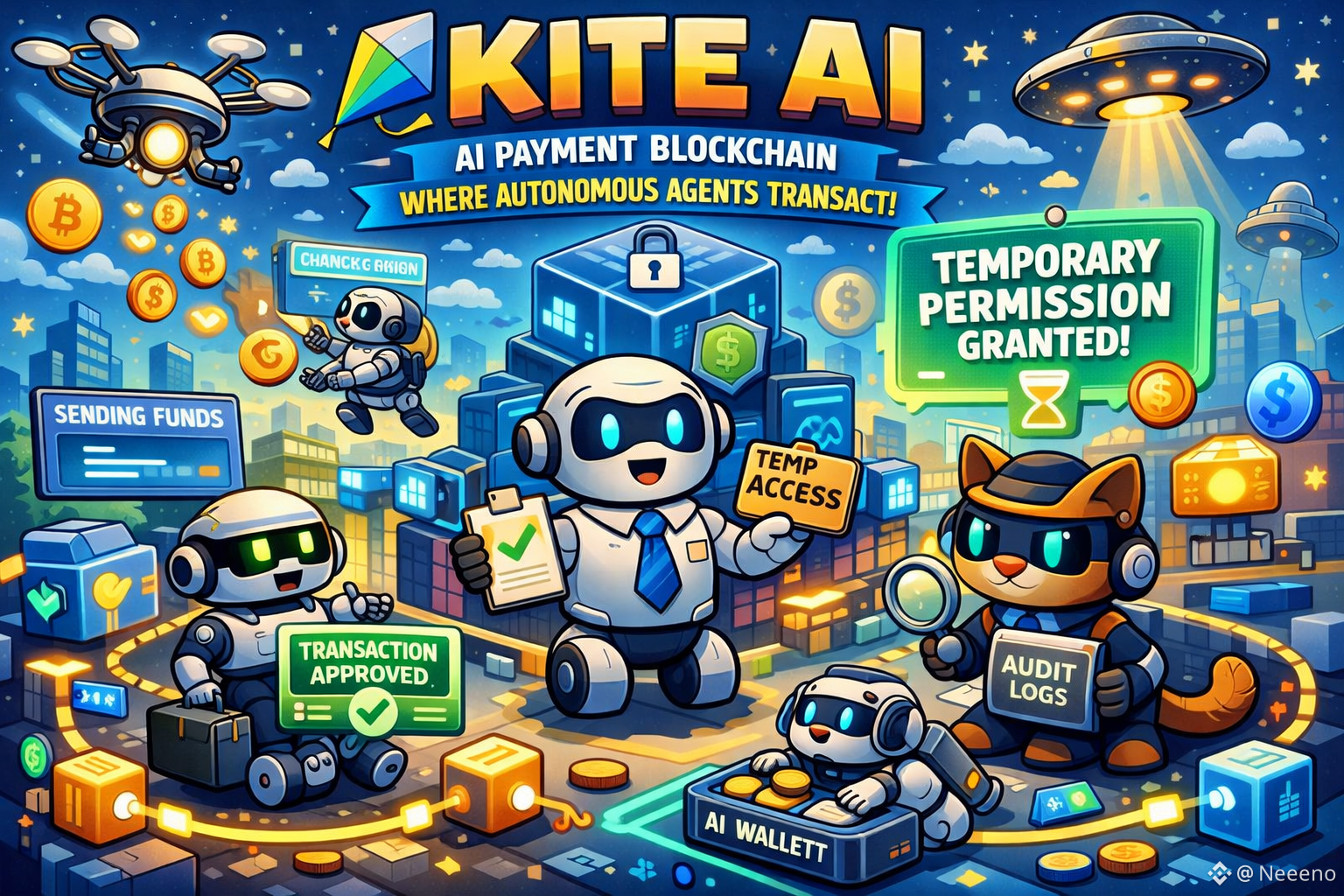
From what the project describes and what industry writers are pointing to, @KITE AI isn’t just another blockchain token or a trendy crypto play. It’s an attempt to rethink how machines specifically AI agents can interact economically with the world.
At the center of Kite is a blockchain made for one main job: letting AI agents make payments and work together without needing a person to approve every step. It’s not about letting bots do anything they want. It’s about giving them a clear identity, strict spending rules, and records you can check later, all locked in by secure code.
To understand it, think about how we use apps and online services today.
A simple way to picture this is to look at how we already use apps and services now. Every time we sign in, pay for a subscription, or authorize access, a human eyes the screen and decides yes or no. That’s fine when the scale is one person at a time. But when millions of AI agents might be operating in the background — negotiating prices, buying compute power, accessing data — you quickly run into a bottleneck. People are too slow and too expensive to approve every little action. The result is AI systems that can think ahead but can’t act ahead. Kite’s idea is to close that gap.
The way Kite approaches this is surprisingly simple in concept, even if the technology is complex. First, every agent — be it a chatbot, a data-processing routine, a recommendation engine — is given a cryptographic identity. You can think of it as a digital passport that proves who that agent is, what it’s allowed to do, and where it came from. Second, those identities come with programmable permissions, so the owner (a person or a company) can say “this agent can spend up to $100 this week, but only on certain services.” Third, when agents do transact, those actions get logged immutably on the blockchain. That’s where the “auditable” part comes in: you don’t have to trust the agent; you can verify its actions after the fact.
I want to pause on that last bit because it reveals something deeper. There’s an emotional tangle we all have with automation. On the one hand, we want systems that make our lives easier. On the other hand, we’re wary of handing over control. What Kite is trying to promise — and this is what makes it compelling right now — is not no control, but structured, transparent control. You can let an AI handle things on your behalf, but you still get an immutable record and enforceable rules about what it could and couldn’t do. It’s not magic; it’s policy enforced by math.
This idea matters particularly because of where technology is right now. We’re entering what some in the industry call the agentic economy — a world where software agents don’t just assist humans, they act independently on their behalf. These agents might buy compute, negotiate service contracts, fetch data, and even pay for products and perks. That’s not theoretical anymore; it’s happening in pilot projects and inside companies experimenting with AI workflows. The missing piece has been reliable financial infrastructure that doesn’t require a human touch at every step. Kite and projects like it are trying to provide that piece.
You can see the rising interest reflected in investor activity too. Big names from traditional finance and tech — PayPal Ventures, Coinbase Ventures, and others — have put money behind this idea. That tells you two things: one, there’s serious belief that autonomous payments aren’t just a sci-fi dream; and two, there’s confidence that blockchains are the right tool to build them.
But let’s be clear. Systems like this are still early. Giving AI agents economic agency raises tricky questions around security, liability, and trust. When machines handle real value, someone has to take responsibility if something goes wrong.
Kite’s approach is to give agents strict boundaries and a record that can be checked later. But we’re not past the testing stage yet, and real use will reveal the weak spots. That’s part of how new ideas improve. .
The broader point isn’t about Kite alone. It’s about what the next layer of digital interaction looks like. Today we mostly let AI give advice, like picking a movie or helping write a message. In the future, we may let it take actions too, as long as we can check what it did and hold it responsible. That change won’t happen overnight, and it will raise questions about tech, laws, and trust. Projects like Kite show people are already trying to deal with those questions in practical ways.
I don’t know exactly where this will land. Nothing in technology ever unfolds exactly as predicted. What stands out to me is this: secure and transparent payment systems for AI agents are no longer just theory. They’re starting to shape how people think about AI using money in the real world. It’s worth paying attention to where that goes

