

The crypto market has just witnessed a strong price surge as Bitcoin suddenly bounced back to the $90,000 level in a short period. On social media, the wave of FOMO quickly spread, with a series of posts praising the 'bounce' and expectations for a new bull cycle. However, beneath that vibrant surface, many on-chain analyses suggest that this development may not be as simple as what the majority are seeing.
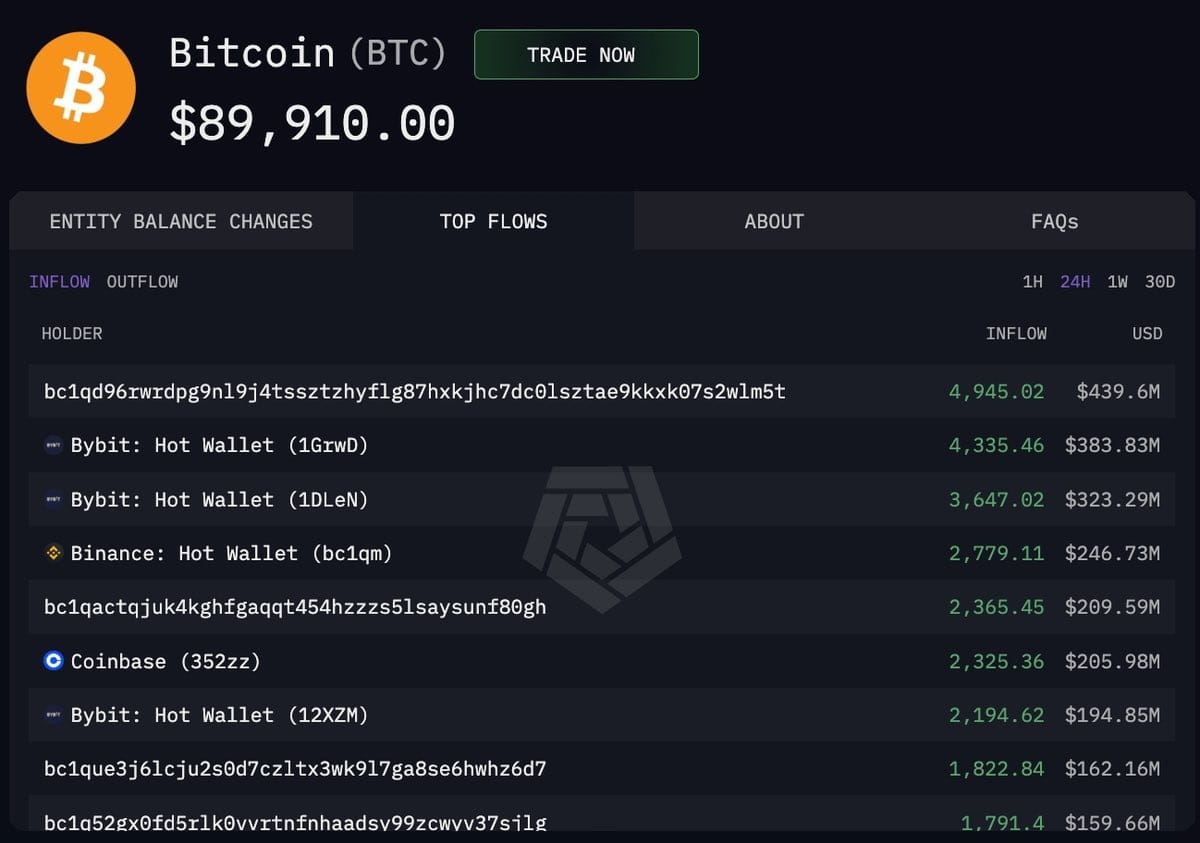
Some analysts believe that the recent pump bears many signs of a liquidity manipulation scenario, rather than stemming from natural buying demand in the market.
What does unusual on-chain cash flow reveal?
According to on-chain data shared by the community, within just a few short hours, many large entities including whale wallets and familiar trading organizations such as Bybit, Binance, Kraken, or Wintermute bought a total of approximately $2.5 billion worth of Bitcoin. The scale of this cash flow immediately raised suspicions, as it occurred in the context of low market liquidity.
In conditions of thin liquidity, the price of Bitcoin can be pushed up significantly without needing tens of billions of USD. Just a sufficiently large amount of capital concentrated over a short time can create a strong price movement, causing a widespread psychological effect across the market.
When low liquidity becomes the 'leverage' for price manipulation.
Analyses indicate that, before the Bitcoin surge, the order book depth on many derivatives and spot exchanges was below average. This created ideal conditions for the price to be pulled up quickly and decisively.
The price was pushed up strong enough to trigger FOMO psychology, while simultaneously wiping out high-leverage short positions. When shorts are liquidated en masse, the forced buying pressure pushes the price even further, creating a feeling that the market is entering a real breakout phase.
The goal is not to increase the price, but to hunt for liquidity.
According to the perspective of many veteran traders, the ultimate goal of this pump is not to maintain an upward trend. Instead, it serves as a liquidity trap.
When shorts were 'rekt', the market began to see a large number of new long positions being opened in a state of excitement. This is precisely the moment when big players can dump a massive amount of Bitcoin, pushing the price down sharply and liquidating the newly formed long positions.
This scenario is not new in the crypto market, but this time the level of transparency of on-chain cash flows has led many to believe that manipulation is becoming increasingly difficult to hide.
The thin line between legality and market manipulation.
In traditional financial markets, such price manipulation behaviors can lead to severe penalties, even imprisonment. However, with crypto – a global, decentralized market with many legal gray areas – these activities are often disguised as legitimate trading.
The fact that large organizations take advantage of low liquidity to manipulate prices, technically, does not always violate the law. But fundamentally, it makes retail investors become exit liquidity, bearing the greatest risk when the market reverses.

