

I first ran into @Lorenzo Protocol the way you run into a lot of crypto projects: a link in a group chat, a skim, then back to real life. At the time it felt like an experiment ambitious, a bit abstract, and very easy to file under “interesting, but we’ll see.” What surprised me is how little drama there was in its next chapters. No sudden reinvention. No loud pivot. Just a slow tightening of the screws.
That slower tempo is suddenly fashionable, and not because people have become more patient overnight. The whole industry has been getting tired in a useful way.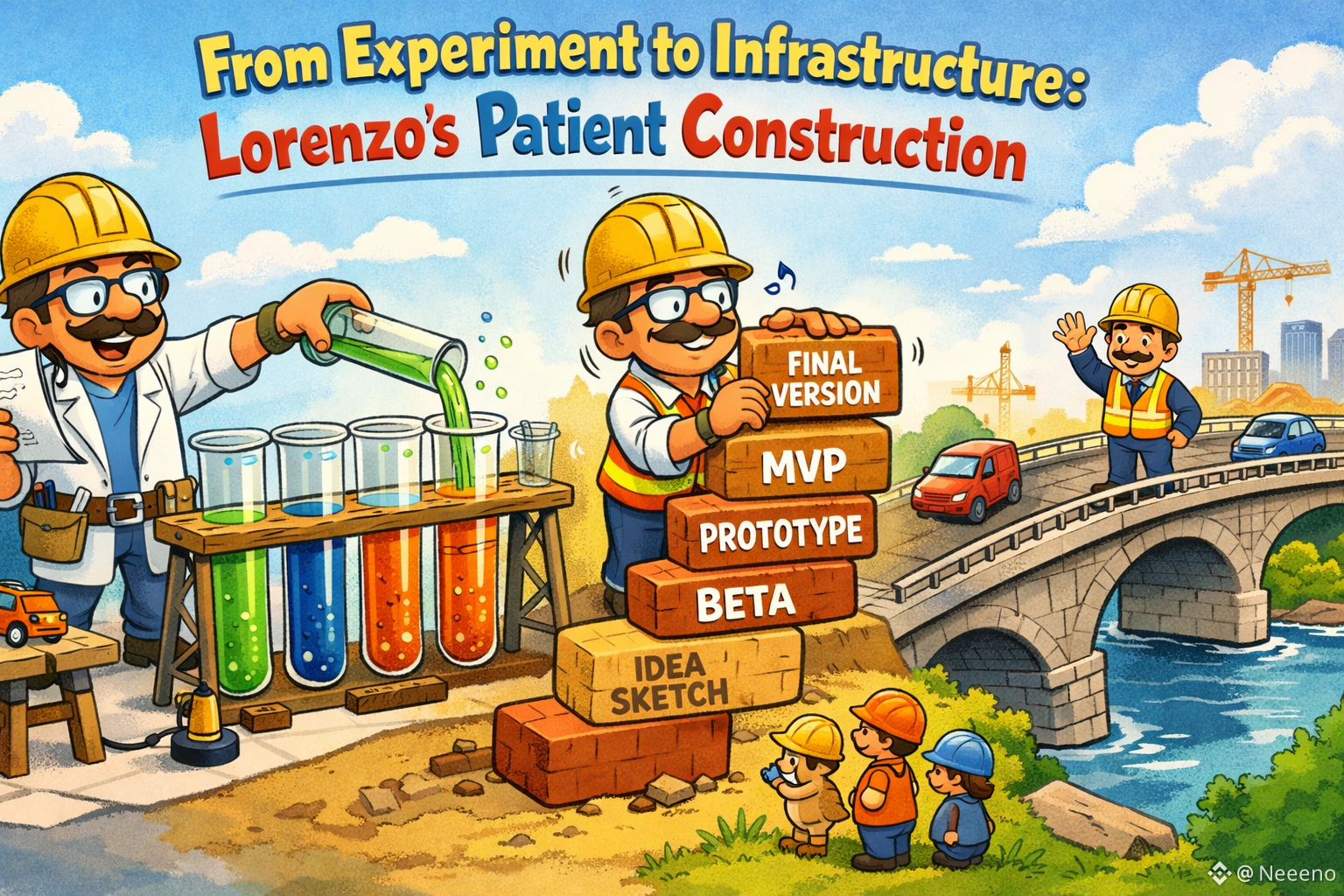
After years of excitement and hype, more teams want on-chain finance to be reliable: consistent, trackable, and able to keep working when something breaks. You can tell from the way people speak today. . “Infrastructure” shows up more than “moonshot.” “Risk” shows up more than “narrative.” Even outside crypto, companies are pouring money into compute and reliability because prototypes don’t carry a business.
In that context, Lorenzo’s “patient construction” lands differently. Recent community writing about it keeps circling the same idea: it’s starting to feel less like a prototype and more like rails that other things can run on. I don’t take community posts as gospel, but I do pay attention to tone. When people stop pitching and start describing how something fits into their mental map, you’re watching a project mature in real time.
The simplest way I can explain Lorenzo’s aim is this: it treats Bitcoin less like a museum piece and more like working capital. For a long time, the dominant culture around Bitcoin was “hold it and don’t touch it.” That instinct comes from hard-earned scars. But in 2025, “don’t touch it” has started to feel incomplete. More firms want exposure to Bitcoin, yet they also want yield, controls, and accounting that doesn’t require a small army. Meanwhile, crypto-native users have gotten curious about whether Bitcoin can be used without becoming a fragile imitation of everything it once criticized.
This is where the infrastructure mindset matters. If you want Bitcoin liquidity to move through different strategies or across different ecosystems, you can’t rely on trust-me energy. You need rules that survive bad weeks, not just good ones. One reason I’ve kept an eye on Lorenzo is that it talks about architecture the way long-term teams do: modular, upgradeable, designed so a new piece can be added without cracking the whole foundation. The project has described modularity as a way to keep the system adaptable while still leaning on Bitcoin for shared security.
I’ve seen the opposite pattern too many times to ignore the contrast. A team launches a clever mechanism, it works for a quarter, and then the real world arrives. Liquidity shifts. Fees spike. A partner changes terms. Suddenly the system needs maintenance, and maintenance isn’t glamorous. The projects that survive are the ones that planned for the boring stuff—monitoring, clear boundaries, and the humility to assume users will do surprising things at 2 a.m.
Lorenzo’s bet also lines up with a broader trend people are watching: the institutionalization of crypto without turning it into a carbon copy of traditional finance.
That balance is hard. Institutions aren’t looking for trends—they’re looking for reliable systems that work easily and don’t shock them.. Crypto users, on the other hand, don’t want a walled garden that strips out everything interesting
The middle ground is tech that keeps things open and compatible on-chain, while also giving risk teams and auditors simple dashboards and reports.
It’s hard to notice because it happens slowly, through many small decisions focused on making things steady, not exciting. Interfaces get clearer. Documentation starts answering the annoying questions. Partnerships look less like marketing and more like plumbing. The conversation shifts from “is this real?” to “what can I build with it?” That’s the point where an experiment becomes something closer to public utility—not because it’s perfect, but because it’s dependable enough that other people will stake their own reputations on it.
There’s a quiet emotional element here too. A lot of people came into crypto looking for freedom and got a crash course in chaos instead. Watching a project choose patience can feel like relief. Not the kind that makes headlines, just the kind that makes you think: maybe this space can grow up without losing its edge.
Lorenzo may or may not end up as a lasting layer in that future. Nobody gets to declare that early. That’s why people care now: it’s moving from smart tests to solid systems.More is on the line, more people are paying attention, and “good enough” doesn’t cut it anymore.


