

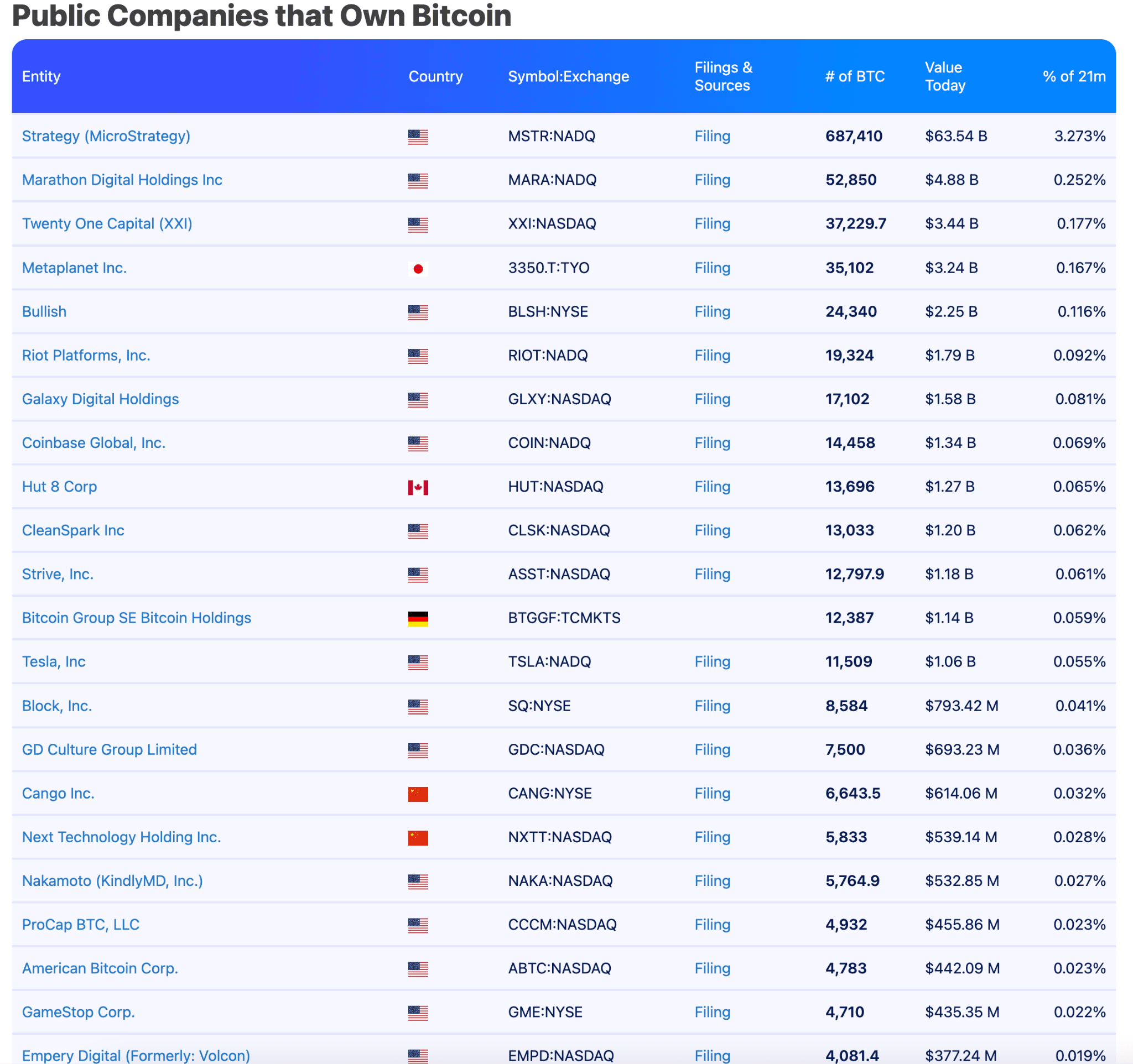
In the world of cryptocurrency, an unprecedented structural change is quietly taking place. The latest data shows that the top 100 publicly traded companies holding the most Bitcoin globally have quietly accumulated over 1,100,000 Bitcoins in their treasuries.
This figure not only sets a historical record but also means that approximately 5.26% of the total supply and 5.5% of the circulating supply are strategically locked by these entities. This is far from just a simple 'whale holding' and marks the beginning of a new era—Bitcoin is transforming from a speculative asset into a long-term strategic reserve asset on the balance sheets of global enterprises.
From "Trading Chips" to "Strategic Reserves": The Disruption of Game Rules
The entry of listed companies has completely changed the rules of the Bitcoin market. Unlike retail investors or hedge funds chasing short-term fluctuations, technology and investment giants like MicroStrategy and Metaplanet back Bitcoin as a long-term asset allocation and "lock it in the vault" with corporate financial strength and credit. Their goal is not short-term arbitrage but rather to see it as a long-term value storage tool to cope with currency depreciation and enhance balance sheet resilience.
This behavior has produced two direct and profound impacts:
1. Liquidity Absorption and Market Stability:
A large amount of "floating chips" that could have been frequently traded in the market are being permanently or long-term absorbed. This effectively removes the most uncertain selling power from the market, resulting in price fluctuations being driven more by long-term value recognition and macro financial trends rather than short-term speculative sentiment. The Bitcoin market is thus becoming deeper and more stable.
2. The Strongest Credibility Endorsement:
Every major investment by a listed company must undergo strict auditing, board approval, and accountability to global shareholders. Incorporating Bitcoin into their balance sheets is akin to conducting a continuous and public "value evangelism" for Bitcoin using their own credibility and trillions of dollars in credit. This is more persuasive than any analyst report or media promotion, greatly accelerating mainstream society's consensus on the value of cryptocurrencies.
"Scarcity Accelerator": A Structural Future of Supply Shock
One of the core narratives of Bitcoin is absolute scarcity—its total supply is fixed at 21 million, and new supply is reduced by "halving" every four years. The accumulation behavior of listed companies acts as a "scarcity accelerator" on this already strict set of rules.
Statistics show that in just the past six months, the Bitcoin holdings of the top 100 listed companies have surged from about 854,000 to 1,110,000, a net increase of over 260,000, averaging about 43,000 "sucked away" each month. These purchased Bitcoins are unlikely to return to the circulating market for the next five, ten, or even longer years. This is physically "destroying" liquidity, leading to a structural tightening of the actual supply of freely tradable Bitcoin. In the future, any new incremental demand entering the market may trigger a more significant price response due to the extreme scarcity of the circulating supply.
The "Coming of Age" of the Ecosystem: The Beginning of Attracting Larger Traditional Capital
The massive allocation by listed companies is a strong signal that is attracting the attention of the traditional financial world's larger and more cautious "whales." Top-tier capital, known for its stability and long-term nature, such as pension funds, insurance capital, and sovereign wealth funds, is beginning to examine Bitcoin from a new and more serious perspective.
Their potential entry will not only bring an enormous amount of capital but also signifies a fundamental shift in the pricing logic of Bitcoin: moving from being primarily driven by retail sentiment and cyclical speculation to a new paradigm driven by global macro allocation, institutional asset rebalancing, and long-term value storage demand. The traditional "four-year cycle" theory may thus be reshaped.
Conclusion: Sailing with Whales, Not Being Crushed by Them
For early market participants, the accumulation trend of listed companies should not be simply viewed as a threat of "institutions crushing retail investors." On the contrary, it is the strongest affirmation of value and developmental catalyst received by the Bitcoin ecosystem since its inception. It is creating a more solid fundamental, broader consensus, and potentially less volatile mature market environment for everyone.
This is not merely a victory for institutions but a "coming of age" for the entire cryptocurrency ecosystem. Understanding the essence of this trend—that Bitcoin is completing a critical leap in infrastructure, credit endorsement, and liquidity— and progressing along with it, is perhaps the perspective one should have in this era. The tide has come, and the direction is already clear.
The above information is compiled based on online resources and does not represent the views of the AiCoin platform, nor does it constitute any investment advice. Readers are advised to discern and manage their own financial risks.
