

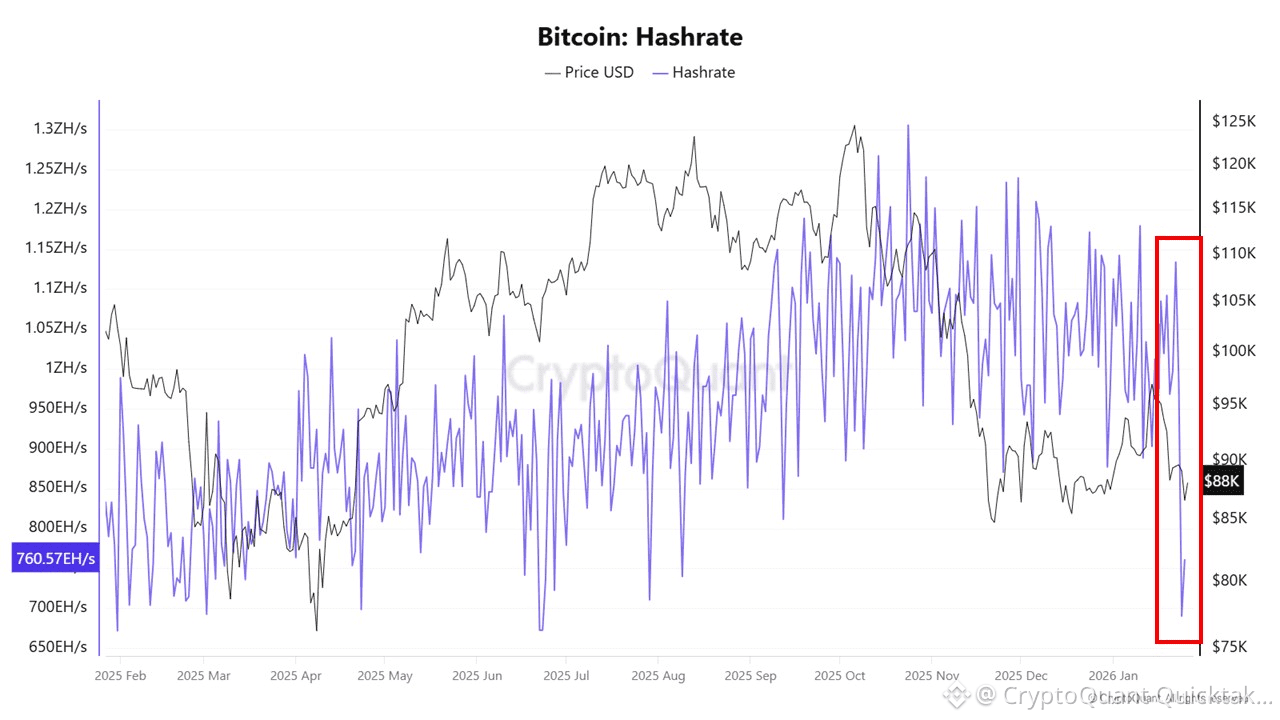
According to data from CryptoQuant analysts Ki Young Ju, Darkfost, and Julio Moreno, Bitcoin’s hashrate has dropped sharply in recent days. Observations show a fall from around 1.13 ZH/s to roughly 690 EH/s within two to three days—about a 30% short-term decline. The attached chart highlights a clear divergence: while price has hovered near $88,000, hashrate alone has fallen steeply.
Crucially, this move should not be immediately labeled as classic miner capitulation driven by price weakness. The primary catalyst is a severe cold wave across the United States that has strained power grids. As electricity demand surged, non-essential usage was curtailed and power costs spiked, prompting miners to temporarily reduce operations. Given the U.S. represents a large share of global hashrate—especially with major hubs concentrated in Texas—these operational decisions quickly affected network-wide metrics.
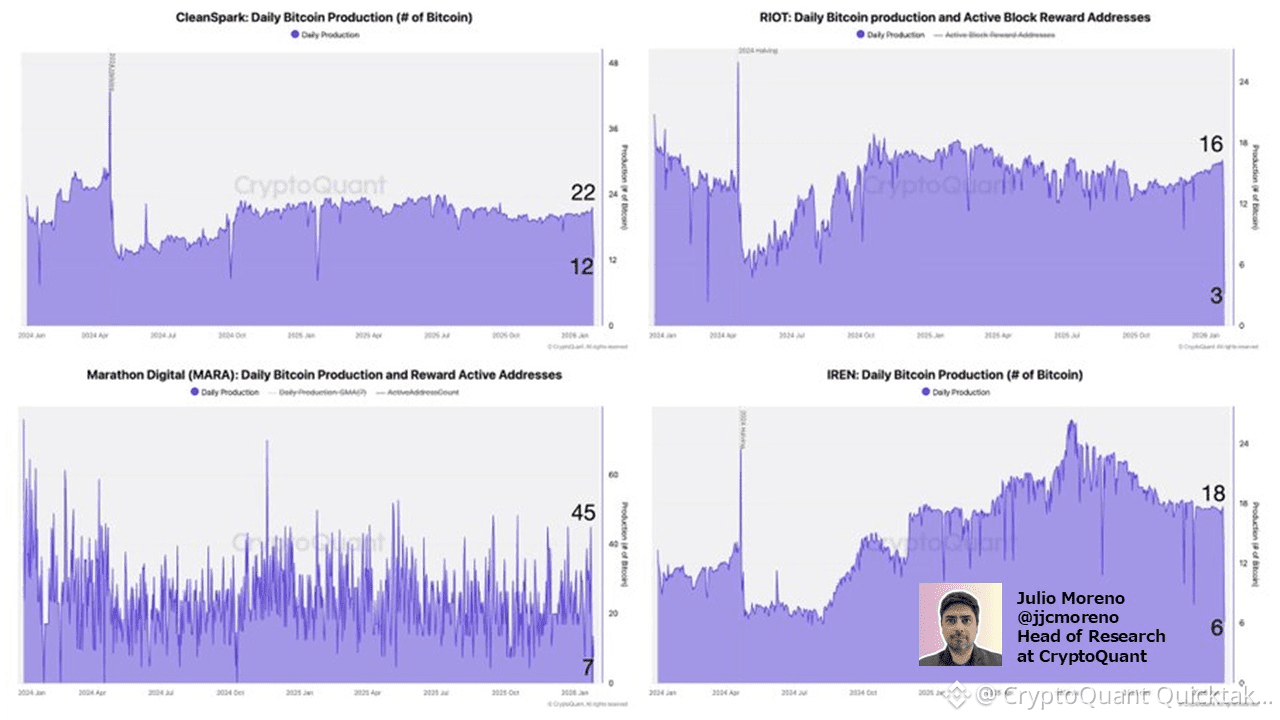
Julio Moreno’s data shows the impact in daily production. Over the past several days, CleanSpark fell from 22 BTC to 12 BTC, RIOT from 16 BTC to 3 BTC, and IREN from 18 BTC to 6 BTC. MARA, which relies heavily on solo mining and is therefore more volatile, dropped from 45 BTC to just 7 BTC.
Viewed on a medium-term basis, miner-specific on-chain data shows uneven depth of impact. MARA displays a clear deviation below its monthly average, while CleanSpark, RIOT, and IREN show sharp short-term declines but limited evidence of structural damage to production capacity. This points to temporary, region- and power-driven adjustments rather than uniform industry deterioration.
Near term, block intervals have lengthened and the next difficulty adjustment is expected around −4%. Key checks ahead are hashrate recovery speed, post-adjustment stability, miner exchange inflows, and whether the price-hashrate gap closes—factors that will determine whether this shock proves temporary or structural.
Written by XWIN Research Japan
