

As we enter 2026, the Ethereum market has not welcomed the anticipated 'good start', but instead continues to fluctuate below key price levels. From the beginning of the year until now, the ETH price has retraced all gains and turned to decline, consistently trading below the psychological threshold of $3000.
However, beneath the calm price surface, large capital flows represented by 'whales' are turbulent, exhibiting rare polarization and intense competition. On one side are the early holders and short-term traders distributing their chips, while on the other side are off-market funds buying on dips and making long-term layouts. This tug-of-war between bulls and bears is pushing Ethereum towards a critical turning point.
 One, sellers: profit-taking and strategic adjustments
Recent market sell pressure mainly comes from two directions: early whales, who have been dormant for years, taking profits, and active whales tactically reducing positions based on market fluctuations.
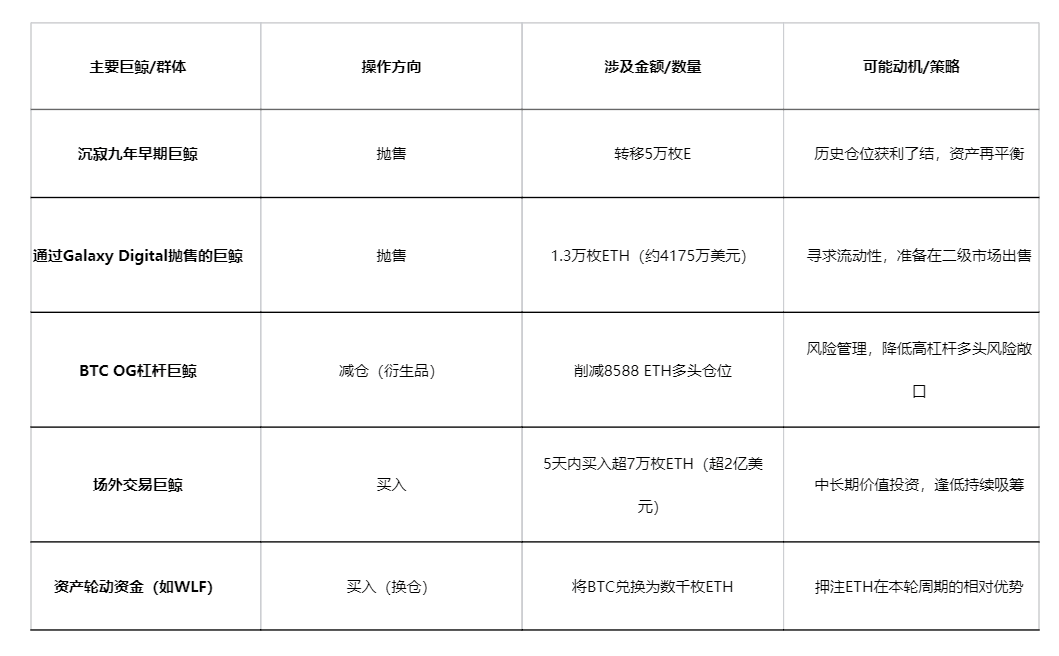
● First, the dormant whales awaken, and historical chips enter the market. On-chain data shows that an early Ethereum holder who had been dormant for nine years recently began to act, transferring 50,000 ETH to addresses related to the market.
○ The movements of such 'ancient' addresses are often interpreted by the market as potential profit-taking signals, as their holding costs are extremely low, and any sale at any price could yield substantial profits. Although this address still holds a large amount of ETH, its initiation of transfers alone is enough to affect market sentiment.
● Secondly, large-scale sell-offs through professional channels have drawn attention. On January 19, monitoring discovered that a suspected whale was selling through Galaxy Digital's over-the-counter trading wallet.
○ This wallet transferred 13,000 ETH in one go and quickly deposited half of it into mainstream exchanges such as Binance, Bybit, and OKX, with a total value of about $41.75 million. Engaging in over-the-counter trading through professional institutions like Galaxy Digital before transferring to exchanges often indicates that the seller seeks more direct liquidity and is prepared to sell in the secondary market.
● In addition, leveraged whales are actively reducing risk exposure. This is not limited to the spot market; important players in the derivatives market are also adjusting their positions. A whale marked as 'BTC OG Insider Whale' reduced its ETH long position on Hyperliquid by 8588 ETH in just ten minutes on January 26.
○ Although after adjustments they still hold a long position in ETH worth about $620 million with 5x leverage, the active reduction in positions indicates that even bulls are becoming cautious near this price level and are starting to manage risks.
These sell-off behaviors are not isolated events; they collectively constitute a significant outflow trend since the beginning of the year. Data shows that from the beginning of 2026 to January 23, the overall holdings of Ethereum whales have decreased from about 31 million to slightly above 29 million, with a cumulative sell-off of approximately 1.63 million ETH.
Two, buyers: bargain buying and asset rotation
Corresponding to the sellers, another group of whales sees the price pressure as an opportunity to accumulate chips, and their buying behavior is equally resolute and on a large scale.
● The strong accumulation by over-the-counter whales is the most eye-catching. According to Lookonchain, an over-the-counter whale address has been continuously buying in the past five days, accumulating over 70,000 ETH, with a total value exceeding $200 million. This behavior of making large purchases through over-the-counter channels without concern for short-term fluctuations usually represents a strong optimism about the long-term value of the asset.
● The rotation of funds from Bitcoin to Ethereum is another trend worth noting. Some whales are adjusting their cryptocurrency asset allocations, shifting funds to Ethereum.
○ For example, the DeFi project World Liberty Financial, supported by President Trump, recently exchanged thousands of Ethereum for Bitcoin;
○ Other large addresses also executed similar operations of 'exchanging BTC for ETH'. This indicates that some smart money believes that Ethereum may have greater relative growth potential or resilience than Bitcoin in this market cycle.
● The continuous exhaustion of exchange supplies is a direct result of whale buying behavior. CryptoQuant monitoring data shows that the reserves of Ethereum on exchanges are continuously declining.
○ This means that the strength of withdrawing ETH from exchanges and transferring it to private wallets for long-term holding is greater than the strength of depositing it into exchanges for sale. The contraction of exchange supply is a classic bullish on-chain signal because it indicates that the potential selling power in the market is weakening while the number of long-term holders is increasing.
 Three, market structure: the key game area of $2700-$3100
The bulls and bears' confrontation among whales does not take place in a vacuum but unfolds around specific price ranges. On-chain data analysis clearly indicates that the $2700 to $3100 range has become the core gaming interval and key consensus area for the current ETH market.
● This interval has accumulated a massive amount of chips. According to statistics, between $2700 and $3100, approximately 17.9 million ETH has densely piled up, accounting for 22.6% of the total circulating supply of ETH; just at the $3100 level, there are 4.43 million ETH chips.
These chips mainly come from two groups: first, investors who bought the dip during the period from May to July at $2600-$2700 and subsequently continued to add positions, raising their average cost to $3100; second, a new batch of dip-buying funds that entered when prices corrected to $2700-$2800 in late November.
This structure has produced two important market implications:
1. $3100 is not a strong resistance: Since most holders around this price level are in a trapped state, once the price rebounds to this point, they are more inclined to break even or slightly reduce losses rather than sell off in large quantities, so it will not form a strong rebound resistance.
2. $2700 constitutes key consensus support: This price level is generally viewed by market participants, especially some institutions, as an important demand area. On-chain analysts point out that $2700 is one of the few consensus support areas currently formed; once it effectively breaks down, the price may enter a 'vacuum zone' lacking clear technical anchor points and chip support, leading to accelerated declines. Therefore, the contest between bulls and bears at this price level will be exceptionally fierce.
Four, divergence signal: the contradiction between weak prices and strong fundamentals
Currently, the Ethereum market presents a thought-provoking divergence phenomenon: the coexistence of weak price performance and continuously strengthening network fundamentals. This might provide another perspective for understanding the differentiated behavior of whales.
Although the price hovers below $3000, the usage activity of the Ethereum network is rising. According to CryptoOnchain data, the seven-day moving average of active Ethereum addresses has risen to about 718,000, setting a new historical high. A rise in price while on-chain activity declines is a dangerous signal; conversely, when prices are stable or decline while on-chain activity increases, it is often seen as a bullish divergence that may signal the accumulation of upward momentum.
The factors driving network activity are multifaceted:
● The popularization of Layer-2 scaling solutions has reduced user transaction costs and thresholds.
● The activity of ecological applications such as DeFi and NFTs has shown signs of recovery.
● The increase in retail participation complements the behavior of whales.
This divergence suggests a short-term misalignment between market trading sentiment (reflected in prices) and the practical value of the network (reflected in on-chain activity). Trading-oriented whales that focus on short-term price fluctuations may choose to exit or short, while value-oriented whales that focus on the long-term development prospects of the network may view this as a good opportunity to position themselves.
Five, the market direction after the whale confrontation
Ethereum is at a crossroads formed by the interplay of whale battles, on-chain fundamentals, and the macro environment. The fierce confrontation between bullish and bearish whales is essentially a repricing of Ethereum's short-term trends and mid-term value.
In the short term, market trends will depend on the outcome of this contest. If selling pressure persists, especially if the price effectively breaks below the key consensus support of $2700, it may trigger wider stop-loss and panic selling. Conversely, if buying pressure can withstand selling pressure and successfully establish a bottom at the key support level, with the continued decrease in exchange inventory of ETH and the gradual recovery of market confidence, the upward momentum for a breakout will also continue to accumulate.
In the long term, the core factors determining the value of Ethereum will still return to its network effects, ecological development, and continuously growing real utility. The movements of the whales are an important window for observing market sentiment and the flow of funds, but they are by no means the only determining factor. For investors, while paying attention to large capital battles, it is more important to penetrate the short-term price fluctuations and gain insight into the evolutionary trajectory of Ethereum as a global decentralized computing platform. This fierce battle between whales, regardless of the outcome, is merely a vigorous annotation on this long evolutionary road.

