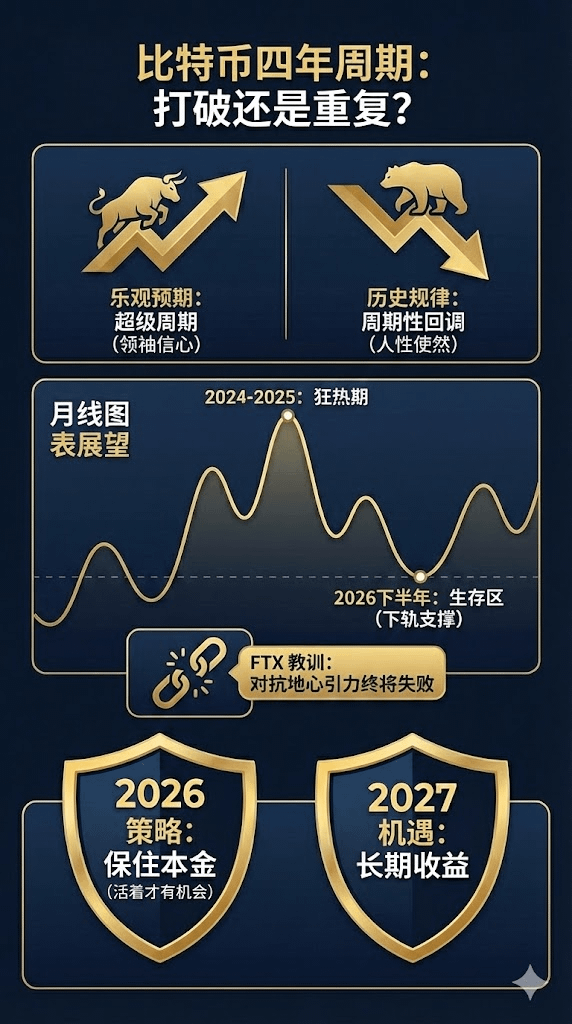
Regarding Bitcoin, there are always two voices in the market. One is the 'cyclical theory,' firmly believing in a four-year cycle; the other is the 'super cycle theory,' which believes this time is different.
As we approach 2026, according to the traditional model of 'three years up, one year down,' we will enter a correction period. However, recently, several industry leaders, including CZ and MicroStrategy CEO Michael Saylor, have expressed the view that with the approval of ETFs and the entry of institutions, the traditional four-year cycle has been broken, and Bitcoin will enter an eternal bull market.
But can this really be trusted? As retail investors, should we listen to the 'calls of confidence' or observe the 'laws of history'?
1. There is nothing new under the sun.
Soros once said: 'The history of the world economy is a continuous drama based on illusions and lies.'
Human nature has not changed for thousands of years. At the end of every bull market, someone will stand up and say, 'This time it's different.'
Looking back to 2022, at that time, countless big shots and retail investors firmly believed that the cycle was dead and the bull market was perpetual. Even the strong SBF (Sam Bankman-Fried) of FTX tried to use his own strength to counteract the gravitational pull of the cycle by 'selling Bitcoin to buy altcoins.' What was the result? Liquidity dried up, tall buildings collapsed, and guests dispersed.
History has proven countless times: any individual's will is insignificant in the face of macroeconomic cycles.
2. Listen to their words, but observe their actions even more.
For industry leaders, confidence is more important than gold.
CZ and Saylor must be optimistic because they are the totems of the industry; their responsibility is to inject confidence into the market, which is their 'job description.'
But as investors, we cannot only listen to surface talk. Careful friends who analyze the changes in the position structures of major institutions (including exchanges) will find that Smart Money often begins to quietly manage risk when everyone is at their most frenzied.
Institutional defensive actions are often more honest than their public speeches. Don't just look at what they say, but see what they have done to address potential risks.
3. Technical aspect: Where is the 'golden pit' of 2026?
Set aside emotions and return to the charts.
From the monthly line perspective, although there will be rebounds and temptations in the process, mean reversion is an ironclad rule.
My judgment is: In the next year (2026), the price will likely seek support near the lower boundary of the monthly Bollinger Bands.
Time frame: Expected in the second half of 2026.
Operational strategy: Reaching near the lower boundary of the monthly line is the real long-term buying opportunity.
4. Final words: Being alive means having a future.
If 2024-2025 is a carnival, then the theme of 2026 is likely to be **'Survival'**.
Do not let short-term fluctuations disturb your judgment, and do not ignore risks because of calls from big shots.
Round and round, repeating cycles. Even if this time the process is slightly different, the outcome is still likely to be the same.
In 2026, be sure to protect your principal. Only by surviving through 2026 will you qualify to catch the real wealth of 2027.
(Disclaimer: This article only represents personal views and does not constitute investment advice. The market has risks; investing requires caution.)
#BTC #周期理论 #宏观分析 #Strategy增持比特币 #投资心得