

According to CoinMarketCap data, the global cryptocurrency market cap now stands at $2.57T, up by 1.24% over the last 24 hours.
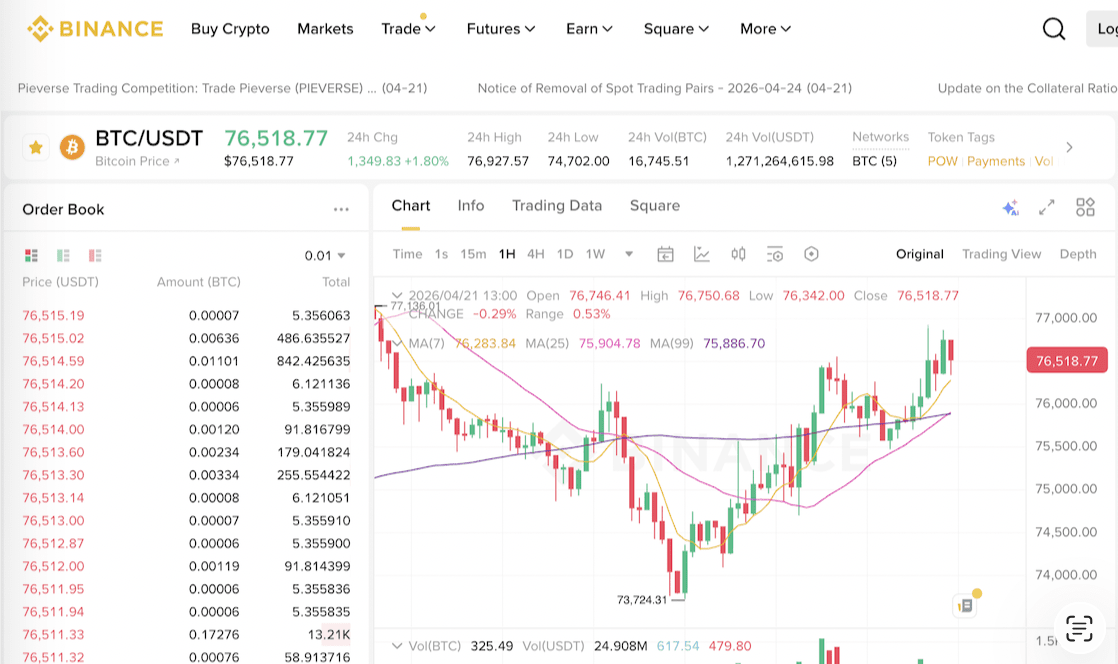
Bitcoin (BTC) has been trading between $74,702 and $76,928 over the past 24 hours. As of 09:30 AM (UTC) today, BTC is trading at $76,256, up by 1.64%.
Most major cryptocurrencies by market cap are trading mixed. Market outperformers include DENT, EDU, and TRU, up by 59%, 31%, and 31%, respectively.
Bitcoin Climbs Toward $77K as Strategy Overtakes BlackRock and Retail Sales Jump 1.7%
Bitcoin is continuing to attract stronger institutional support, with Strategy reclaiming the title of largest Bitcoin holder and ETF inflows helping stabilize volatility. While BTC is approaching key resistance near $77,000–$78,000, altcoins remain weaker as DeFi sentiment struggles to recover from the KelpDAO exploit.
At the macro level, stronger U.S. retail sales and discussions around a U.S.-UAE currency swap show how energy prices and geopolitical tensions are still shaping market sentiment. If Middle East tensions continue to ease, Bitcoin could benefit further from lower oil prices, stronger risk appetite and the potential for a short squeeze above current levels.
Key Takeaways
Bitcoin rose toward $77,000 but faced resistance near the key $78,300 level.
Altcoins and DeFi tokens remain under pressure after the $290 million KelpDAO exploit.
Negative funding rates could create conditions for a short squeeze if Bitcoin remains resilient.
Summary
Bitcoin recovered above $75,000 and briefly approached $77,000 as broader market sentiment improved. However, the market continues to face resistance near the $78,300 level, while altcoins and DeFi tokens remain weaker due to the fallout from the KelpDAO exploit. Negative funding rates suggest many traders are still positioned short, which could create the conditions for a larger upside move if Bitcoin continues to hold current levels.
Key Takeaways
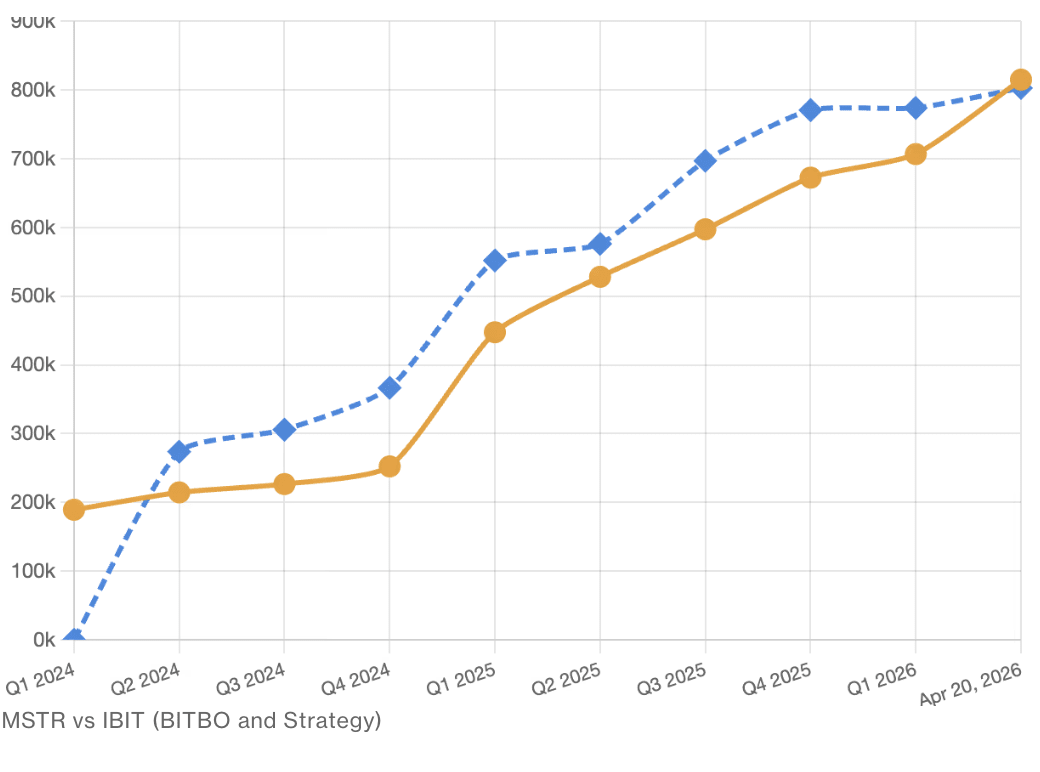
Strategy now holds 815,061 BTC, surpassing BlackRock’s IBIT holdings of 802,824 BTC.
The company added nearly 80,000 BTC in 2026 alone, including a recent 34,164 BTC purchase.
Strategy has outperformed IBIT significantly since 2024 due to its leveraged accumulation model.
Summary
Strategy has reclaimed the title of the world’s largest Bitcoin holder after surpassing BlackRock’s IBIT ETF. The company now holds more than 815,000 BTC after aggressively buying during Bitcoin’s recent drawdown. The milestone highlights the growing role of corporate treasury strategies in the Bitcoin market and reinforces institutional confidence in long-term BTC exposure.
U.S. Retail Sales Beat Expectations in March, Surging 1.7% on Record Gasoline Receipts From Iran War
Key Takeaways
U.S. retail sales increased 1.7% in March, marking the strongest monthly gain in a year.
A record 15.5% rise in gasoline station receipts drove much of the increase.
Higher oil prices linked to the Iran conflict remain a key risk to future consumer spending.
Summary
U.S. retail sales rose 1.7% in March, beating expectations and marking the strongest monthly gain in a year. Much of the increase was driven by higher gasoline prices, which surged because of Iran-related disruptions in oil markets. While the data points to stronger economic activity, rising fuel costs could eventually weigh on consumers if geopolitical tensions continue.

U.S. Considers Currency Swap with Amid Iran Conflict Fallout
Key Takeaways
The U.S. is considering a currency swap arrangement with the UAE.
The proposal aims to support economic stability amid ongoing Iran-related tensions.
The move could strengthen financial ties between the U.S. and one of its closest Middle East allies.
Summary
The U.S. is exploring a potential currency swap arrangement with the UAE as part of broader efforts to stabilize the regional economy amid the Iran conflict. The move would provide additional liquidity support and strengthen financial ties between the two countries. It also highlights how geopolitical tensions are increasingly shaping global financial policy.

Bitcoin Is Now Less Volatile Than South Korea's Stock Market -- and Institutional Capital Is Why
Key Takeaways
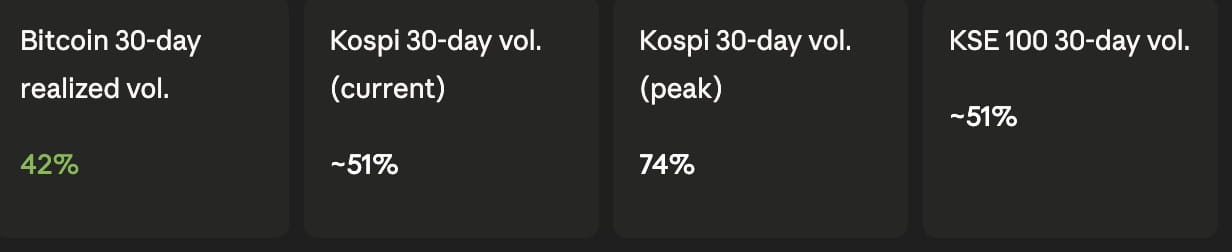
Bitcoin’s 30-day realized volatility has fallen to 42%, below South Korea’s Kospi and Pakistan’s KSE 100.
Institutional ETF flows are helping reduce Bitcoin’s historical price swings.
Markets will closely watch whether Bitcoin maintains this stability if Middle East tensions escalate again.
Summary
Bitcoin’s realized volatility has dropped below that of major equity benchmarks such as South Korea’s Kospi, marking a significant shift in how the asset behaves. The change is largely being driven by steady institutional inflows through spot Bitcoin ETFs, which are helping reduce the large price swings typically associated with crypto. If Bitcoin maintains this lower volatility profile during future geopolitical shocks, it could further strengthen its position as a maturing asset class.
Market movers:
ETH: $2319.89 (+0.65%)
BNB: $635.74 (+1.62%)
XRP: $1.4387 (+1.60%)
SOL: $85.62 (+0.80%)
TRX: $0.3288 (-0.27%)
DOGE: $0.09532 (+0.92%)
WBTC: $76039.79 (+1.66%)
U: $0.9995 (-0.01%)
XAUT: $4766.37 (-0.12%)
ADA: $0.2502 (+1.30%)