


I went to experience the functionality. Trading US stocks using cryptocurrency was indeed realized, but it was achieved through tokenized stocks. Simply put, what you buy is not the direct stock, but cryptocurrency representing US stock assets. The services are provided by Ondo and XStocks.
How to use it in the Binance wallet is shown in the figure below
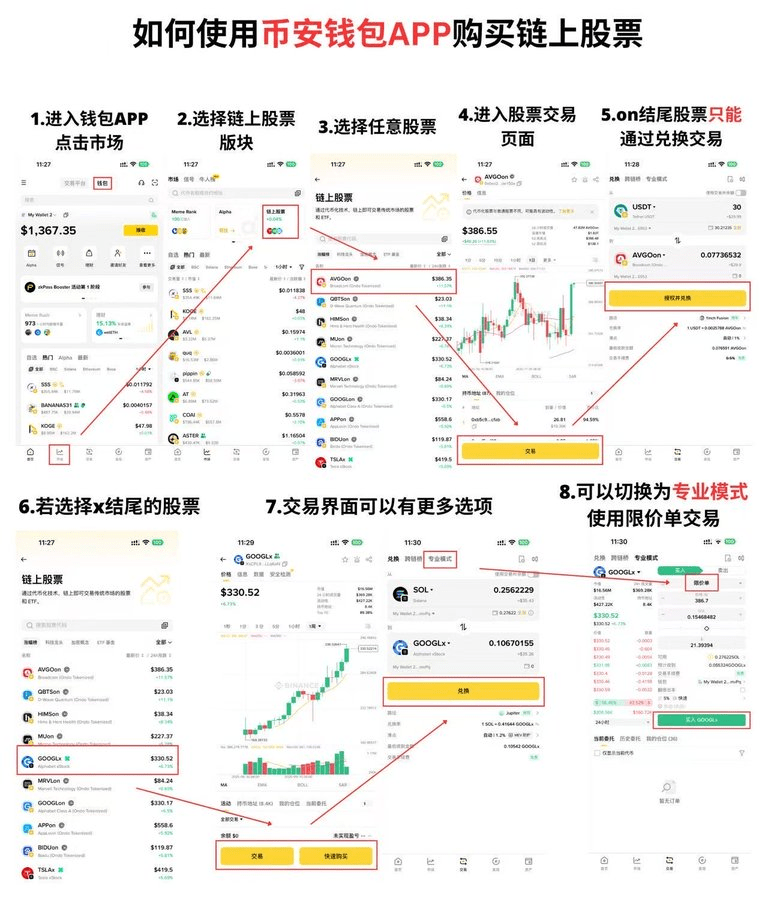
Let's talk about the feelings from the experience
1. Trading varieties: Approximately 100 mainstream US stocks and some cryptocurrency concepts are supported, which should meet the needs of most trading US stocks. There are many individual stocks, but fewer ETF types are supported. QQQ is available, but SOXL and TQQQ are not.
2. Usage habits: Still following the cryptocurrency habit of 24-hour trading, able to trade fractional shares, and instant settlement. The lack of certain restrictions found in US stock trading aligns more closely with the habits of cryptocurrency enthusiasts.
3. Trading fees: Trading within the Binance wallet can be done directly using USDT/USDC, and transactions are fee-free. However, for the same stock like AAPL/AAPL on (Apple), the price difference is about 0.5% to 0.6%. This is considered a reasonable range because converting the funds for withdrawal also incurs this fee. It’s acceptable for long-term holding, but frequent trading can be quite painful due to this loss.
Binance’s decision to place [on-chain stocks] in the wallet is quite clever, as it does not affect users on the main site. Within the same app, you can trade cryptocurrencies and use the wallet for stock trading, all while staying within the Binance app.
RWA is seen as the next wave of innovation, and the tokenization of US stocks is the best landing spot for RWA. With Ondo and XStocks providing services behind the scenes, it is crucial to seize Binance as the most important traffic entry point. All tokenized stocks are issued and traded on the BNB Chain, which is vital for Binance's public chain ecosystem.
High-frequency stock trading will bring massive on-chain interactions, directly enhancing the network activity and fee income of the BNB Chain (despite low fees for users, the scale effect is enormous).
As the variety of on-chain assets enriches, the BNB Chain is no longer just a paradise for meme coins or DeFi protocols, but rather an underlying infrastructure that carries the value of the real economy represented by companies like Apple and Tesla. Interestingly, stocks can be combined with more engaging DeFi and TradFi Lego-like structures on-chain.
In traditional brokerages, the Apple stocks you hold are usually static. However, in the Binance wallet, tokenized Apple stocks can be used as collateral to borrow USDT or participate in liquidity mining. This means Binance bridges the gap between traditional assets and crypto finance, granting stock assets 'currency attributes' and greatly expanding the dimensions of investment strategies.
It's important to know that in many developing countries, opening a US stock account is extremely difficult (high thresholds, strict regulations). There is a vast number of users who are excluded from the traditional financial system due to inadequate infrastructure. This is more appealing than the story of being able to trade Bitcoin ETFs on US stocks, as it can attract more users and funds, and is likely to be the main theme of the next round of capital speculation.

