
The digital world is changing fast — and one of the biggest forces behind this transformation is smart contracts.
They’re not just a blockchain feature…
They’re the very foundation of Web3.
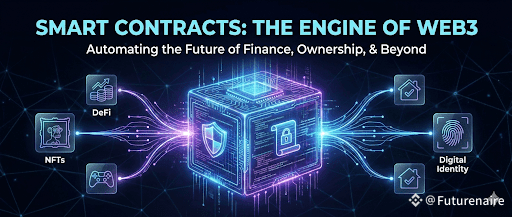
From decentralized finance (DeFi) to gaming, NFTs, digital ownership, identity, and real-world applications — smart contracts are quietly powering everything.
But what exactly are smart contracts?
How do they work?
And why do experts call them the “engine” of Web3?
Let’s break it down in a simple, human way.
--
What Are Smart Contracts? (Simple Definition)
A smart contract is a self-executing digital agreement stored on a blockchain.
It automatically performs actions when certain conditions are met — without:
❌ banks
❌ lawyers
❌ intermediaries
❌ manual approval
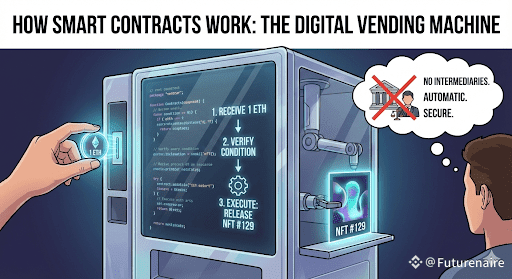
Think of a vending machine:
You put money → machine checks → gives you the product automatically.
Smart contracts work the same way, but in a programmable, decentralized digital environment.
---
How Smart Contracts Work
Smart contracts operate using three basic components:
1. Code
Written in programming languages like Solidity (Ethereum), Rust (Solana), Vyper, etc.
2. Conditions
Example:
“If User A sends 1 ETH, send NFT #129 to User A.”
3. Automatic Execution
Once deployed, nobody can alter or reverse it unless built with upgrade controls.
That makes smart contracts:
✔ transparent
✔ secure
✔ tamper-resistant
✔ trustless (you don’t need to trust anyone)
---
Why Smart Contracts Matter in Web3
Web3 aims to create an internet where:
Users own their assets
No single corporation controls the network
Trust comes from code, not people
Interactions are borderless
Smart contracts make all of this possible.
Here’s why they’re so important:
---
1. They Remove Middlemen
Banks, brokers, marketplaces, agencies — all replaced by secure automated code.
This reduces:
✔ fees
✔ delays
✔ manipulation
✔ corruption
✔ human error
---
2. They Enable Decentralized Apps (dApps)
Every Web3 platform is powered by smart contracts, including:
Uniswap
Aave
MakerDAO
OpenSea
PancakeSwap
Lens Protocol
Crypto games
Metaverse marketplaces
Without smart contracts, these systems simply cannot exist.
---
3. They Power Digital Ownership (NFTs)
NFTs are not just images — they are smart contracts giving:
proof of ownership
transferability
royalties
verifiable scarcity
Creators earn directly — no platform control.
---
4. They Power DeFi (Decentralized Finance)
Smart contracts enable:
✔ staking
✔ lending
✔ borrowing
✔ yield farming
✔ decentralized exchanges
✔ automated market makers
✔ liquidity pools
Billions of dollars move through DeFi using nothing but trustless code.
---
5. They Enable Programmable Money
Money can now:
distribute itself
enforce rules
pay royalties
unlock content
restrict usage
reallocate automatically
This is something traditional finance could never do.
---
Real-World Uses of Smart Contracts
1. Finance
Automated loans, insurance payouts, escrow systems, royalties, payroll.
2. Supply Chain
Track products from factory → shipping → delivery.
No fraud, missing items, or fake data.
3. Real Estate
Tokenization, fractional ownership, automated rental agreements.
4. Digital Identity
Self-sovereign identity (SSI) where users control their own data.
5. Gaming & Metaverse
Ownership of:
skins
weapons
land
characters
achievements
Players can sell or move assets across platforms.
6. Government & Public Records
Land registries, certificates, voting systems.
Many countries are already testing smart contract-based solutions.
---
Smart Contracts in Popular Blockchain Networks
Blockchain Smart Contract Language Strengths
Ethereum Solidity Most secure, biggest ecosystem
Solana Rust High-speed, scalable
BNB Chain Solidity Low fees, large dApp adoption
Polygon Solidity Fast, affordable, Ethereum-compatible
Cardano Plutus Research-driven, formal verification
Avalanche Solidity Fast finality, customizable chains
Each chain improves smart contracts in different ways (speed, cost, scalability).
---
Are Smart Contracts 100% Safe?
Not always.
Smart contracts are only as good as their code.
Poor coding can lead to:
⚠ hacks
⚠ exploits
⚠ rug pulls
⚠ drained liquidity
⚠ frozen funds
That’s why audits from platforms like CertiK, Hacken, or Trail of Bits are important.
---
Common Risks
Bugs in code
Unverified contracts
Hidden functions (backdoors)
Upgradable logic controlled by founders
Fake tokens or phishing dApps
Governance manipulation
Always verify before interacting.
---
The Future of Smart Contracts
Smart contracts will soon integrate with:
⭐ AI agents
⭐ Internet of Things (IoT)
⭐ Enterprise software
⭐ Governments
⭐ Real-world assets (RWA)
⭐ Global payments infrastructure
Imagine an AI agent executing smart contract trades or your car paying tolls automatically via blockchain.
We’re closer to that future than we think.
---
Final Thoughts
Smart contracts are not just a technology — they are a revolution.
They turn the internet from a read/write world (Web2) into a read/write/own world (Web3).
They remove the need for trust…
Automate processes…
Lower costs…
Increase transparency…
And give users true ownership for the first time in digital history.
As Web3 grows, smart contracts will be at the heart of every innovation.
The future is automated.
The future is decentralized.
The future is powered by smart contracts.