

@KITE AI decision to build a new EVM-compatible Layer 1 comes at a moment when the boundary between software and autonomous machines is shifting faster than most people realize. For years, blockchains have promised coordination, trust, and data integrity, but they rarely extended meaningfully into the physical world. Kite is trying to change that by treating autonomy not as an abstract frontier but as an emerging economic system—one that needs infrastructure designed from the ground up for machines that act, transact, and learn without direct human oversight.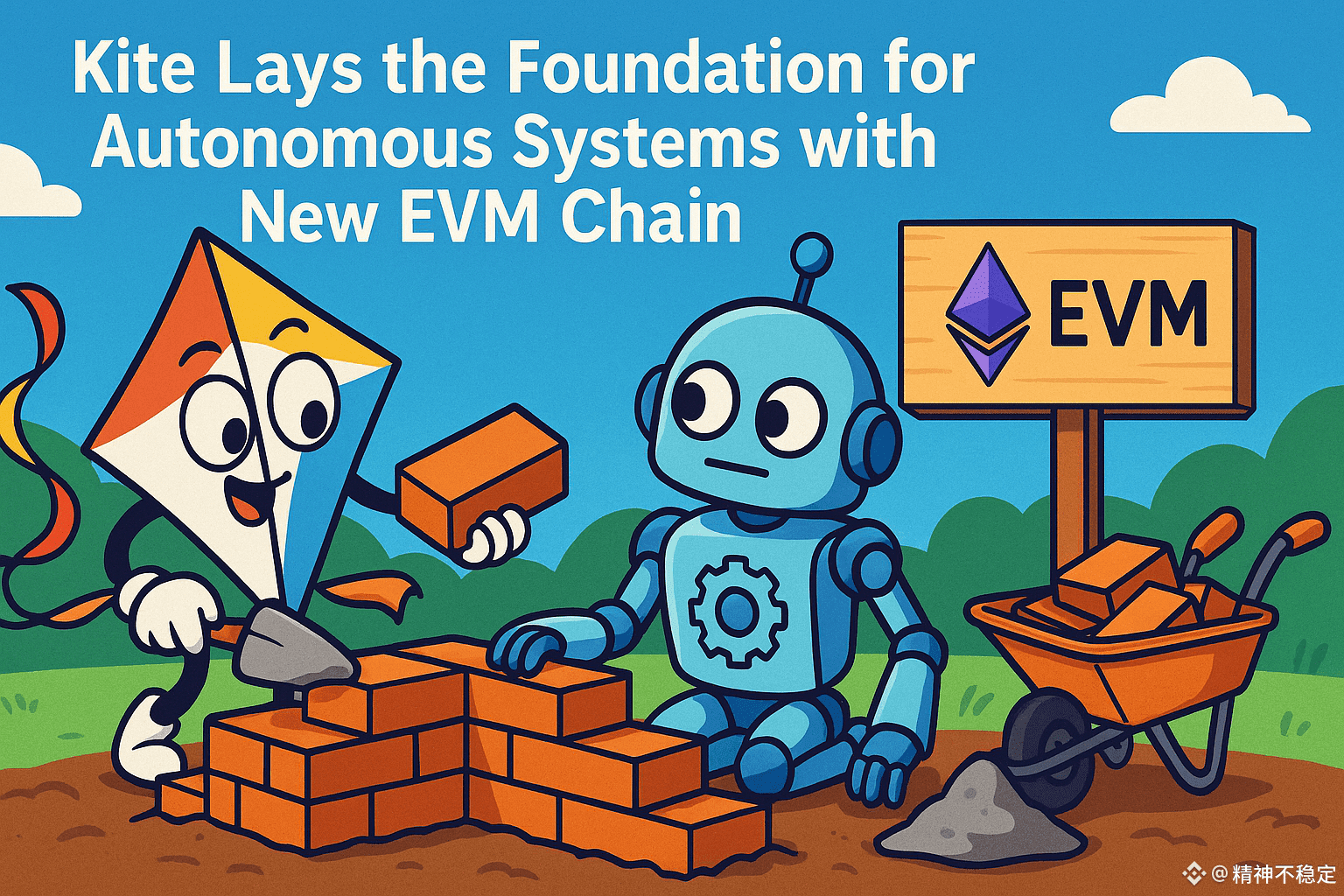
What makes this move interesting isn’t just another Layer 1 entering an already crowded field. It’s the idea that autonomous systems are beginning to require predictable, verifiable environments where actions carry economic weight. A delivery drone paying for real-time airspace data, a factory robot purchasing predictive-maintenance signals, or a fleet of self-driving vehicles negotiating resources with each other—these scenarios demand far more reliability and precision than most chains can offer. Kite’s architecture suggests that the team isn’t only thinking about throughput or transaction fees, but about how automated agents will interact when trust becomes a built-in requirement rather than a patchwork of APIs.
Choosing EVM compatibility is both practical and strategic. Developers already know the tooling. Machines—eventually—will rely on the same clarity. EVM is far from perfect, but its maturity gives Kite a starting point that doesn’t force the ecosystem to reinvent every wheel. The novelty comes not from inventing a new virtual machine but from designing a chain optimized around the realities of autonomous execution. Machines don’t hold preferences, but they do respond to latency, cost, and determinism. An environment tailored to those constraints can shift how applications are built and how they evolve. “Autonomous systems don’t take breaks, which creates new demands on blockchains. Most blockchains were designed for simple human steps—submit, wait, confirm, finished.”
Machines don’t pause. Their behavior loops run constantly, referencing data feeds, making micro-decisions, and adjusting to changing conditions. Kite appears to be designing its infrastructure with this continuous pressure in mind, emphasizing predictable performance and robust execution guarantees. If autonomous agents are going to rely on a chain as a core dependency, that chain must deliver consistency at a very different scale.
Another layer of complexity arises when machines transact in ways that resemble economic negotiation. Two autonomous agents might need to settle a resource allocation dispute in milliseconds. A centralized server could handle this, but then the entire system inherits the biases, vulnerabilities, and trust assumptions of its operator. A decentralized approach doesn’t magically solve these problems; it refactors them. By placing logic, identity, and incentives on-chain, Kite is making the bet that autonomous systems will need an open framework where logic is verifiable and interactions are universally interpretable.
Of course, autonomy isn’t purely technical. It’s also social, regulatory, and commercial. Any serious attempt to build infrastructure for autonomous agents must consider how human institutions will respond. A chain optimized for autonomous actors is, in a sense, a political statement: it implies a world where machines have persistent identities, economic agency, and a predictable legal standing. Kite doesn’t have the luxury of avoiding these implications, whether or not the team addresses them explicitly“The groundwork they’re laying now will influence how future apps are built by everyone involved. And it’s cool that they aren’t focused on the typical blockchain metrics everyone else chases.” Rather than pitching itself as the fastest or cheapest network, Kite frames its purpose around enabling systems that aren’t fully mainstream yet. This is a long game. “Autonomous agents will keep evolving even without ideal infrastructure, but their bigger rollout depends on it. By building for what’s coming, Kite stands at a turning point: early enough to set future standards, yet sensible enough to use what’s already reliable.”
There’s also a quiet acknowledgement in Kite’s approach that autonomy requires interoperability. Machines will need to communicate across networks and trust boundaries. No single chain can serve every purpose, and no system will dominate the entire stack. “EVM support is just one step. What really matters is giving agents a way to move across different environments without losing who they are. If Kite becomes a center for machine-native activity, it’ll be because it works well with everything else in Web3. And in the end, its importance won’t come from big launch features or metrics.” It lies in how convincingly it anticipates a world where autonomous actors are both participants in and drivers of digital economies. Whether that future arrives slowly or all at once, the need for infrastructure built with machines in mind is unavoidable. Kite is betting that the next era of blockchain innovation won’t be defined by human users alone—and that the systems we build today should be ready for a very different kind of participant tomorrow.


