

@KITE AI When I first encountered the idea of AI agents as independent economic actors, it felt like a thought experiment interesting on paper, but distant and ethereal. Fast forward to late 2025, and we’re already wrestling with the tangible infrastructure questions that come with that future: how autonomous systems pay each other, how micropayments happen at scale, and how we build trust between entities that never see a human in the loop. Kite AI sits at the center of this conversation, not as hype, but as a concrete effort to re-engineer the rails of digital commerce for a world where machines transact among themselves.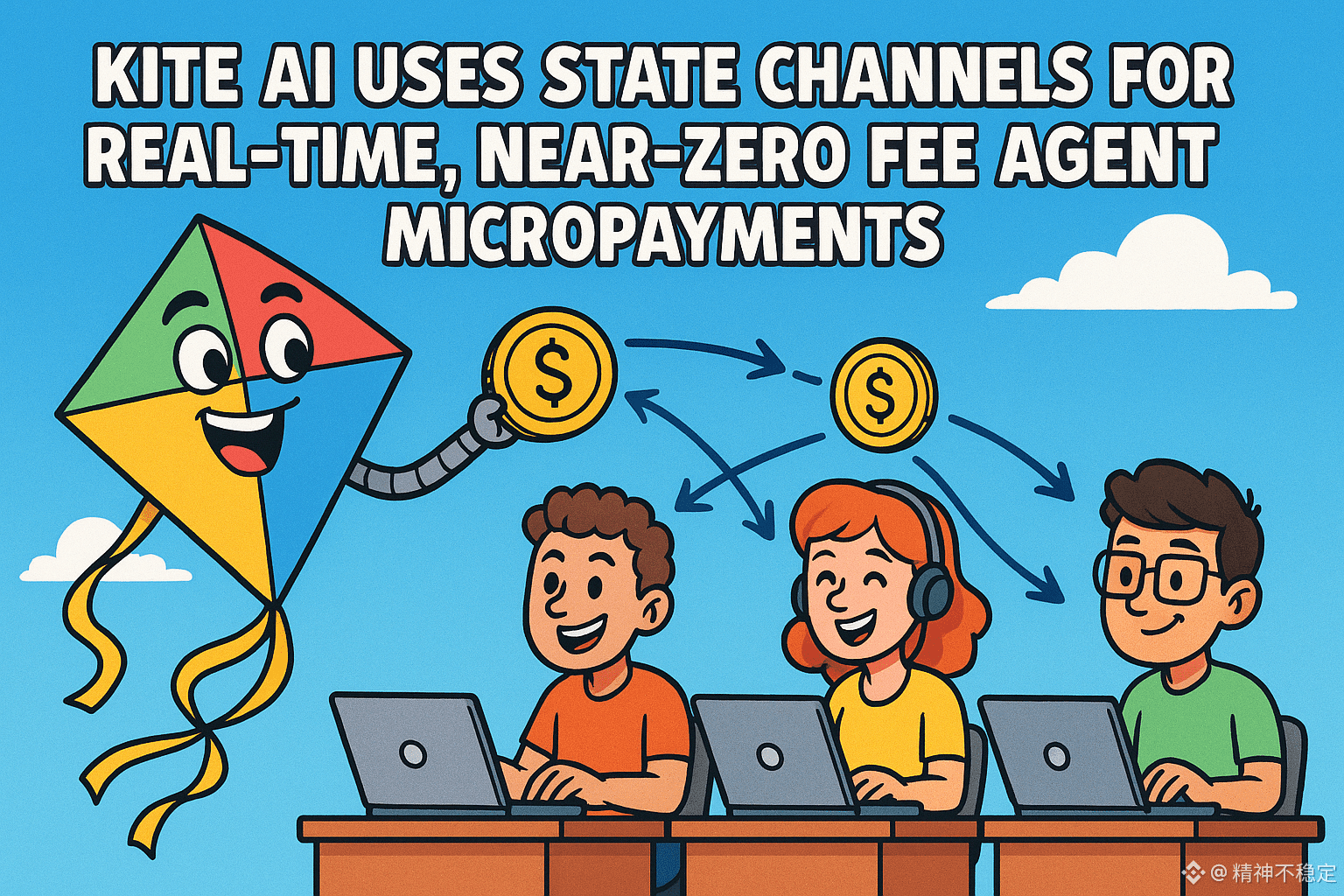
To understand why Kite’s approach matters, it helps to step back and see the problem in plain terms. Traditional payment networks — the familiar credit card processors, bank transfers, and even many blockchain systems — were all designed with humans in mind. Payments are often batch settled, expensive at tiny sizes, and tied to account ownership that assumes a human controls every transaction. An AI agent that wants to pay another agent for a few milliseconds of compute time or a slice of data can’t wait for a five-second block confirmation or pay a dollar in fees just to bill ten cents worth of work. These limitations create friction that quickly becomes a barrier once you multiply them by millions or billions of autonomous interactions. Kite’s core thesis is that this friction must be engineered away if the agent economy is to function at scale. 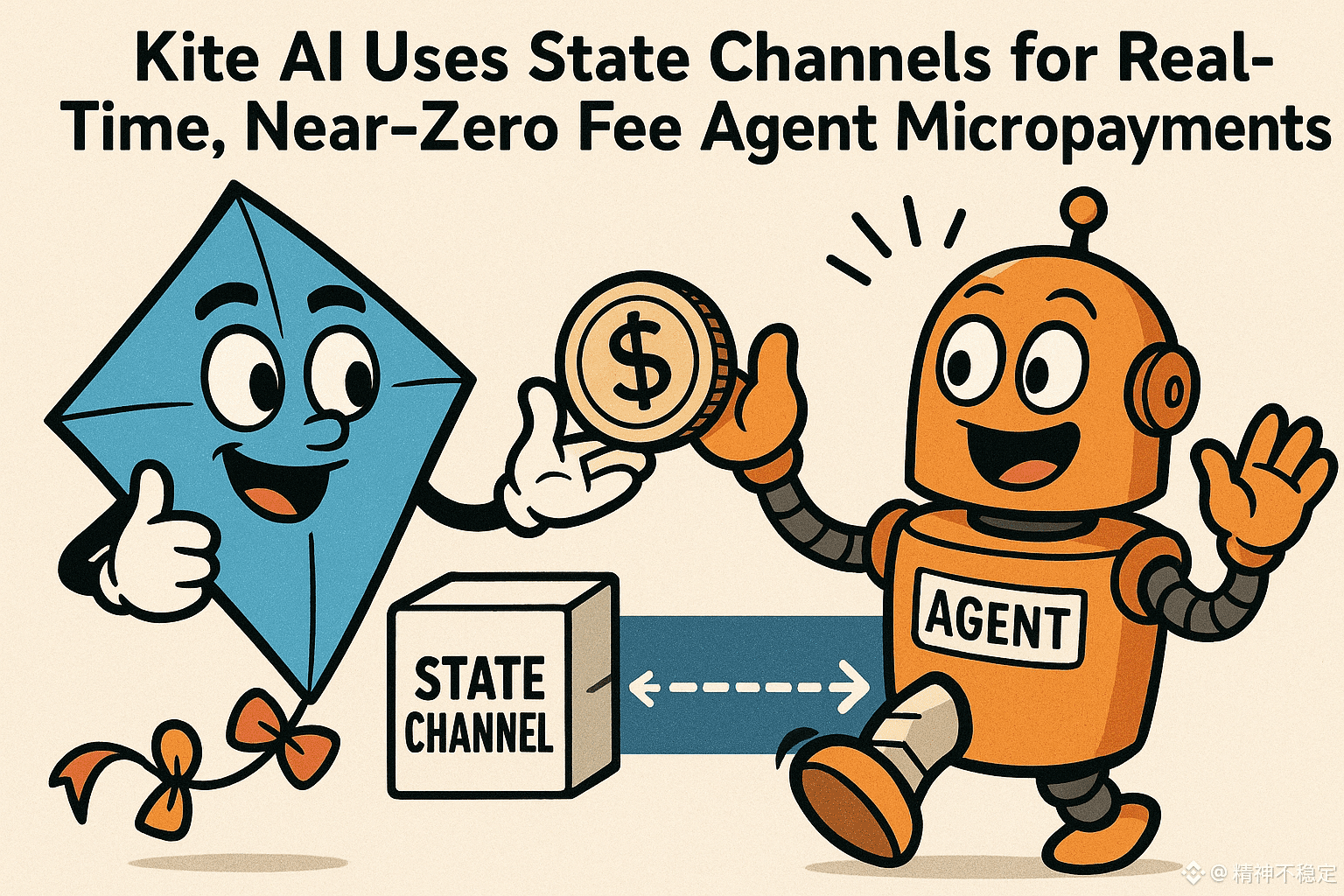
The central innovation in Kite’s design is its use of state channels — a kind of side-path where two parties can conduct many transactions locally and only touch the main blockchain when absolutely necessary. Imagine two agents that trade services constantly over a day. Instead of writing every tiny payment to the blockchain (which is slow and costly), they open a state channel: a secure agreement anchored on-chain. Inside that channel, they send each other signed updates — essentially updating who owes what. Only when the interaction settles do they close the channel and record the final outcome. The result: transactions happen immediately and cost virtually nothing on a per-transaction basis. Thousands — even millions — of micropayments can flow with the speed and cost structure that real-time machine commerce demands.
Years of working with traditional payment systems has taught me that latency and cost are the silent killers of innovation. When Stripe or PayPal charges a fee that dwarfs the value of what’s being paid for, systems evolve around that constraint. Engineers build workarounds; product teams redesign user experiences. Kite’s state channel model pushes against that constraint by design: it assumes that agents will frequently need instant settlement, and it builds a mechanism that supports that pattern. You don’t have to hope that fees stay low — the architecture guarantees it.
What’s especially intriguing about Kite is that it doesn’t just treat state channels as an add-on. The project is building its entire Layer-1 blockchain around agent-native workflows and stablecoin payments, with state channels as a first-class primitive. That means these payment rails aren’t an afterthought; they’re baked into the core transaction model. On top of this, Kite layers cryptographic identities for agents (so every agent has its own verifiable identity and reputation), programmable governance rules (defining what an agent can do on behalf of a human), and cross-protocol compatibility so agents can communicate and transact beyond a single walled garden.
I’ve always appreciated systems thinking in technology — building for the full ecosystem rather than just the standalone component. Kite’s emphasis on interoperability reflects this sensibility. The platform is designed to work not only within its own chain but with emerging standards like x402 for agent commerce and A2A protocols for agent-to-agent communication. This opens up a scenario where an agent built in one environment can transact fluidly with another in a different ecosystem, using the same low-cost, high-speed state channels. Foggy visions of the agentic future become clearer when you can imagine a travel-booking bot coordinating with a currency-conversion bot and a ticketing service, all settling value in milliseconds without a human ever clicking “approve.”
Honestly, “better tech” isn’t always enough to win users. The people side of innovation is often ignored. The teams building these systems aren’t just coders — they’re grappling with questions like: how do you reason about trust between entities that were never designed to trust each other?
What does “reputation” look like for an agent? And when each interaction costs a tiny fraction of a cent, how do companies decide what to charge? These are not trivial questions. Kite’s architecture — with its layered identity and policy enforcement — attempts to answer them, not by glossing over complexity, but by making it part of the system’s foundational logic.
From the perspective of someone who’s watched payments evolve from credit cards to digital wallets to blockchain tokens, the trend here feels less like a bubble and more like an inevitable adaptation. Just as e-commerce demanded faster clearing and settlement than legacy banking could offer, the agent economy demands a payment architecture that’s native to machines. State channels aren’t a nice-to-have; they’re a structural requirement if autonomous systems are going to operate meaningfully without human oversight.
Of course, challenges remain. Kite’s future comes down to timing and traction: launching mainnet, getting people to adopt it, and giving developers solid tools. Right now, it’s a well-designed, realistic attempt to solve a genuine technical pain point.It’s a reminder that the future of technology isn’t just about smarter AI — it’s about smarter economic infrastructure too.

