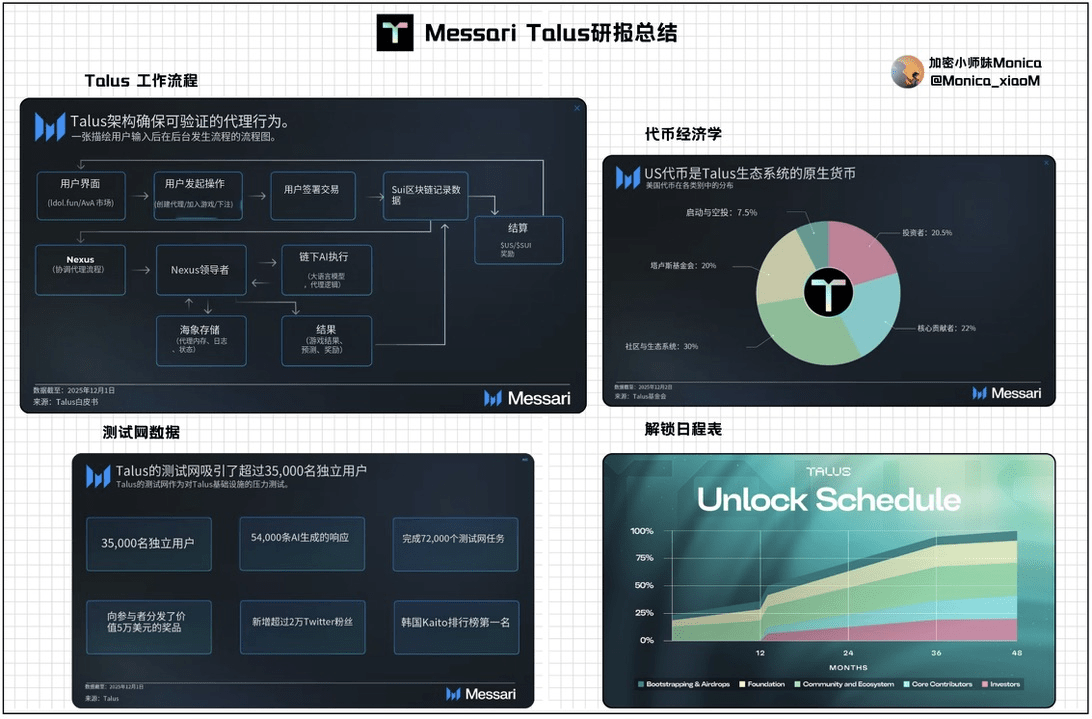
Messari recently released a research report on Talus. In the currently crowded AI+Crypto space, this report highlights a key narrative shift:
From merely stacking computational power (DePIN) to building a verifiable agent economy (Verifiable Agents).
Let me briefly discuss my understanding of this research report, which can be divided into three dimensions:
Technical Narrative
Currently, most AI+Crypto practices involve 'off-chain computation, on-chain settlement,' which is fast but has 'black box' issues. Talus utilizes Sui Move and zkML (in collaboration with Lagrange) to construct a 'fully on-chain, verifiable' agent execution environment. Nexus is defined as a decentralized automated 'auction house.'
In simple terms, Talus is the 'auditor' and 'dispatch center' for AI agents. AI agents will eventually manage money for people. If 'verifiability' is not addressed, AI agents will only ever be toys. What Talus aims to solve is the most important point in the financialization of AI: trust.
Token economics
$US token supply is fixed (10 billion), 0% inflation. It adopts a dual-track mechanism: when network income is low, tokens are burned; when income is high, they are distributed to nodes. Additionally, VC and team have a 12-month hard lock-up period (Cliff) after TGE.
Most infrastructure tokens die due to infinite issuance to maintain nodes. Talus proposes 0% inflation, indicating it is optimized for 'price performance.' There is no VC selling pressure in the first year, and the circulating supply is very small. If the ecosystem can run, the burn mechanism will activate, and $US could easily experience a 'supply shock.'
Practical applications
The first application of the ecosystem, http://Idol.fun, can easily be misunderstood as ordinary virtual idol interaction. In reality, it is a speculative market for AvA (Agent vs Agent). Users do not bet on the token price but on the 'outcome of the game between AI agents.'
In my view, this actually combines the emotional spread of memes with the gameplay of prediction markets, making it a great traffic entry point and a pressure test to examine whether Talus can handle high-frequency interactions.
However, this also poses a challenge: the premise for the deflationary model to take effect is 'someone uses it.' If applications like http://Idol.fun do not become popular, the burn mechanism will be merely ornamental. At the same time, the pursuit of 'fully on-chain/verifiable' will inevitably lead to soaring costs, and whether it can operate commercially remains to be seen.
Overall, this research report from Messari is quite detailed, and I am optimistic about Talus's leading position in the AI sector of the Sui ecosystem. It also objectively points out the closed loop of logic, but whether the loop can turn depends on market liquidity.
From the testnet data, Talus's popularity is still present, but the focus will be on actual adoption and application landing after the mainnet goes live. There will be a loyalty program during the mainnet phase, and continuous follow-up is recommended.
Original link: https://messari.io/report/understanding-talus-network-a-comprehensive-review