

Expectations for a rate cut are soaring, Bitcoin is climbing towards the $94,000 range
The cryptocurrency market is迎來 a critical moment this week, as the Federal Reserve will announce its interest rate decision this Wednesday. The market bets that there will be another rate cut of 25 basis points, with CME FedWatch data showing the probability of a rate cut as high as 87.3%.
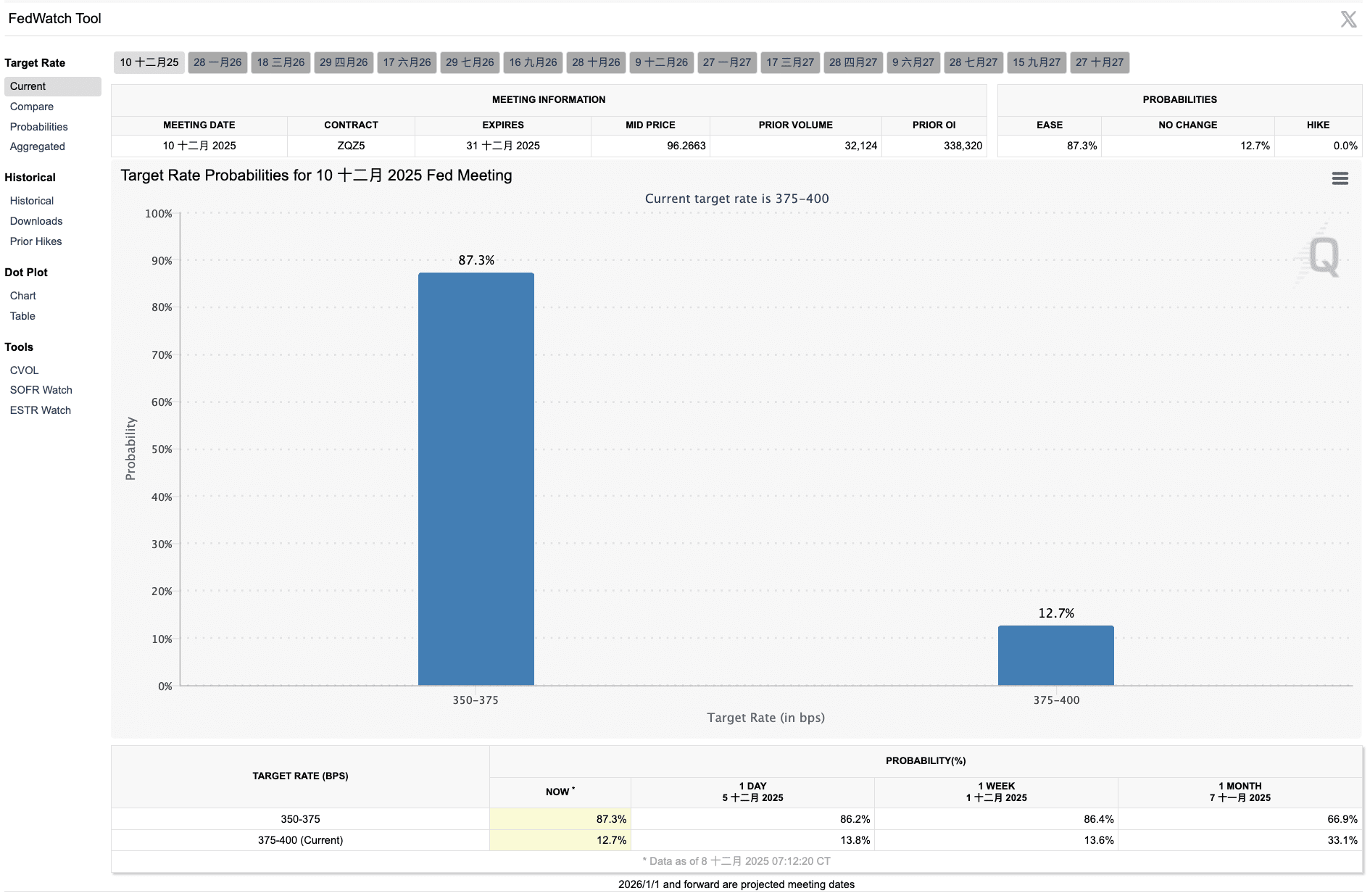 Source: CME FedWatch, the probability of a Federal Reserve rate cut is as high as 87.3%
Driven by this, Bitcoin ($BTC) rose above $92,000 during the Asian session on Monday, approaching last week's high of $94,200. Analysts believe that if Bitcoin can effectively break through the $94,000 resistance area, it is likely to challenge higher resistance levels of $101,000 and $104,000, but this is contingent on the FOMC guidance not leaning hawkish after the meeting.
From a technical perspective, Bitcoin fluctuated between 84,000 and 94,000 last week, with the weekly K line forming a doji, indicating a tug-of-war between bulls and bears. Short-term support lies at 87,200 and 84,000; if the latter is tested again, its support effectiveness will significantly weaken. Stronger support levels are found in the range of 72,000 to 68,000, extending to the key Fibonacci retracement level of 57,700. Although short-term momentum leans bullish, the monthly MACD has already shown a bearish crossover, indicating that mid-term pressure remains.
The market generally bets on a rate cut, but 'hawkish rate cuts' become the biggest variable.
If the FOMC cuts rates as expected this week, it will be the third adjustment of the policy rate this year, accumulating a total easing of 175 basis points since September 2024. Generally, a rate cut symbolizes improved liquidity and reduced funding costs, which is beneficial for driving up risk assets. However, observing the U.S. Treasury market, the 10-year yield has risen to 4.15%, indicating that the bond market has already bet on Powell possibly signaling a 'pause in the rate cut path' during the post-meeting press conference.
Analysts pointed out that if Powell emphasizes a slower pace of rate cuts in 2026 or suggests the need for more labor market and inflation data to support market easing expectations, this rate cut may become a 'hawkish cut', putting short-term pressure on risk assets. The derivatives market also shows similar warning signs: the prices of put options for Bitcoin and Ethereum ($ETH) are generally higher than those of call options, indicating that investors are still guarding against downside risks. Additionally, the 20,000 put option for Bitcoin expiring in June 2026 remains a popular choice, reflecting strong hedging demand from some traders against a long-term correction.
Key inflation data delayed, increasing difficulty in policy interpretation
The October PPI (Producer Price Index) inflation report originally scheduled for release this week has been canceled due to the inability to complete sampling during the government shutdown. The U.S. Bureau of Labor Statistics stated that it will merge the data for October and November to be released in January 2026, leaving the market lacking important inflation information during the FOMC week.
Nevertheless, most officials still rely on the recently released September Core PCE as a benchmark. This data fell below market expectations, significantly increasing the probability of a rate cut. Additionally, Kevin Hassett, who may succeed as the Federal Reserve Chair, also supported a 25 basis point rate cut in a recent interview with CNBC, enhancing the clarity of market policy signals. However, the lack of comprehensive inflation data also introduces uncertainty in policy interpretation, making it difficult for businesses and investors to accurately formulate their operational and financial plans for early 2026.
Historical warning signs: After 7 FOMC meetings this year, Bitcoin experienced significant declines in 6 instances.
Even though the market generally looks favorably on a rate cut, Bitcoin's historical trend shows another aspect. Analyst Ali Martinez compiled the market reactions after 7 FOMC meetings this year, among which Bitcoin experienced significant corrections after 6 of them, with an average decline of 15%. The largest drop was 25% after the January meeting, and the most recent was a 19% plunge after the October rate cut.
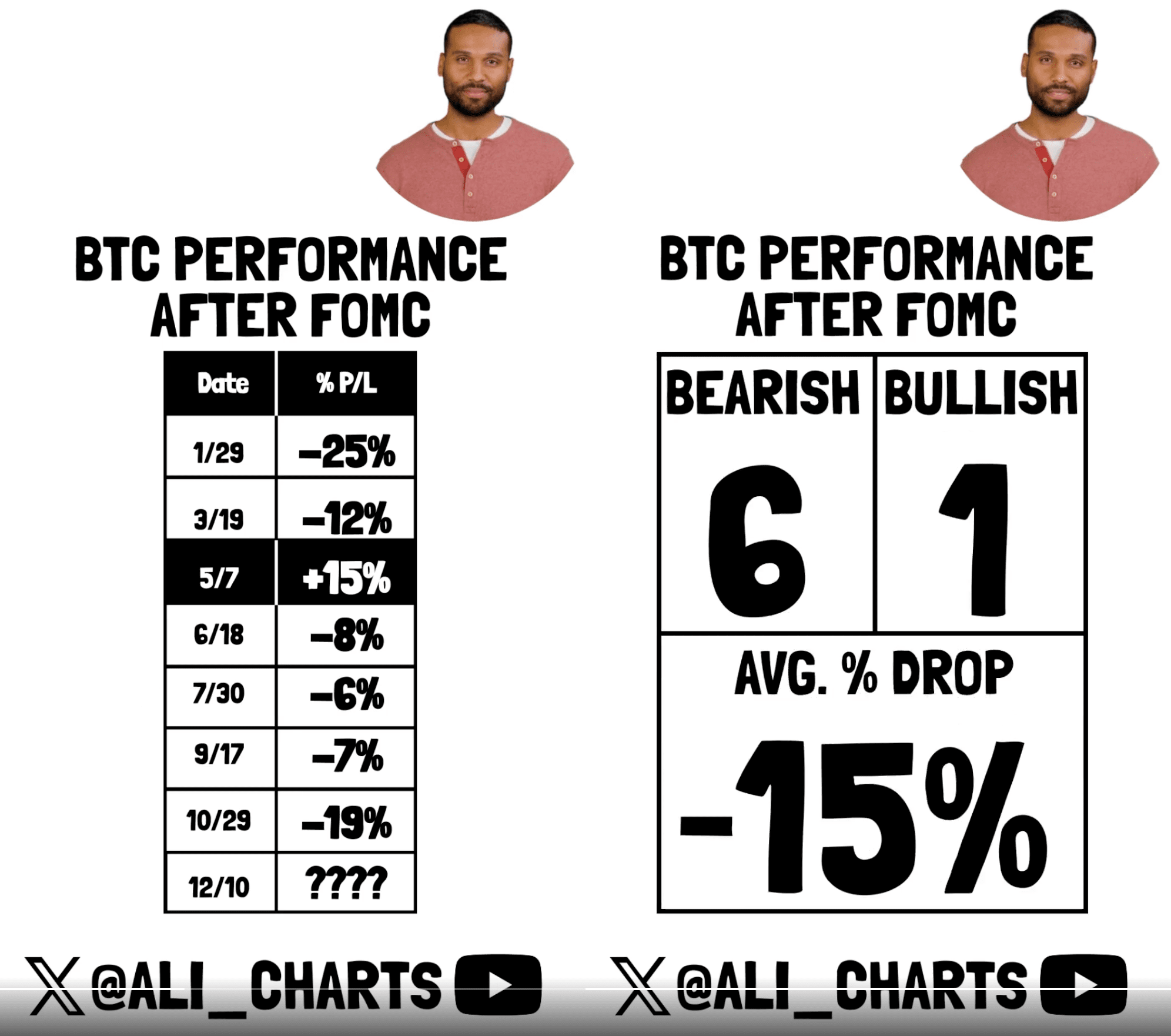 Source of the image: X/@ali_charts Analyst Ali Martinez compiled the market reactions after 7 FOMC meetings this year.
Martinez pointed out that this rate cut has already been fully reflected in prices, and what will truly influence market direction will be the description of the 2026 policy path during Powell's press conference. If the Federal Reserve suggests a slowdown in the easing cycle or expresses a stronger vigilance regarding inflation risks, the market may once again replicate the downward pattern seen in the previous six instances.
Moreover, the altcoin market clearly shows signs of fatigue. According to CoinDesk indicators, CD20 has risen by 1.34% since December, but CD80, which covers more small and mid-cap tokens, has fallen by 1.37%. Meme coins and metaverse tokens have plummeted by 53% and 62% respectively this year, indicating that funds are concentrated in mainstream assets like Bitcoin and Ethereum, and market risk appetite has yet to recover.
'What will happen to Bitcoin next? With 6 declines out of 7 FED meetings, will this week's rate cut repeat the tragedy?' This article was first published in 'Crypto City'.

