

JPMorgan issues on-chain commercial paper for Galaxy, USCP Token makes its debut
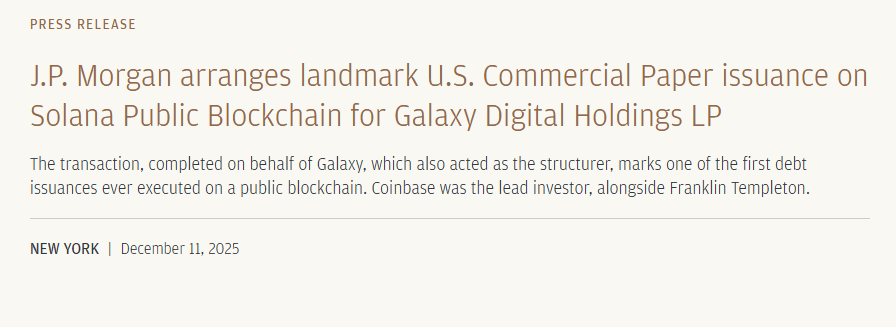
Well-known investment bank JPMorgan has announced that it has assisted crypto asset management firm Galaxy Digital's subsidiary in issuing commercial paper on the Solana blockchain, reportedly one of the first debt issuance cases fully executed on a public blockchain, marking a milestone.
This is also the first time Galaxy has issued commercial paper in the United States, and it is also the first appearance of the 'USCP Token'. JPMorgan's USCP Token is a short-term corporate debt instrument issued through the Solana blockchain, aimed at facilitating capital raising.
In the on-chain commercial paper issuance case by Galaxy, the U.S.-listed cryptocurrency exchange Coinbase played a key multi-faceted role, acting not only as the custodian and wallet service provider for USCP tokens but also jointly investing with asset management giant Franklin Templeton, which has also been early in the tokenization field, having previously launched a tokenized money market fund.
How do on-chain commercial papers and USCP work?
How do Galaxy's notes and USDP tokens specifically work? Officials reveal that JPMorgan is responsible for issuing tokenized assets representing debt and handling settlements, while Galaxy's investment banking division is responsible for creating the issuance structure.
The issuance and redemption of these tokenized assets will be paid using the USD stablecoin USDC issued by Circle.
JPMorgan has already laid out its strategy in the blockchain and tokenization market.
Although JPMorgan's CEO was previously a Bitcoin skeptic, the investment bank had already laid out blockchain technology behind Bitcoin early on. JPMorgan developed JPM Coin as early as 2019 and launched its blockchain division Onyx in 2020.
The department has now been integrated under the Kinexys brand, having previously collaborated with partners like BlackRock and Siemens to execute blockchain-based repurchase transactions, cross-border payments, and tokenized asset settlements.
This time, JPMorgan is further pushing real-world financial instruments onto public blockchain infrastructure by launching USCP tokens on the Solana chain.
The tokenization market is projected to be worth 18.9 trillion dollars, but WFE holds a conservative view.
In recent years, the financial circle has witnessed a trend of "RWA tokenization," which is a technology that converts real financial assets (debt, funds, equity, real estate, etc.) into digital tokens on the blockchain, enabling them to be traded and managed on digital platforms.
Proponents of tokenization believe it can bring efficiency improvements and faster settlement speeds to the financial industry.
Predictions from Boston Consulting Group (BCG) and Ripple indicate that by 2033, the market size for tokenized assets could skyrocket to 18.9 trillion dollars.
However, the World Federation of Exchanges (WFE), representing major global stock exchanges, has recently reminded twice about the risks of tokenization, stating that many tokenized stocks are marketed as "equivalent to real stocks," but in reality, most are nominally held and do not enjoy shareholder rights.
Further reading:
The Exchange Federation wrote to the SEC: There should be a tightening of the crypto exemption mechanism, and warned about the risks of tokenized stocks.
In Taiwan, the Financial Supervisory Commission and the central bank are open to tokenization, allowing financial institutions like Cathay to experiment with the issuance of tokenized assets, and the central bank has also collaborated with the Central Securities Depository to conduct deeper technical integration, hoping to secure a place in the global wave of tokenization.
Further reading:
Central Bank Governor: TWQR, wholesale CDBC, and tokenization will be promoted together, stablecoins are like modern wildcat banks.
"Milestone for the financial industry! JPMorgan issues on-chain commercial papers for Galaxy, USCP tokens debut" was first published in "Crypto City".


