


Hashkey, a Hong Kong-compliant exchange, is about to list on the Hong Kong Stock Exchange with a valuation of HK$19 billion, but a close reading of the prospectus reveals many problems. For example, regardless of how badly HSK's stock price falls in the market, the company's balance sheet will not be affected, concealing the risk of token price volatility.
Researchers further warned that Hashkey's list of total digital assets did not detail the proportions of Bitcoin, Ethereum, and its own token, HSK. This means outsiders cannot know how much of its assets consist of highly liquid mainstream cryptocurrencies and how much is HSK, which is issued by the company itself and has lower liquidity. The author adds: This risk is very similar to that of FTX and FTT in the past.
Furthermore, Hashkey utilizes the concept of "breakage" to prematurely recognize revenue, thus beautifying its financial statements. This is similar to purchasing Starbucks gift certificates; if you set a target of 95% of people not using them, you can legally "launder" that 95% of liability into revenue even when very few people actually use them.
(HashKey, a Hong Kong-compliant exchange, will officially list on December 17th, with a valuation of HK$19 billion.)
The first exchange to issue its own token and list it on the stock exchange, Hashkey's on-chain revenue is only one dollar.
As Hashkey is the world's first exchange to issue its own platform token and list its stock on the stock market, the role of the HSK token after its listing is attracting considerable attention. On page 53 of the document, Hashkey defines HSK as the Hashkey platform token, used to pay gas fees on the Hashkey Chain. However, as we mentioned before, the HashKey Chain is a "dead public chain," generating only $1 in public chain revenue and a TVL of only $1.21 million in 24 hours, meaning there is practically no activity on the chain.
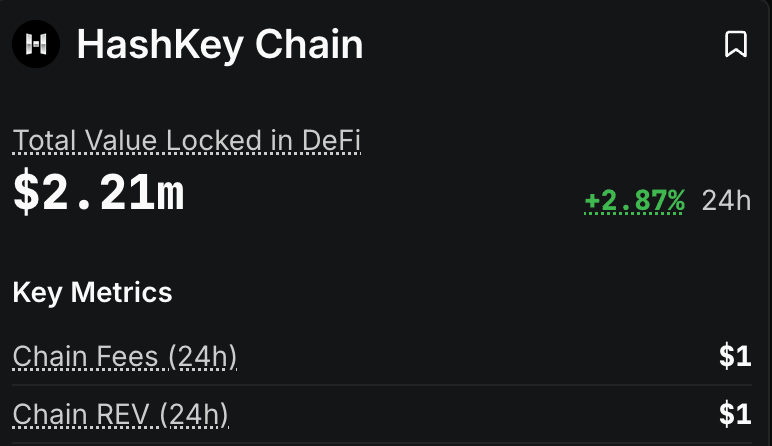
(Hong Kong-compliant exchange HashKey is about to IPO! Data reveals years of losses and a 90% plunge in its platform token)
On page 425 of the document, Hashkey states, "Although we committed in the HSK white paper to use 20% of our net profit to repurchase and destroy HSK from the market, no repurchases were made during the period as we have not yet met the repurchase conditions."
In layman's terms, if Hashkey, which has been losing money for years, finally turns a profit, 80% of its value will go to stocks and 20% to HSK tokens. Hashkey is valued at HK$19 billion (approximately US$2.44 billion). Multiplying this by 20%, we get a market capitalization of around US$490 million for HSK. Given its current circulating market capitalization of US$100 million, a FDV of US$400 million seems like an undervaluation.
No matter how badly HSK's stock price falls, it won't be reflected on Hashkey's balance sheet.
However, researcher Lacie analyzed Hashkey's positioning of HSK from an accounting perspective. As is well known, issuing tokens is equivalent to issuing debt. HashKey treats tokens as service vouchers. When issuing HSK tokens to users or KOLs, it's not considered a cash handout in accounting, but rather a company owing users future services (e.g., future transaction fees that can be offset with tokens). Therefore, issuing tokens immediately adds a contractual liability to the balance sheet. This represents the company's obligation to fulfill its obligations.
The value of HSK, which is listed under liabilities, is locked and will not be adjusted based on fluctuations in the HSK price on the secondary market (exchanges). Therefore, no matter how much HSK's price falls in the market, the company's balance sheet will not be affected, thus concealing the risk of token price volatility.
Researchers expose how Hashkey manipulates financial statements using accounting standards.
He further stated that Hashkey prematurely recognized revenue from anticipated non-usage to beautify its financial statements. This is the biggest point of contention raised in the article. For liabilities to be converted into revenue (recognition of revenue), users typically need to actually "use" the tokens (e.g., to offset transaction fees). However, the article points out that the actual usage rate is extremely low (less than 2%). To make revenue look better, HashKey used the following accounting techniques:
Rule of thumb: According to the concept of "breakage" in IFRS 15 accounting standards, if a company expects that customers will not exercise their rights (i.e., will not use the tokens), the company can recognize this part of the liability directly as revenue in proportion.
How it works: HashKey sets an extremely low "expected usage rate" (only 5%, as mentioned in the text). In other words, the company assumes that 95% of the tokens issued will not be used.
Result: Based on this assumption, the company can directly convert approximately 95% of the token value issued from "liabilities" to "revenue." This allows the company to significantly increase its book revenue even without actual business growth (few users are using the tokens).
The author adds that this scenario can be illustrated by Starbucks gift certificates: You sell 100 yuan worth of gift certificates, but based on historical data, you expect only 5 yuan to be used to buy coffee (expected usage rate of 5%), and the remaining 95 yuan will be lost or forgotten by customers (expected non-usage rate of 95%).
In accounting, when a customer spends the $5, you recognize $5 in revenue. What about the remaining $95? Does it remain on the books as a debt indefinitely? No. IFRS 15 stipulates that when you recognize the $5 "revenue for use," you must proportionally recognize the remaining $95, which is not expected to be used, as revenue at the same time.
In fact, 100% of the amount will eventually become revenue. It's just that 95% is "released" into the revenue statement under the guise of "breakage," following the usage pattern of the remaining 5%. Therefore, by setting a high non-use rate, a large amount of debt can be recognized as revenue in advance, which is logically sound in accounting. If you set a target of 95% non-use, you can legally "launder" that 95% of debt into revenue even with very few actual users.
He raised a question: In this situation, if you were the hashkey, would you pump and dump HSK?
He further questioned the total amount of digital assets listed in the prospectus, noting the lack of a detailed breakdown of the proportions of Bitcoin (BTC), Ethereum (ETH), and its own token (HSK). It remains unclear how much of its assets are highly liquid mainstream cryptocurrencies and how much is HSK, a token issued by the company itself with lower liquidity.
The author adds: If one still remembers, one of the problems with FTX's Alameda Research back then was that its assets were over-concentrated in FTT.
(Alameda’s assets and liabilities have been out of balance sheet, and it holds 60% of FTT’s total circulating shares. It is suspected that it will become insolvent if it encounters another major fluctuation.)
There is a serious mismatch between the trading volume of compliant exchanges worldwide and the company's market capitalization.
Hashkey has compiled a market overview of compliant exchanges worldwide on page 161 of the document, which includes:
Company A: Upbit
Company B: Coinbase
Company C: Bithumb
Company D: Kraken
Company E: Bitvavo
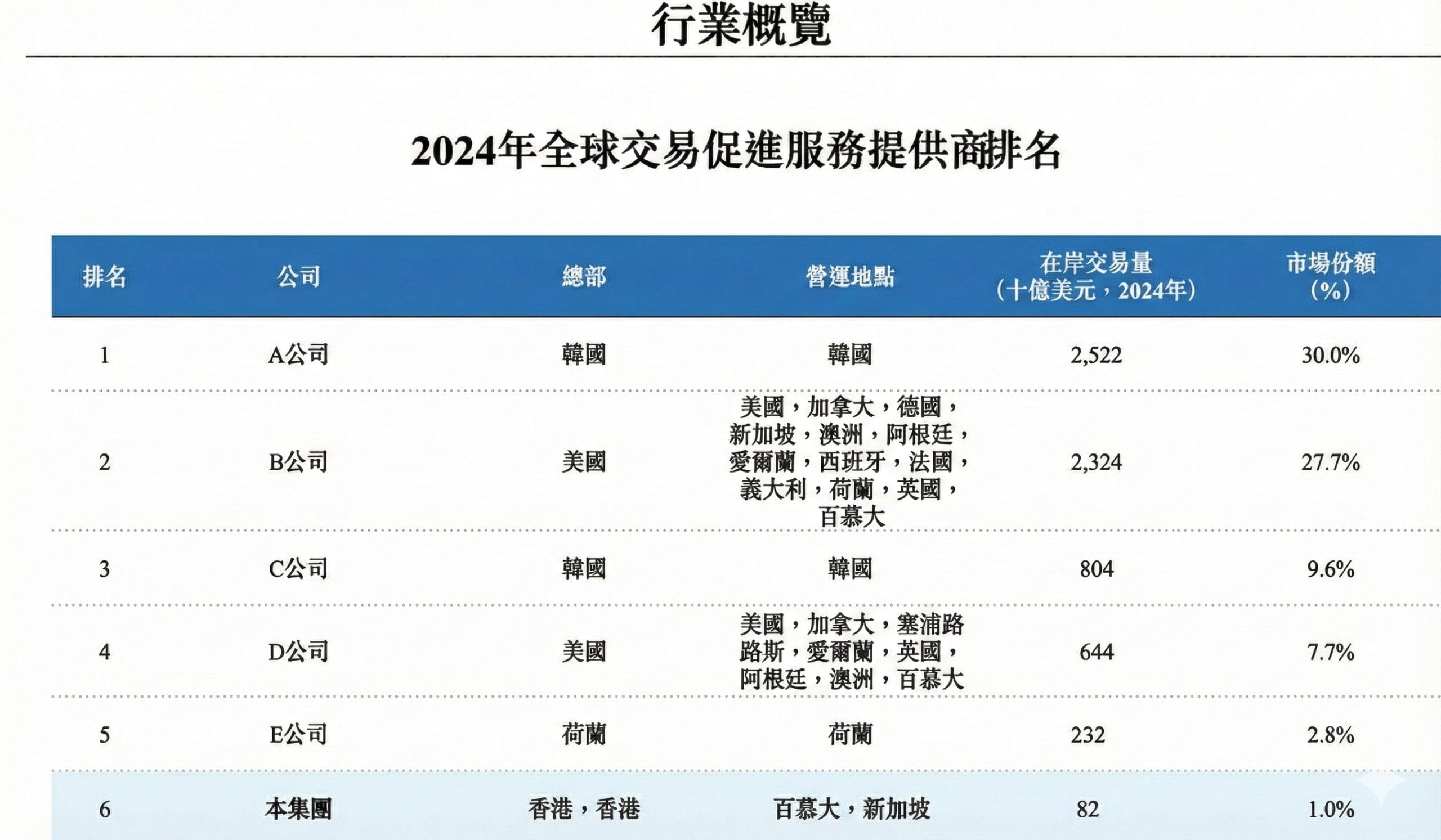 Source: Hashkey Translation: Gemini 3
This table reveals an interesting fact: the world's largest compliant exchange by trading volume is surprisingly South Korea's Upbit, not the US's Coinbase. Upbit's company filings reveal a combined valuation of $13.6 billion. Meanwhile, the publicly traded Coinbase has a market capitalization of $75.4 billion. Coinbase's trading volume is only 92% of Upbit's, yet its market capitalization is 5.5 times that of Upbit.
(Innovation can truly transform wealth! Song Chi-hyung and Kim Hyung-nyeon became billionaires thanks to Upbit.)
Company D in the table, Kraken, is currently seeking an IPO with a latest valuation of $20 billion. This means Kraken's trading volume is only a quarter of Upbit's, yet its valuation is 1.47 times that of Upbit. Finally, looking at the protagonist of this IPO, Hashkey, its valuation is HK$19 billion, approximately $2.44 billion. Hashkey's trading volume is only 3.2% of Upbit's, but its market capitalization is about 17% of Upbit's.
(Kraken's valuation surges to $20 billion: Citadel contributes $200 million, accelerating IPO process in 2026)
It is worth considering whether this severe mismatch between market capitalization and market share reflects the compliance barriers and costs in different countries, or whether it implies the ceiling of the service areas of these exchanges.
This article, "Hashkey's IPO Next Week on the Hong Kong Stock Exchange! Researchers Warn of Two Major Risks: Seriously Beautified Financial Statements and Lack of Asset Transparency," first appeared on ChainNews and ABMedia.


