

OCC issued a significant interpretive letter, allowing banks to act as 'riskless intermediaries' for crypto assets.
The Office of the Comptroller of the Currency (OCC) officially released Interpretive Letter 1188 on Tuesday, opening a crucial door for national banks to enter the cryptocurrency market.
This document clearly states that national banks can participate in 'riskless principal' transactions involving crypto assets, meaning banks are allowed to act as intermediaries for customers buying and selling cryptocurrencies without bearing the risk of asset price fluctuations.
According to the OCC's definition, a so-called risk-free party transaction refers to a bank purchasing assets from one customer and simultaneously selling them to another customer.
In this model, banks will not list crypto assets in their inventory; they essentially act as brokers or agents, only temporarily holding assets in very few cases of settlement failure.
The release of this guideline symbolizes a decisive step in the process of integrating crypto asset businesses into the traditional banking system. The OCC analyzed the legal basis for such activities in detail in the letter, viewing them as a natural extension of the 'business of banking.'
Regulators cited Section 24 of Volume 12 of the U.S. Code, pointing out that banks have long engaged in similar risk-free transactions in the securities market, and it is entirely reasonable to extend this logic to non-security crypto assets.
The OCC emphasizes that these services are highly similar to traditional brokerage and custody businesses, providing customers with a channel to enter the cryptocurrency market through regulated entities, while effectively reducing the risks faced by customers when trading on unregulated platforms.
For banks, this means they can leverage existing settlement and risk management infrastructures to explore new revenue sources without significantly increasing balance sheet risks.
Traditional financial giants rush in, with PNC and Bank of America taking the lead in deploying crypto services.
With the regulatory red light turning green, traditional financial giants in the U.S. have quickly taken action to integrate crypto services into their core businesses. PNC Bank announced shortly after the OCC guidelines were released that it has become the first major U.S. bank to offer direct Bitcoin trading services to eligible private banking clients through its own platform.
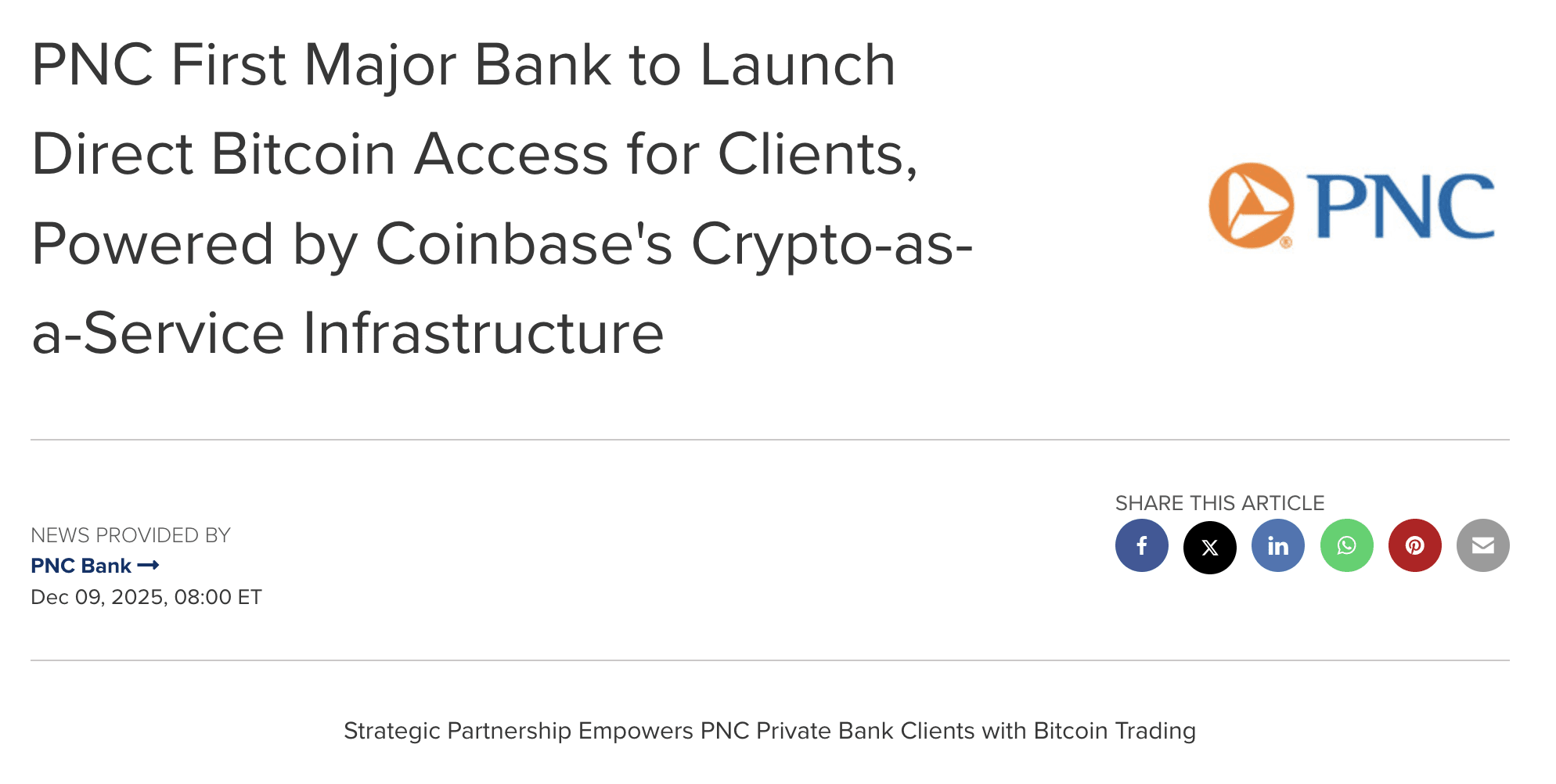 Source: PR Newswire PNC announced it has become the first major U.S. bank to offer direct Bitcoin trading services to eligible private banking clients through its own platform.
This service is based on the strategic partnership established between PNC Bank and Coinbase in July, utilizing Coinbase's infrastructure as underlying support, allowing customers to safely buy, hold, and sell Bitcoin without leaving the banking system. This move by PNC is seen as a milestone for traditional banks entering the crypto trading industry, breaking the previous limitation that banks could only offer related ETFs or fund products and achieving true direct exposure to assets.
At the same time, Bank of America also announced a significant policy adjustment last week, allowing its wealth management department's clients to allocate 1% to 4% of digital assets in their portfolios. This new regulation applies to Merrill, Bank of America Private Bank, and the Merrill Edge platform, directly granting over 15,000 financial advisors the authority to actively recommend crypto assets to clients.
In the past, these advisors were often unable to engage with the crypto industry due to internal compliance policies, but the current open policy indicates that internal recognition of digital assets as a legitimate and necessary asset class is rapidly increasing. Analysts point out that this shift is consistent with the OCC's decision in March this year to remove the requirement for banks to obtain 'prior approval' for engaging in specific crypto businesses, as well as the release of Interpretation Letter No. 1186 in November, allowing banks to hold a small amount of crypto assets to pay for blockchain operational expenses (such as gas fees), demonstrating that the ongoing relaxation of the regulatory environment is injecting strong confidence into the market.
Further reading
U.S. banks give the green light to crypto investments! Advisors can recommend clients to allocate up to 4% in crypto assets.
The U.S. Office of the Comptroller of the Currency: Banks can pay blockchain gas fees with cryptocurrencies, enhancing on-chain integration efficiency.
Regulatory logic shifts towards risk control, clarifying the lines between securities and non-securities assets.
In the OCC's released Interpretation Letter No. 1188, it not only granted banks operational authority but also meticulously outlined the regulatory logic, particularly in distinguishing between 'security-type' and 'non-security-type' crypto assets. The letter clearly states that risk-free party transactions involving crypto assets classified as securities have long been permitted under existing securities laws; the focus of this interpretation letter is to explicitly expand this authority to non-security crypto assets.
The OCC believes that, despite the differences in asset classes, the nature of the risks faced by banks when handling such transactions is the same, mainly focused on counterparty credit risk, particularly settlement risk. With decades of experience in managing these types of risks, banks are capable of conducting business under a secure and sound framework.
However, openness does not mean laissez-faire. The OCC repeatedly emphasizes in the document that banks must establish risk control measures that are as strict as those for traditional financial businesses when engaging in such activities. This includes having robust cybersecurity protocols, anti-money laundering (AML) compliance procedures, and monitoring mechanisms for operational risks. Banks must confirm the legal compliance of each transaction before engaging in it and ensure that the activity falls within the scope of their charter.
The OCC conveyed a clear message through this document: regulators support financial innovation, but these innovations must be integrated into the regulated banking system, rather than growing rampantly in a legal gray area. This strategy of 'banking' crypto activities aims to enhance the transparency and stability of the entire crypto market by introducing bank-level compliance standards, thereby protecting consumers from potential harm from unregulated entities.
Breaking free from 'Operation Choke Point 2.0', Coinbase and Circle's bank license applications are in the spotlight.
This policy shift by the OCC is widely interpreted as a concrete manifestation of the U.S. government's transition from the 'Operation Choke Point 2.0' accused during the Biden administration to the pro-cryptocurrency policies of the Trump administration. Over the past few years, the crypto industry has been complaining that regulators have been informally pressuring banks to cut ties with crypto companies.
However, with the Trump administration taking office and pledging support for the digital asset industry, the attitude of federal regulators underwent a 180-degree turn. OCC Acting Comptroller Jonathan Gould explicitly stated in a public speech on December 8 that cryptocurrency companies seeking a federal bank charter should be treated on par with traditional financial institutions.
He believes that the banking system has the capacity to evolve and there is no reason to treat digital asset businesses differently from traditional banking businesses, as banks have been providing custody services electronically for decades.
In this friendly regulatory atmosphere, 14 institutions have submitted applications to the OCC for a national trust bank charter, including crypto exchange giant Coinbase, stablecoin issuer Circle, and blockchain payment company Ripple. If these heavyweight companies successfully obtain banking licenses, they will fundamentally change the competitive landscape of the crypto industry, enabling direct access to the federal payment system, reducing reliance on third-party banks, and significantly improving capital operational efficiency.
Gould's statements and the OCC's continuous release of friendly guidelines greatly enhance the likelihood of approval for these applications. The market widely expects that as we approach 2026, U.S. regulators will continue to update their crypto asset framework, further eliminating barriers between traditional finance and digital assets, and the OCC's Interpretation Letter No. 1188 is undoubtedly a crucial piece in this financial transformation puzzle. Banks, fintech companies, and crypto-native enterprises will closely monitor subsequent regulatory developments, preparing for a more integrated new financial era.
'The OCC allows crypto business, banks can conduct risk-free matchmaking, accelerating crypto's integration into mainstream finance.' This article was first published in 'Crypto City.'

