
I have been in the cryptocurrency field for a full ten years. In the first three years, I personally reduced the principal of 1,000,000 to less than 300,000, and this painful loss nearly plunged my family into a desperate abyss. During that time, I stayed home for nearly two months, isolated from the world, while my wife's frequent arguments and threats of divorce only added to the misery. Fortunately, with my indomitable will, I firmly believed I could turn everything around.
In the fourth year, I resolutely resigned from my job, deciding to use the remaining 300,000 as a gamble, fully dedicating myself to cryptocurrency trading. I made a solemn vow to my wife, promising to turn the tide, or I would willingly accept all consequences.
Since then, I have devoted myself to learning and practicing, deeply reflecting on past mistakes and operational oversights. I carefully observe and study the investment strategies and techniques of those predecessors in the cryptocurrency circle, gradually finding my own trading path. After relentless efforts, my account finally began to turn profitable. The hardships and difficulties along the way from losses to gains can only be understood by myself.
I began to adopt a strategy combining the medium and short term, abandoning the previous blind quick in-and-out approach, and instead creating a detailed plan for the account. I firmly believe that combining medium and short term is the best way to achieve stable asset appreciation. Thus, relying on wisdom and persistence, I gradually accumulated from the initial capital of 300,000 to now, with the account balance skyrocketing to over 85.7 million.

Before discussing technical patterns, I strictly followed the following 9 rules of engagement:
1. Buy sideways, buy pits, don't buy vertically; the selling point is where the market is boiling.
Buy when the price is sideways or declining, and avoid chasing after high prices. At the same time, sell when market sentiment is boiling.
2. Continuous small rises are genuine; exit during continuous large rises.
A slight rise may represent a genuine market rebound, while a continuous large rise may indicate a bubble. Therefore, hold during small rises, but consider exiting during large rises.#BitDigital转型
3. A sharp rise should be followed by a pullback; do not dig deep holes or buy too much.
When the price rises sharply, pullbacks often occur; it is better to buy on the retracement rather than chasing at high levels.
4. Accelerated rises should see tops; sell quickly during sharp declines and gradually sell during slow rises.
Accelerated price increases during a major rise may indicate that the trend is about to end, and one should pay attention to top signals. During sharp declines, one should sell promptly, while during slow rises, one can gradually sell.
5. A sudden drop with low volume is intimidation; sell quickly during a gradual drop with increased volume.
When the price drops sharply but the trading volume is low, it may be caused by market panic, and one can choose to hold. Conversely, when the price drops slowly but the trading volume increases, it may indicate that short selling pressure is increasing, and one should exit promptly.
6. When the price breaks through the lifeline, do not hesitate to swing trade.
When the price breaks through a significant support or resistance level, large fluctuations may occur, and it may be worth considering short-term swing trading.
7. Pay attention to daily, weekly, and monthly charts; follow the main force to earn money.
Carefully observe the price movements across different time frames and trade according to the flow of major funds.
8. If the cryptocurrency price rises without volume, the main force is luring buyers; do not stand guard.
When the price rises but the trading volume does not increase, it may indicate that the main force is luring buyers, and caution should be exercised to avoid being trapped.
9. A low volume new low is a bottom; enter when volume increases.
When the price declines but the trading volume decreases, it may indicate the formation of a bottom, and buying may be considered. Conversely, when the price rises and trading volume increases, it may signal the start of an upward trend, and one should enter the market promptly.
Chart patterns are an indispensable part of technical analysis. One of the most basic structures is the '1-2-3 reversal pattern.' The 1-2-3 pattern is quite common and often appears at many price reversal points.
What is the 1-2-3 pattern?
The 1-2-3 chart pattern consists of three segments of price fluctuations (three-wave structure), each segment creates a pivot point. The name '1-2-3' comes from these three pivot points. At first glance, this pattern seems unremarkable. After all, any fluctuation in market prices will occasionally create pivot points. However, if you can identify and confirm the 1-2-3 pattern, it can help you anticipate potential reversals in advance.
What does the 1-2-3 reversal pattern look like?
Here is an example of the 1-2-3 reversal pattern:
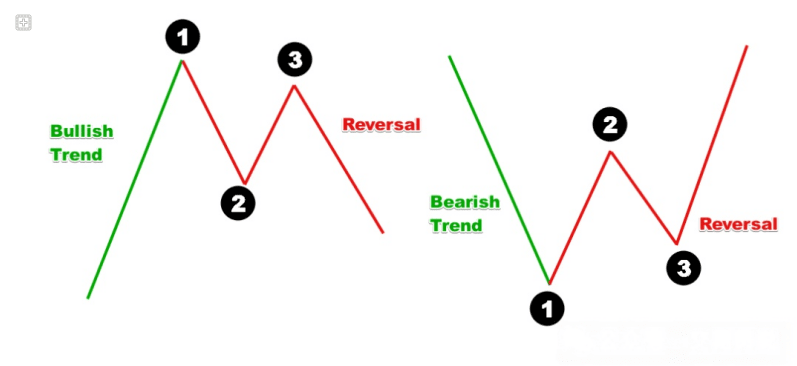
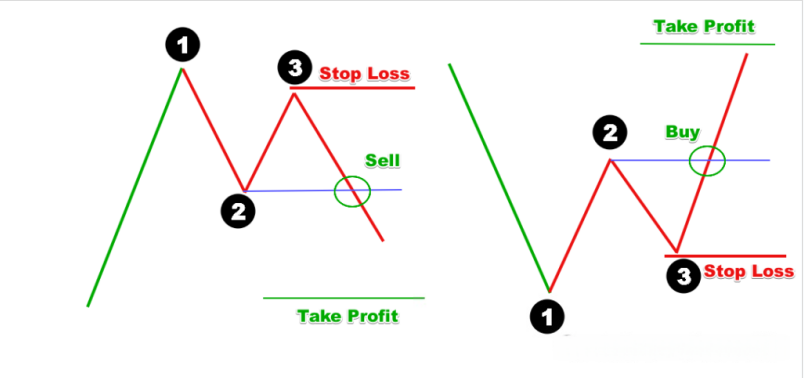
The 1-2-3 reversal pattern typically manifests in two scenarios: in the first structure, the original uptrend reverses to a downtrend; in the other structure, the original downtrend reverses to an uptrend.
You may have noticed that the structural parameters of the 1-2-3 pattern are very similar to those of double tops and double bottoms. In fact, when used as a reversal pattern, the 1-2-3 pattern essentially becomes a deformed double top or double bottom pattern.
The structure composition of the 1-2-3 pattern
The 1-2-3 chart structure includes a three-wave structure (forming three pivot points) and a confirmation breakout.
Pivot Point 1
This is the first turning point in the trend. Each time a trend pullback starts, it may become a potential pivot point 1. If a 1-2-3 pattern is valid, then after forming pivot point 1, the price is likely to break through the original trend line.
Pivot Point 2
The following turning point often appears outside the previous trend line or channel. This is usually a good signal that the trend may end and reverse.
Pivot Point 3
Pivot Point 3 is crucial for confirming the 1-2-3 reversal pattern. This is because it is the last key component in the structure of this pattern. In an effective 1-2-3 reversal pattern, pivot point 3 will not exceed pivot point 1; in the worst case, it will be on the same level as pivot point 1. When pivot point 3 approaches pivot point 1 but does not touch it, it indicates a stronger structure of the 1-2-3 reversal pattern.
Confirmation point
The confirmation point tells us: 'Hey! The 1-2-3 pattern may have formed; now could be a good entry opportunity!' The confirmation point is at the horizontal position of pivot point 2. If the price breaks through the confirmation point in that direction, the pattern is considered established.
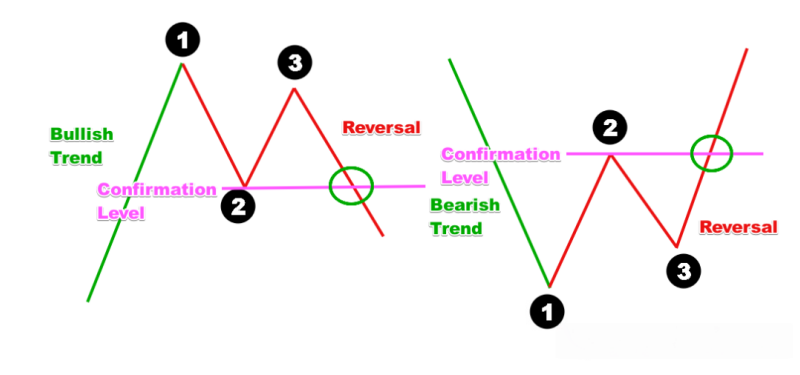
The above illustration shows an example of confirming a 1-2-3 pattern reversal. When the price breaks through the extreme position near pivot point 2, the pattern is confirmed, and the green circle in the chart indicates that moment.
Target price
When trading the 1-2-3 pattern, your target price should usually be equidistant with the 'height' of the entire 1-2-3 pattern. Starting from the confirmation point, project that distance outward to obtain the approximate target price area.
How to measure the size of the 1-2-3 pattern
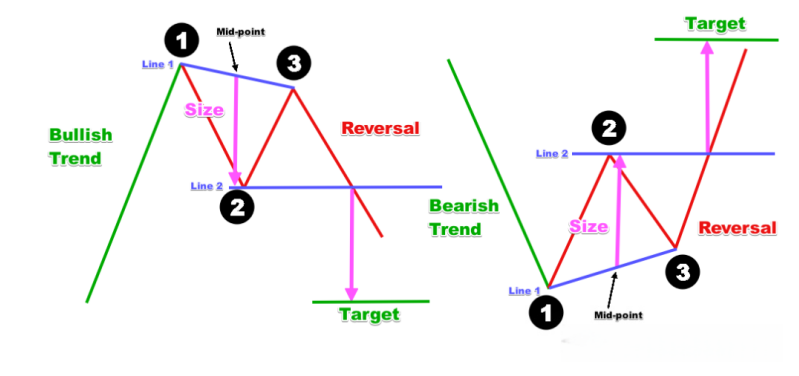
To measure the size of this pattern, you need to draw a few reference lines yourself.
✔ Segment 1: Connects pivot points 1 and 3.
✔ Segment 2: A horizontal line that passes through pivot point 2.
The size of the 1-2-3 pattern equals the vertical distance between the midpoints of segments 2 and 1.
The two purple lines in the chart represent segments 1 and 2 respectively. The pink arrow indicates the application of the amplitude of the 1-2-3 chart pattern after the price confirms the pattern; the green horizontal line shows the area we expect the price to enter.
Stop loss settings for the 1-2-3 pattern
Whether it is the 1-2-3 pattern or other pattern trades, stop losses must be used. The stop loss for the 1-2-3 pattern should be placed near the area of pivot point 3. In highly volatile markets, prices may sometimes briefly pierce pivot point 3 and then return to the right track.
You obviously do not want the stop loss to be triggered due to such a 'false breakout,' so a smarter move is to place the stop loss slightly outside pivot point 3.

In the above illustration, the red horizontal line indicates the ideal stop loss area when trading the 1-2-3 reversal pattern. If it is a bearish pattern, the stop loss should be set above the high point of pivot point 3; if it is a bullish pattern, the stop loss should be below the low point of pivot point 3.
In the illustration below, we also marked the approximate take-profit area in 1-2-3 pattern trading. This level is also calculated using the previously mentioned 'amplitude measurement' method. Thus, you have mastered all the key trading price levels of the 1-2-3 reversal chart pattern.
Using the oscillating indicator for the 1-2-3 trading strategy
The 1-2-3 reversal pattern is very suitable for use with oscillating indicators. The reason is that oscillators can identify extreme market states, thereby further confirming the possibility of a trend reversal. The approach is simple: match the reversal signals of the 1-2-3 reversal pattern with the reversal signals provided by the oscillating indicators.
Taking RSI (Relative Strength Index) as an example.
If in an uptrend and the chart is forming a potential 1-2-3 reversal pattern, we will look for overbought signals on the RSI. This can yield stronger reversal confirmations, thus increasing the success rate of the pattern.
Conversely, if the trend is down and a 1-2-3 reversal pattern appears, we will attempt to match this signal with the RSI's oversold signal.
We can also obtain another type of signal from the RSI—the regular divergence signal. When the 1-2-3 pattern signal coincides with RSI divergence, it significantly increases the odds of the 1-2-3 reversal pattern trade.
Moreover, using price action analysis to assist decision-making is also very important. After all, identifying the formation of other chart patterns often provides additional reference value at critical moments.
Next, let's look at an example of a 1-2-3 strategy that combines RSI and price action.
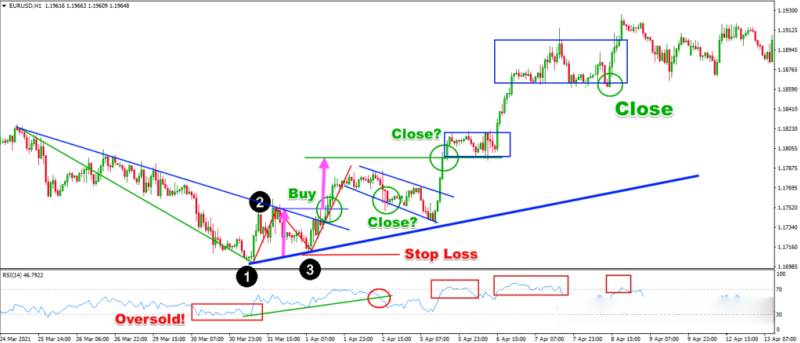
The above image is the H1 (1-hour) chart of Euro/USD. The bottom of the chart shows the RSI indicator.
The black 1-2-3 points mark the three pivot points of the 1-2-3 pattern; the structure marked by the blue box in the chart represents other chart patterns that we will refer to in our trading analysis.
The progress of things is as follows:
We identified a downtrend on the chart (blue descending trend line). Initially, the first two pivot points may not be easy to recognize. However, when the price forms a higher low at pivot point 3 and subsequently closes a candlestick that breaks through the blue descending trend line, it will trigger some bullish judgments. At the same time, the first rectangle on the RSI indicator shows that the market is in an oversold state.
Next, we find that the price suddenly broke through the trigger line of the 1-2-3 pattern, which can be seen as a signal to go long.
We set the stop loss below pivot point 3 and set the take profit at the position equal to the amplitude of the pattern (indicated by the pink arrow).
Notice that the price initially did not touch the green take-profit line. Instead, the price first experienced a pullback and formed a flag chart pattern (blue downward channel). It is worth noting that during the same period, the RSI, although it broke its green trend line, had not yet entered the overbought zone.
Note that stop loss orders remain valid throughout the process and have not been triggered.
Subsequently, the price broke out of the flag consolidation and eventually reached our take-profit line. If you did not use a take-profit order in the trade but relied entirely on price action to decide the exit position, then you might analyze the price movement like this.
The price then enters another phase of sideways consolidation and pushes up again. At the same time, the RSI gives a strong overbought signal. The market begins to consolidate, and we see a candle close below the lower edge of the consolidation range, which is a clear signal to close the position.
If you close the position near the target price, this trade can yield about 45 points of profit.
If you did not close the position at the target but chose to continue holding based on strong price action, then in this case, the profit would reach about 108 points.
The interesting part of this trading case is that the performance of the 1-2-3 reversal pattern is very similar to a double bottom structure. Our trading method is also very close to the classic double bottom pattern operation.
The 1-2-3 pattern as a continuation pattern
Although we typically view the 1-2-3 chart pattern as a reversal pattern, it can also serve as a trend continuation pattern. In other words, sometimes the signals it emits do not indicate a trend reversal, but rather that the market is undergoing a gentler correction and will continue to move in the original direction thereafter.
Let's return to the structure of the three pivot points.
When the price forms pivot point 3 and briefly changes direction, two situations will follow, and we need to judge them separately:
Situation #1: Potential trend reversal
This is the situation we discussed earlier—trading the 1-2-3 pattern as a reversal pattern. If the price breaks above the level near pivot point 2, it will confirm a potential reversal and trigger a reversal trade.
Situation 2: Potential trend continuation
Another possibility is that the price fails to effectively break through pivot point 2, or only slightly breaks through and quickly falls back; this structure is more likely to be a gentle correction. When the price breaks through pivot point 3, it will signal a trend recovery. In this case, consider continuing to trade in the original trend direction.
Stop loss settings for 1-2-3 continuation trades
If you trade the 1-2-3 pattern as a trend continuation pattern, the stop loss should be placed outside pivot point 2.
Setting the target price for the 1-2-3 continuation pattern
The measurement method remains unchanged:
✔ Segment 1: Connects pivot points 1 and 3.
✔ Segment 2: A horizontal line that passes through pivot point 2.
✔ The vertical distance between segment 2 and the midpoint of segment 1 is the measure of the pattern's amplitude.
But because the current confirmation is for trend continuation, this amplitude measurement should be applied in the direction of trend continuation. The starting point of the target price should be calculated from pivot point 3.
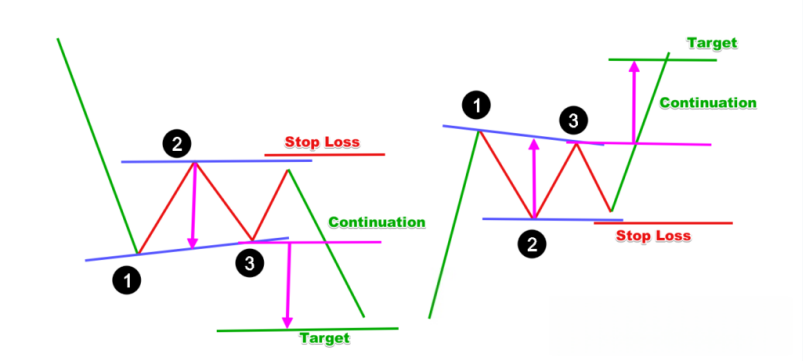
In many cases, the continuation version of the 1-2-3 pattern will exhibit characteristics of wedges, flags, or triangles.
1-2-3 continuation pattern trading strategy
Let's apply this variant to the Forex 1-2-3 pattern strategy with the RSI indicator.
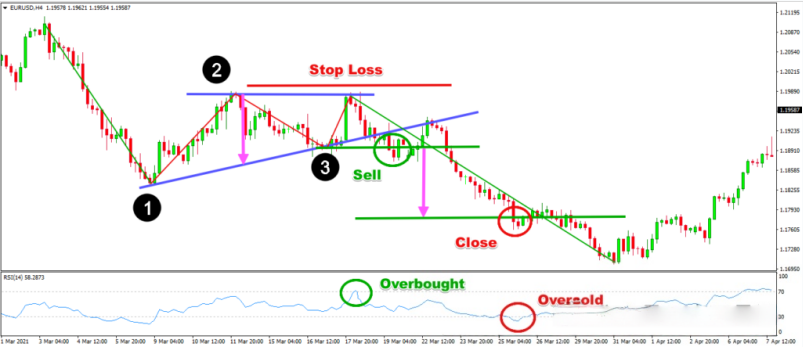
Let's look at the 4-hour chart of Euro/USD. The bottom of the chart also shows the RSI indicator.
The beginning of the chart shows a clear downtrend. Subsequently, the price enters a consolidation phase. We confirmed the presence of pivot points 1, 2, and 3. However, this time the price failed to break through the resistance level at pivot point 2, instead turning down and breaking below pivot point 3's level. In this case, we judge that the 1-2-3 trading pattern is more likely to act as a trend continuation pattern rather than a reversal pattern.
At the same time, the RSI indicator has given an overbought signal, further reinforcing the bearish expectations on the chart. This is a good short opportunity.
The stop loss should be set above pivot point 2. The target price needs to apply the amplitude of the pattern downwards from the confirmation position of pivot point 3. We determine the target by measuring the size of the pattern and projecting downwards from the confirmation point (indicated by the pink arrow).
After the confirmation signal appears, the price forms a pullback and turns the original support at pivot points 1 and 3 into resistance, which is another stronger short signal.
When the price reaches the target position, the RSI indicator has already signaled oversold, which is a very good reason to close the position.
Interestingly, when serving as a trend continuation pattern, the 1-2-3 structure here is very similar to a typical ascending triangle pattern, and our trading method is also consistent with the handling of ascending triangles.
Conclusion
✍ The 1-2-3 chart pattern is very common in price action and usually appears as a reversal signal.
✍ The 1-2-3 pattern consists of three pivot points.
✍ The confirmation point of the 1-2-3 pattern is at pivot point 2.
When trading the 1-2-3 pattern, the target price should be based on the pattern's amplitude and start calculating from outside pivot point 2. The stop loss should be set outside pivot point 3.
✍ The structure of the 1-2-3 reversal pattern is similar to double tops or double bottoms.
✍ The 1-2-3 chart pattern works better when combined with oscillating indicators (such as RSI).
✍ Combining price action techniques can effectively enhance the quality of using the 1-2-3 pattern.
✍ The 1-2-3 pattern can also be used as a trend continuation pattern.
✍ As a continuation pattern, the confirmation level is at pivot point 3.
The target price should also be based on the pattern's amplitude, starting from outside pivot point 3. The stop loss should be set outside pivot point 2.
✍ The structure of the 1-2-3 continuation pattern is similar to consolidation structures such as triangles, wedges, or flags.
This is the trading experience that Yan An shares with everyone today. Many times, you lose many profitable opportunities due to your doubts. If you do not dare to boldly try, engage, and understand, how can you know the pros and cons? You only know what to do next after taking the first step. A warm cup of tea, a piece of advice, I am both a teacher and your chatty friend.
Fate brings us together; knowing each other is another matter. I firmly believe that destiny will lead us to meet, while separation is the will of heaven. The journey of investment is long, and momentary gains and losses are merely the tip of the iceberg. Remember that even the wisest can make mistakes, and the foolish may gain from their errors. Regardless of emotions, time will not pause for you. Put aside your worries and rise again to move forward.
The martial arts secret has been given to everyone; whether you can become famous in the arena depends on yourself.
Everyone must save these methods and watch them again. If you find them useful, you can share them with more people who trade cryptocurrencies around you. Follow me to learn more valuable insights from the cryptocurrency world. After getting caught in the rain, I wish to hold an umbrella for the traders! Follow me, and let’s walk together on the path of cryptocurrency!


