
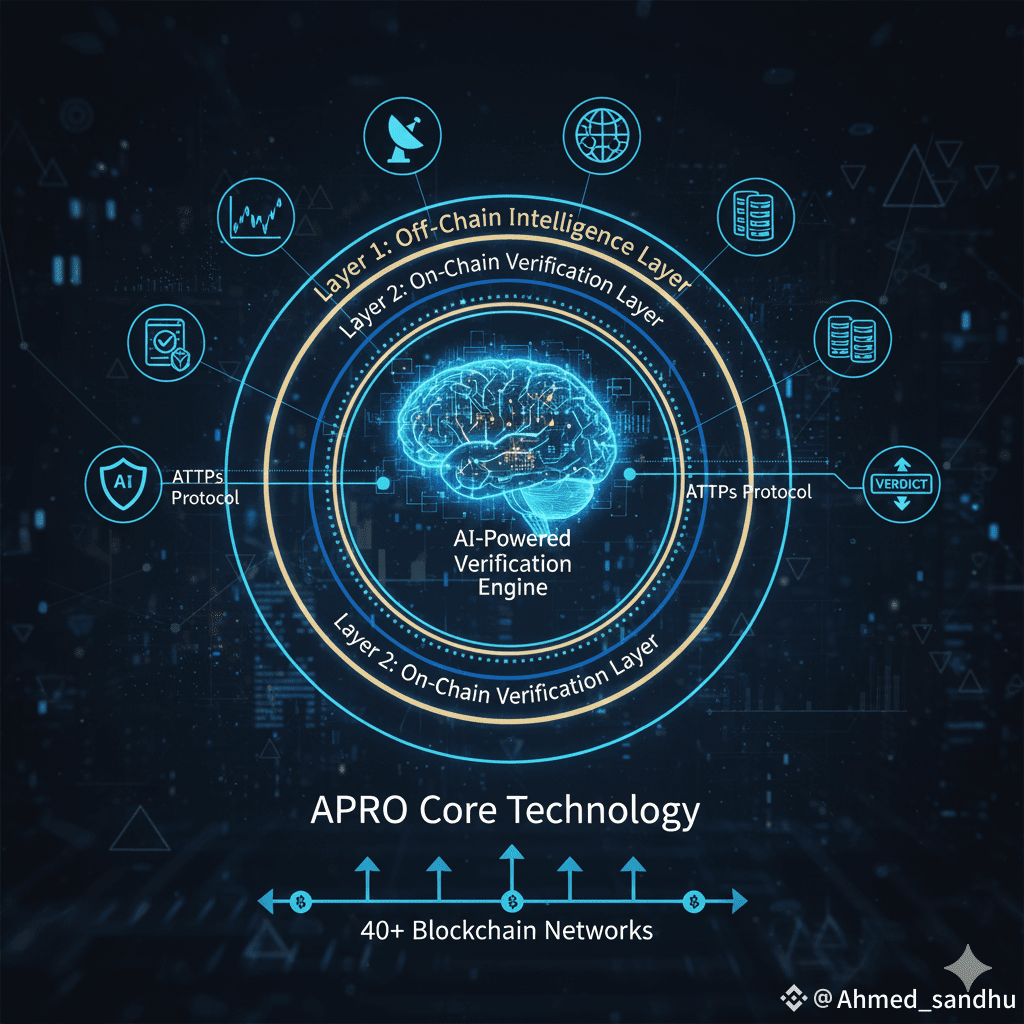
APRO’s Core Technology and Innovation: Engineering Web3’s Intelligence Layer
APRO Oracle is not merely an incremental update to existing oracle technology; it represents a paradigm shift toward an Intelligent Oracle System. By fusing decentralized data aggregation with sophisticated Artificial Intelligence (AI) verification, APRO is engineering a new layer of infrastructure designed to meet the high-speed, high-stakes requirements of modern DeFi, AI-driven agents, and the emerging Real-World Asset (RWA) market.
The core of APRO's innovation lies in its multi-layered architecture, which elevates data from a simple feed to a truly verified and cryptographically secure reality-check for the blockchain.
1. The Hybrid Dual-Layer Architecture
APRO's foundational technology is a dual-layer network that separates the resource-intensive tasks of data processing from the critical function of on-chain verification, ensuring both efficiency and security.
Layer 1: The Off-Chain Intelligence Layer (Data Aggregation & Computation):Function: This layer consists of decentralized Node Operators who collect raw data from a vast array of sources (exchanges, institutional APIs, IoT networks).
Innovation: Complex processes like data filtering, statistical aggregation (e.g., Time-Weighted Average Price), and initial security checks are performed here. This off-chain computation is fast and cost-effective, preventing the main blockchain from being clogged by heavy processing loads.
AgentText Transfer Protocol Secure (ATTPs): A specialized protocol used by APRO's AI agents for secure, standardized communication and data transmission, addressing the inherent lack of verification standards in AI-to-AI communications.
ions.
Layer 2: The On-Chain Verification Layer (Verdict & Settlement):Function: This layer receives the final, computed data consensus from Layer 1. It is responsible for final on-chain verification and delivery to smart contracts.
Innovation: This layer is secured by $AT token staking and slashing mechanisms. It acts as an arbitration network (often called the Verdict Layer), intervening to recompute and settle disputes when data feeds diverge significantly, guaranteeing the final output is robust and tamper-proof.
of.
2. AI-Powered Verification Engine
The most disruptive technology APRO introduces is the integration of Machine Learning (ML) models to act as an active, intelligent data security layer—a capability missing in earlier oracle generations.
Anomaly and Manipulation Detection: The AI engine continuously analyzes incoming data streams against historical patterns and current market metrics.If a node attempts to submit data that is a statistical outlier or indicates a sudden, inexplicable jump (like a flash loan attack), the AI flags it instantly.
This proactive filtering ensures that erroneous or manipulated data is quarantined before it can harm a dApp, making the network self-auditing and dynamically adaptive to new attack vectors.
rs.
Source Reconciliation: In scenarios where multiple high-quality sources conflict, the AI performs a weighted consensus calculation, prioritizing the most reliable, high-volume sources to deliver a true, high-fidelity price feed.
3. Multi-Chain and Ecosystem Flexibility
APRO is architected for the expansive, multi-chain future of Web3, offering superior flexibility compared to single-chain solutions.
Cross-Chain Capability: APRO natively supports 40+ blockchain networks, including Ethereum, BNB Chain, Solana, and key Bitcoin ecosystem layers like the Lightning Network and Runes protocol. This multi-chain support is crucial for the interoperability needed for global finance.
Dual Data Delivery Models: To serve diverse application needs, APRO offers two distinct methods for data delivery:Data Push: Continuous, real-time data streams (low latency) for high-frequency applications like derivatives trading and algorithmic liquidations.
Data Pull: On-demand data requests, which are more cost-efficient for event-driven applications like insurance payouts or occasional asset valuation.
on.
4. Economic Security and Shared Collateral
Security is enforced through economics, where node operators are incentivized to be truthful and penalized for dishonesty.
Staking and Slashing: Node operators must stake the native $AT token as collateral. Reporting incorrect data leads to their staked tokens being "slashed" (taken away), creating a powerful economic deterrent against malicious behavior.
Verifiable Randomness: APRO provides cryptographically secure and verifiable randomness, which is essential for fair play in decentralized gaming, NFT minting, and the creation of unbiased cryptographic systems.
Conclusion: A Leap to Oracle 3.0
APRO's core technology—its hybrid dual-layer, AI-powered verification, and multi-chain architecture—establishes a new benchmark for decentralized data integrity. By moving beyond simple aggregation to actively verify and intelligently filter data, APRO is not just solving the Oracle Problem; it is building the Intelligent Truth Layer that will power the next generation of highly automated and secure DeFi, RWA tokenization, and AI applications.
Would you be interested in seeing a comparison of APRO's core features against a traditional oracle network?


