In the fast-moving, information-exploding world of cryptocurrencies, 'heat' and 'traffic' are almost equivalent to the code for wealth. As the world's largest cryptocurrency exchange by trading volume, any minor action from Binance and its executives can create enormous waves in the market. However, this unparalleled influence is a double-edged sword; it is both the cornerstone of Binance's success and makes it a target for opportunists, exploiters, and even attackers.
A series of recent events—from co-founder He Yi's WeChat account being hacked, to internal employees using official accounts for 'mouse warehouses' operations, to a careless typo by a senior executive giving birth to a meme coin with a market value of tens of millions of dollars—undoubtedly point to one core phenomenon: everyone in the crypto circle wants to ride on Binance's heat.
External attacks
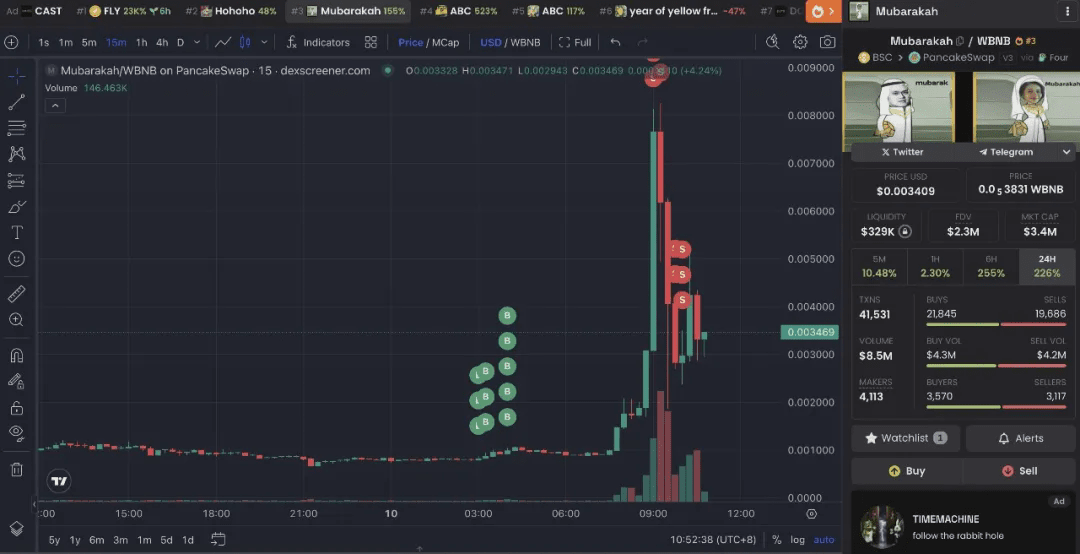
One of the triggers of the incident was the hacking of the WeChat account of Binance's new co-CEO He Yi. It was reported that a WeChat account, linked to He Yi's old phone number and no longer in use, was hacked into late at night on December 9. The hacker then exploited He Yi's significant influence in the crypto circle to promote an unknown meme coin named 'MUBARA' (also known as Mubarakah) widely in their friend circle and chat groups, creating the illusion that He Yi was personally 'calling the shots.'
On-chain data analysis firm Lookonchain quickly tracked the complete path of this scam. The data shows that about seven hours before the scam messages began to spread, two newly created wallet addresses (0x6739 and 0xD0B8) had quietly spent approximately 19,479 USDT to purchase 21.16 million MUBARA tokens on the decentralized exchange Pancake Swap. After the false endorsement of He Yi's account fermented in the community, the price of MUBARA surged from about $0.001 to $0.008 within minutes, with its market capitalization briefly hitting $8 million, attracting a large number of uninformed retail investors to buy in at a high price.
Just as market liquidity peaked, hackers began to sell off large amounts of tokens. Data from Lookonchain indicates that the attacker sold 11.95 million MUBARA, cashing out 43,520 USDT, even though they still held tokens worth about $31,000, resulting in a paper profit close to $55,000. This was a textbook 'Pump-and-Dump' scheme, and He Yi's personal reputation became a cheap tool for the hackers to harvest retail investors.
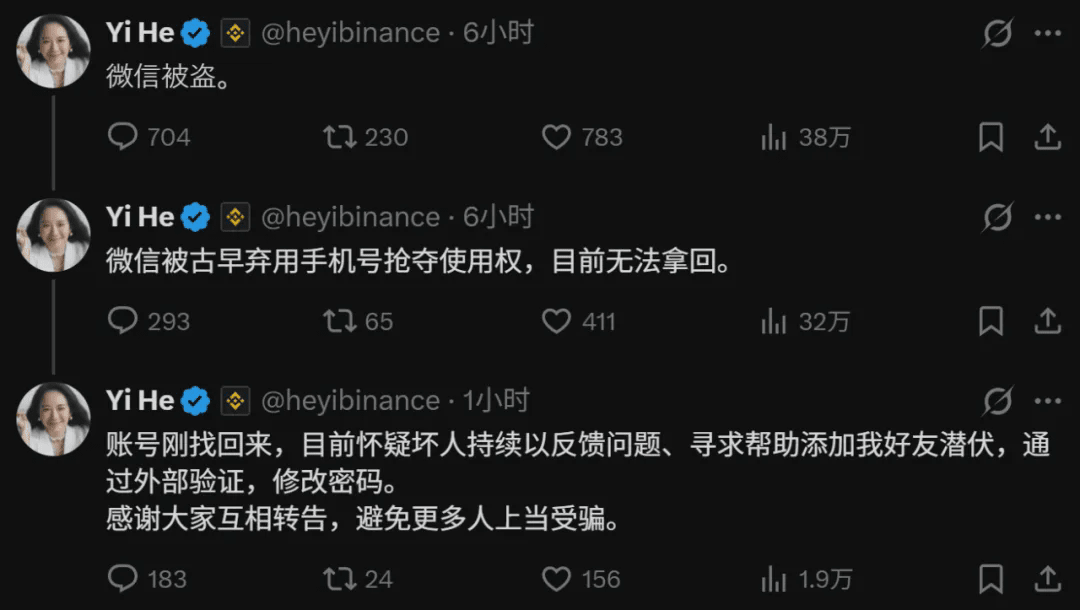
After the incident, Binance founder Zhao Changpeng (CZ) and He Yi quickly reacted. CZ warned users on the X platform: 'The security of Web2 social media is not that strong. Please stay safe! Do not buy meme coins mentioned in hacker posts.' He Yi clarified that the account had already been abandoned and could not be recovered due to the takeover of the phone number, reminding everyone not to trust any related token promotions. This incident starkly revealed that, in the current market environment, the digital identities of top industry leaders have become highly valuable targets for attacks.
Internal corruption
If external hacker attacks are a threat that is difficult to completely prevent, then corruption from within is even more alarming. Almost simultaneously, another, more serious incident of this nature was uncovered within Binance.
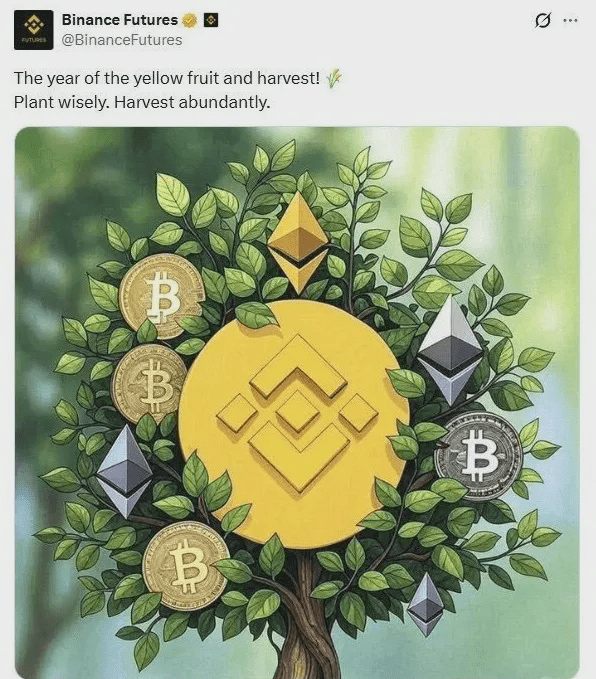
On December 7, a community user discovered that the official X account of Binance Futures published a post at 1:30 PM that contained an image and text stating, 'The year of the yellow fruit and harvest!' However, on-chain data shows that a meme coin with the same name and image, 'year of yellow fruit', had already completed token deployment one minute earlier, at 1:29 PM.
This one-minute time difference, in the eyes of seasoned crypto veterans, is almost ironclad evidence of 'insider trading'. The community generally questions, besides internal employees, who can accurately predict the content of the official account's next post a minute in advance? This is clearly an act of internal personnel using their position to deploy tokens in advance and then leveraging the influence of official channels to attract retail investors to take over.
In response to the community's doubts, Binance's reaction was swift and decisive. Binance's Chinese community leader Sisi publicly stated that an internal investigation had been launched and reiterated a 'zero tolerance' attitude towards any corrupt behavior. Soon after, Binance officially announced that an employee had used the brand account as a personal promotional tool, which constituted a serious violation. The employee has been immediately suspended and the matter has been referred to relevant law enforcement agencies for legal accountability.
In order to demonstrate its determination to rectify and encourage community supervision, Binance announced a total reward of $100,000 to be shared among the five whistleblowers who provided valid evidence through official channels the earliest. Former CEO CZ also made a rare strong statement, warning that Binance collaborates closely with law enforcement agencies in multiple countries, stating, 'Those who do this have nowhere to escape.'
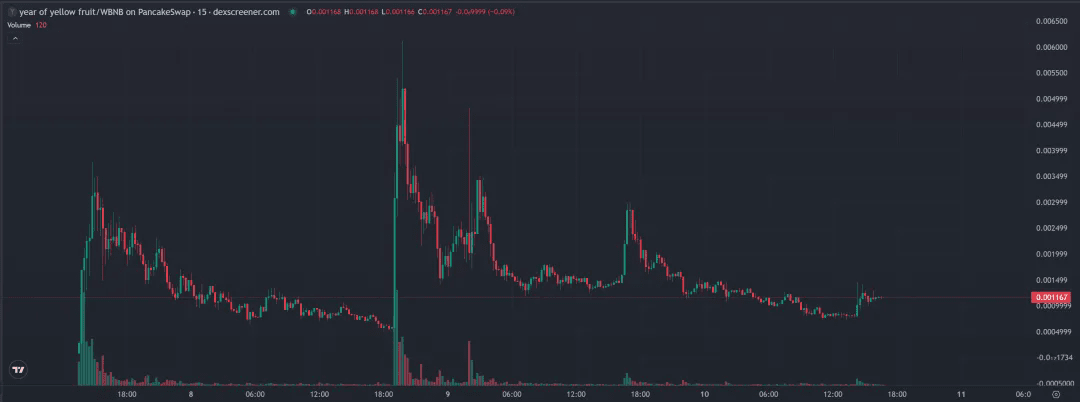
However, the most ironic thing is that just after Binance officially confirmed 'insider trading' and dealt with the employees involved, the token 'year of yellow fruit', which should have collapsed, instead became the new focus of market speculation due to its alternative 'official certification', with its price rising instead of falling, briefly surpassing $0.0061, setting a new historical high. This absurd drama once again confirms the crazy logic of the meme market that 'everything can be speculated', and indirectly reflects the market's extreme desire for the label 'Binance'.
Unintentional act
If the first two events were malicious, the subsequent 'DOYR' incident was purely a community carnival triggered by an accident, showcasing how astonishing Binance's 'heat' is.
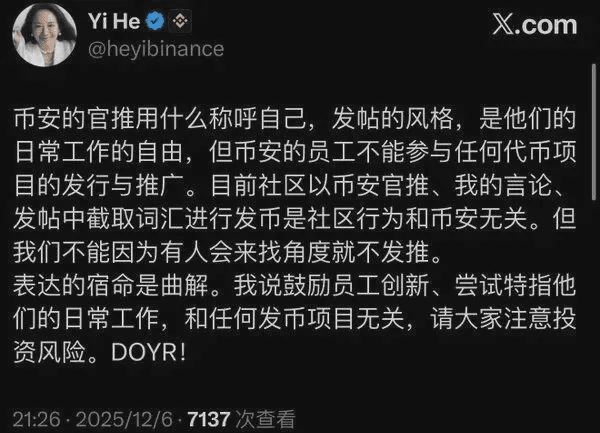
In a tweet interaction, He Yi inadvertently mistyped the industry term 'DYOR' (Do Your Own Research) as 'DOYR'. This unintentional typo was quickly captured by sharp market speculators. Within a few hours, a meme coin named DOYR was created on the BNB Chain, rapidly spreading under the hype of 'He Yi concept coin'.
CZ later retweeted and jokingly clarified: 'DOYR=DO YouR meme?' (Do your own meme?), emphasizing that tweeting does not imply endorsement of any token. However, market sentiment had already been ignited. According to GMGN data, the price of the DOYR token skyrocketed within 12 hours, with its market capitalization briefly exceeding $15 million, and total trading volume reaching as high as $45 million.
A harmless typo can actually spawn an asset worth tens of millions of dollars, which reflects the market's heightened attention and excessive interpretation of every word and action by Binance's executives. He Yi later admitted in a media interview that the pressure was enormous, stating that even casually posting a meme could be turned into a MEME, leading to joy if it rises and blame if it falls. This highlights the dilemma faced by Binance executives when making public statements: they must interact with the community while avoiding their words being taken out of context by speculators and used as fuel for hype.
Conclusion
From He Yi's WeChat being stolen to call out trades, to internal employees self-dealing, to market frenzy triggered by a typo, this series of seemingly isolated events actually collectively depicts the complex situation Binance faces as an industry giant. Its brand and influence are so powerful that they have become the 'Tang Seng meat' in the eyes of hackers, speculators, and even corrupt internal members, with everyone wanting to take a piece of the pie.
In the face of this 'backlash of influence,' Binance demonstrated a strong self-cleansing attitude. Whether setting up high rewards to encourage external supervision, decisively dealing with violating employees and resorting to legal action, or repeatedly emphasizing the importance of 'DYOR' to the market, all indicate that Binance understands that to become a 'timeless' enterprise, maintaining the platform's fairness, transparency, and user trust is an unshakable bottom line.
Just as the Coca-Cola recipe is its core asset, for Binance, its brand reputation and user base are also its most valuable treasures. On the road to broader mainstream adoption, how to manage its enormous influence and build a more robust internal and external firewall will be an ongoing challenge for Binance. For all participants in the crypto market, these events serve as a loud wake-up call: while chasing trends and wealth effects, maintaining independent thinking and risk awareness is always the fundamental principle for survival.