
Lead trader CrowleyZhou holds 76,000 USDT in margin, achieving a 23.54% ROI over 180 days, with a cumulative profit of 50,742 USDT, earning substantial returns through 'home run' style swing trading; however, the total profit of the copy trading group is only 912 USDT, revealing a profit gap of over 55 times.
The contrast of 'the lead trader makes a fortune, while the copy trader benefits minimally' stems from its extreme strategy of 'a few big gains + many small losses', as well as the barriers to following swing trading. This article will break down its trading logic, hidden risks, and practical suggestions to help you see the true profit of swing trading.
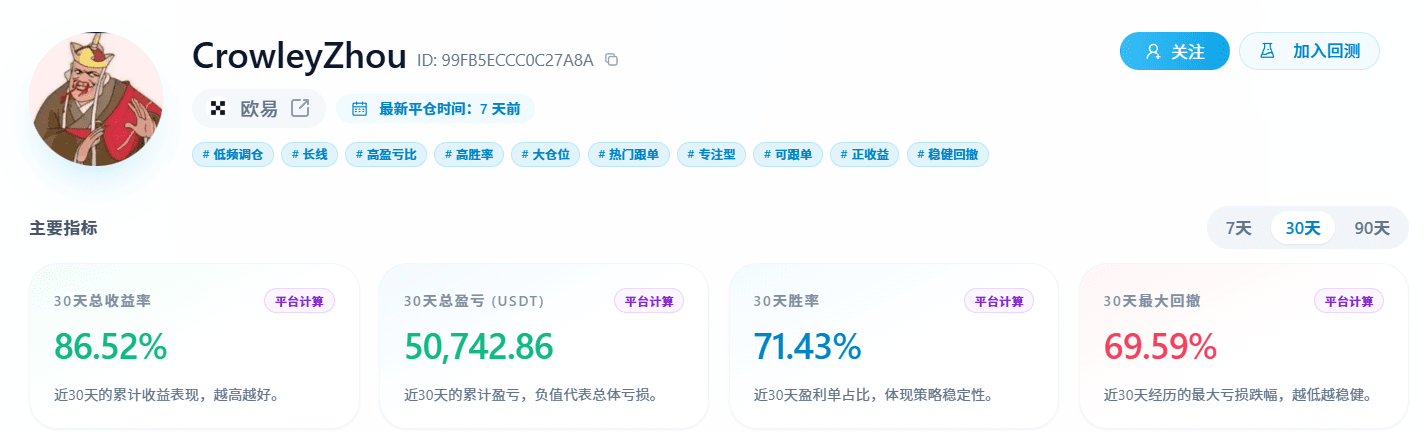
1. Objective analysis of trading characteristics: The core logic of 'home run' swing trading
1. Profit model: A few key trades support all profits
The trader's profit heavily relies on 'betting on big trends', rather than sustained stable profits:
Core profit source: Two trades contributed 58,235 USDT profit (ZECUSDT short earned 36,298 USDT, ICPUSDT short earned 21,937 USDT), with the remaining trades combined net loss of about 7,493 USDT;
Profit curve characteristics: Long periods of sideways movement or slight drawdowns, relying on one or two successful trades for stepwise growth, for example, ZECUSDT short held for 14 days and 12 hours, fully capturing the main downtrend.
2. Trading style: Long-term swing, holding positions and profits coexist
Long holding period: Average holding period of 9 days and 8 hours, most trades held for more than 24 hours, focusing on capturing mid-term trends, not intraday short-term;
Position management polarization:
Profitable positions 'can hold': Correctly judging trends and holding long-term to let profits grow sufficiently;
Loss-making positions 'can endure': Refusing to cut losses when the direction is wrong, such as two SHELLUSDT long positions held for nearly 19 days, ultimately losing 9,471 USDT.
3. Asset and directional preferences: Flexible long and short, focusing on non-mainstream high-volatility currencies
No clear bullish or bearish bias: Bullish trades account for 57%, bearish trades for 43%, flexibly switch based on market conditions;
Assets concentrated in non-mainstream currencies: Trading targets are non-mainstream cryptocurrencies like ZEC, ICP, SHELL, which have greater volatility and provide opportunities for 'home runs' strategies, but also come with high risks.
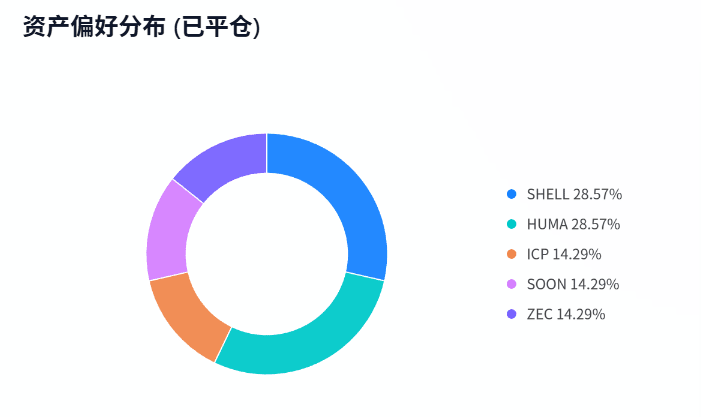
2. Core reasons for low profits in following: 4 major risks that cannot be ignored
Why can the trader earn 50,000, while the followers' total profit is only 912 USDT? The core is the dual constraints of strategy characteristics and following barriers:
1. Extreme uncertainty of returns: Missing key trades = full loss
The trader's profit heavily relies on a few 'big profit trades'. If followers happen to miss these two core profitable trades, ZEC and ICP, and only follow the remaining losing/small profit trades, the account will directly fall into loss; capturing key trends is random and cannot guarantee continuous occurrence.
2. Huge drawdown risk: Holding positions leads to long-term floating losses
The trader has a very high tolerance for losing positions (SHELLUSDT long held for 19 days with a loss of 9,471 USDT), followers need to endure long-term floating losses simultaneously:
Capital occupation pressure: Holding periods of 9 days or even 19 days will lead to following funds being locked for long times, missing other investment opportunities;
Psychological endurance challenge: The longer the floating loss persists, the easier it is for followers to panic and cut losses prematurely, turning the trader's 'final recovery/small loss' into their own 'actual loss'.
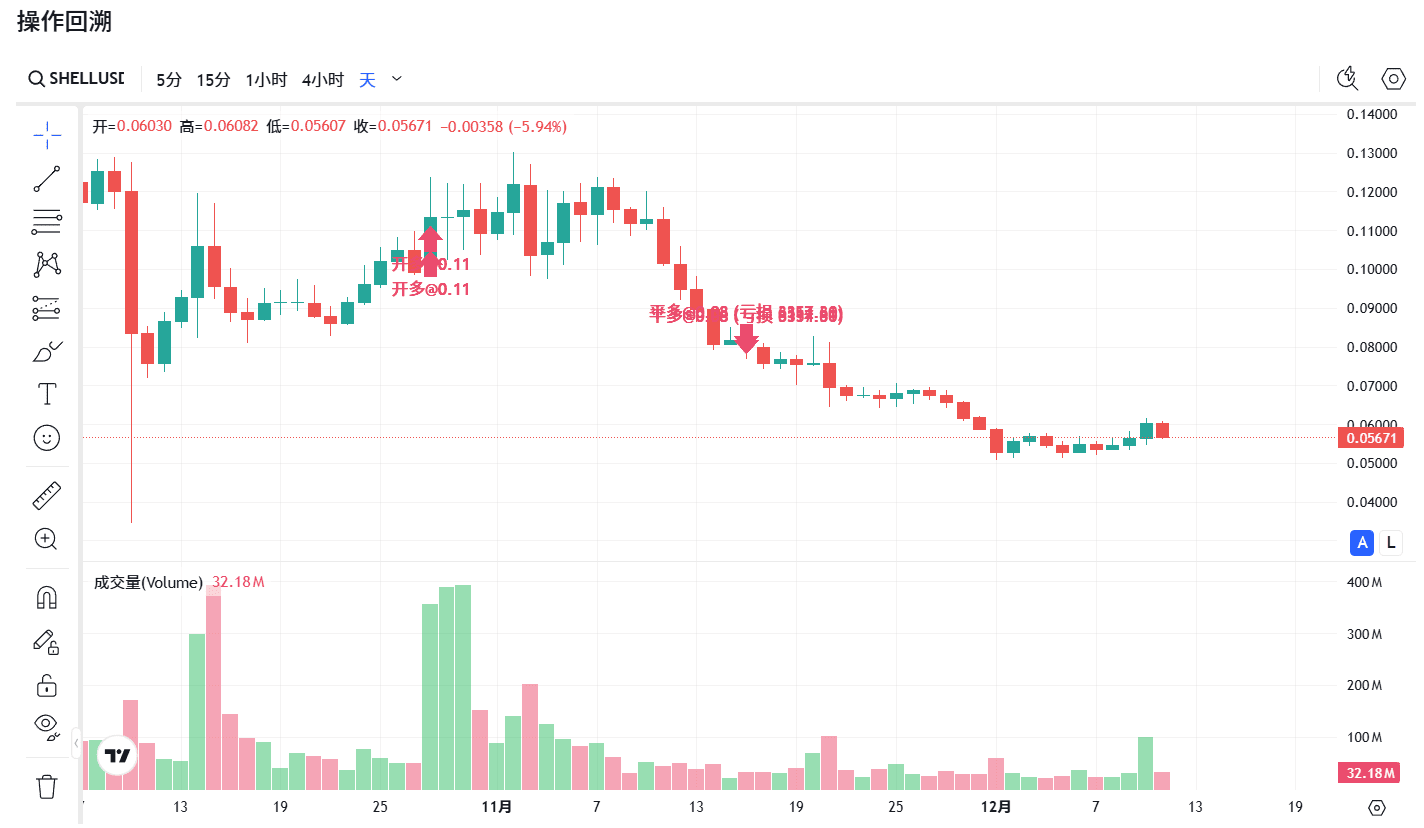
3. Following barriers: Slippage + delays, eroding profit space
High slippage in non-mainstream currencies: Currencies like ZEC, ICP have weaker liquidity than BTC/ETH, a large influx of following funds will lead to execution prices worse than those of the trader, directly eroding profits due to slippage;
Entry/exit delay: Swing trading has high requirements for entry timing, delays in following may result in missing the trend starting point or profit shrinkage at the time of closing.
4. Limited sample data: Luck factors cannot be ruled out
All analyses are based solely on 7 trade records, the sample size is too small, and the 23.54% ROI may contain a significant luck component, unable to prove the long-term effectiveness of the strategy; if future market styles switch, its 'home run' strategy may fail.
3. Rational following advice: Only suitable for aggressive and patient investors
1. Adaptation of target audience profile (strict screening, not suitable for everyone)
✅ Suitable audience for following:
Extremely strong risk tolerance: Can accept a short-term drawdown of over 20% of principal, and losses do not affect normal life;
Extremely patient: Can tolerate funds being tied up for a long time (9-19 days), accept long periods of sideways movement or even floating losses;
Pursuing explosive returns: Not satisfied with stable small profits, willing to take high risks for 'one-time big profits';
Familiarity with non-mainstream currencies: Understand the volatility patterns of currencies like ZEC, ICP, and can judge the continuity of trends.
❌ Absolutely unsuitable target audience:
Risk-averse individuals: Pursuing stable returns, unable to accept long-term floating losses and drawdowns;
Investment novices: Unfamiliar with swing trading logic, easily frightened away by short-term floating losses;
Insufficient capital: Trading funds less than 5000 USDT, difficult to bear slippage and long-term holding costs;
Dependent on 'instant profits': Hope to see returns quickly, lacking patience to wait for key trends.
2. Core practical strategies (can be directly implemented, risk controllable)
(1) Fund management: Small participation, locking in risks
Total fund ratio: Invest no more than 5% of personal contract total funds, and it should be 'completely lossable' idle funds, prepared for total loss psychologically;
Choice of following model: Use fixed amount following, controlling the amount of each following order within 50-100 USDT, avoiding ratio following to reduce risks;
Diversified participation: Do not concentrate all following funds on one trade, follow in batches to reduce the impact of 'missing key trades'.
(2) Risk control operations: Proactive stop-loss, refuse passive holding
Single stop-loss (the core of the core): Set a stop-loss line of 10%-15% for each following trade independently, once triggered, immediately close the position, never follow the trader's holding;
Total account stop-loss: Set a total stop-loss line of 20%, if the cumulative loss of the following account reaches 20%, immediately suspend all following, and decide whether to continue after reviewing;
Manually select orders: Prioritize following trades that clearly show profits (such as ZEC, ICP short trades), manually filter out loss-holding positions that exceed 15 days.
(3) Timing and monitoring of following: Avoid floating loss periods, continuously track
Entry timing: Follow the trader only after a certain trade has turned profitable (e.g., if it has made more than 5%), reducing the risk of misjudging the trend;
Daily monitoring: Check the floating loss situation of following orders, if the trader's position exceeds 15 days and floating loss exceeds 10%, manually close the position;
Give up fantasies: Do not be superstitious about '23.54% ROI', if three consecutive following orders have no significant profits, suspend following for 1 week and reassess the effectiveness of the strategy.
3. Risk warning signals (trigger any to stop following immediately)
The trader experiences a single loss exceeding 6000 USDT (close to its historical maximum loss), or two consecutive trades held for more than 15 days with floating losses;
If the cumulative loss of the following account reaches 20% of total funds, or a single order has a floating loss exceeding 15%;
The overall market of non-mainstream currencies is weakening (average daily decline exceeds 5%), making the trader's trend strategy difficult to be effective;
The trader's new trading samples still mainly consist of 'a few big profits + many small losses', continuing uncertainty in profits.
Tips
Crowley Zhou's 'home run' swing strategy essentially is 'exchanging time and risk for one-time big returns'—the trader's profit of 50,000 is based on a risk buffer of 76,000 margin and the patience of holding long-term, while followers lack these advantages and can ultimately only share meager profits.
In cryptocurrency investment, 'visible profits' do not equal 'realizable profits'. The profit gap in swing trading reminds us: Rationally evaluating one's own risk tolerance and patience is far more important than chasing the paper profits of traders. If unable to accept long-term floating losses and high uncertainty, it is advisable to stay away from such strategies; if determined to try, strictly follow the principles of small participation and proactive stop-loss.
This report is based on publicly available data for objective analysis and does not constitute investment recommendations. Investors need to make rational decisions based on their risk preferences and financial status, always prioritizing the safety of the principal, and not being misled by short-term large profits into blindly following trends.
[This report is a condensed version, the complete analysis report can be obtained using the tool on the homepage]


