
 Some successful individuals I know, whether they are traders, business owners, or in other professions, share a common trait: they excel at studying the patterns of an industry and then consistently executing one thing over the long term.
I also found that many traders fail to achieve profitability because their trading is too 'chaotic.' They buy courses everywhere, seek indicators, and switch systems, resulting in a mishmash of a trading system that leads to mistakes no matter what they do.
Before establishing my own trading system, I researched at least hundreds of trading systems, summarizing their advantages, patterns, and commonalities. Today, I would like to share these experiences with you, believing that they can provide some inspiration.
1. All have clear and quantifiable trading rules.
Systems that can make money in the long run have a common characteristic: clarity.
It's not 'about to enter,' not 'feeling it will rise,' and not 'the pattern looks good,' but rather what conditions must be met to enter, where to set the stop loss, and how to set the target, all with clear standards.
Many people think they have a system, but in fact, they only have 'some ideas,' which are not specific. Thus, situations like this occur: yesterday they thought this was a good opportunity, today they feel it’s not so good; they dare to trade when in a good mood, but hesitate when feeling down; the same market leads to ten different approaches.
This is not a trading system but 'guessing based on feelings.'
So what kind of trading system is quantifiable?
Let me give a simple example: moving average crossover + trend line breakout confirms long and short positions, enter when the market retraces to 50%, set the stop loss at the starting point, with a 2:1 risk-reward ratio.
Please take a look at the chart below.
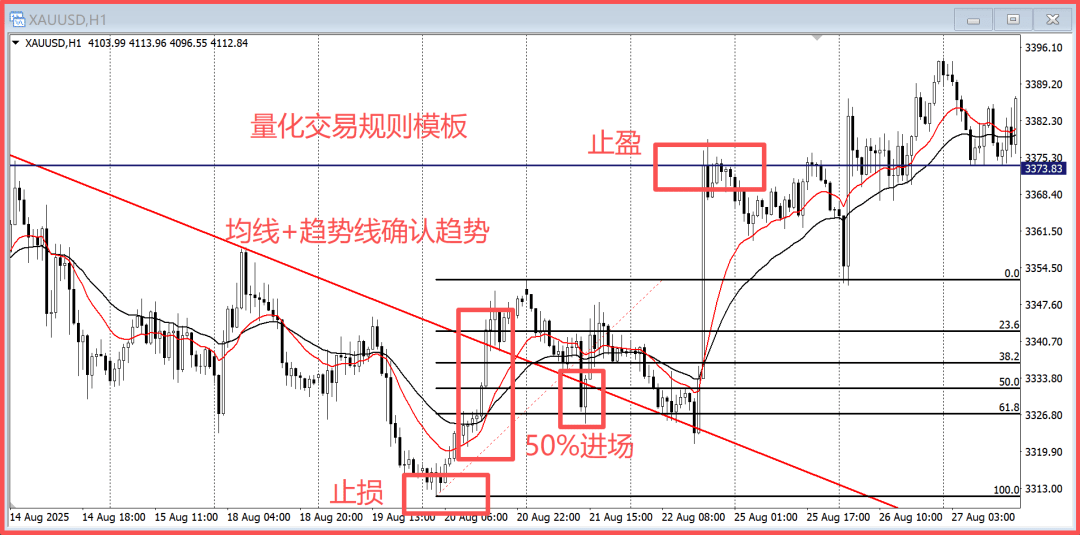 The above image is a 1-hour candlestick chart of gold, where the moving average and trend line (more than 60 candlesticks) breaking upwards confirms the bullish direction. Drawing Fibonacci retracement from the low to the high, enter directly when the market tests the 50% position, placing the stop loss at the low point of the starting wave, and setting a 2:1 risk-reward ratio.
Such operations have no gray areas; if another person operates, it will be the same, which is quantifiable.
Of course, this is just a simple template, and there are many details to refine, such as entering at the 50% position can choose to enter at a smaller scale, reduce stop loss, and expand the risk-reward ratio. Taking profits can choose to exit in batches, adding positions on retracement, etc.
2. All have sustainable probability advantages.
Many people, when they first learn trading, think about finding a '100% correct' system. Unfortunately, the market never allows such perfection to exist.
All technical indicators and patterns ultimately only predict future possibilities based on past prices. Since it is a possibility, it always comes with uncertainty.
But that's okay. A money-making system does not rely on 'winning every time,' but on the accumulation of probabilities. As long as you make your profit and loss structure reasonable, you can still make money in the long run.
For example, a system with a win rate of only 40%, but a risk-reward ratio of 3:1, means losing 1 when losing and making 3 when winning. In 100 trades, the result is still positive.
Profit part: 40 × 3 = 120, loss part: 60 × 1 = 60.
Final result: 120 - 60 = net profit of 60.
This is what is known as 'probability advantage.'
However, relying solely on mathematics is not enough; trading is not done by machines, it is done by humans. If the system's win rate is too low, for example, 10%, although theoretically it can still make money, in practice, if you lose dozens of times, your emotions will have already collapsed. At that time, you will start to doubt the system, increase positions randomly, and even retaliatory trading. If you're not careful, you will return to square one.
So I always say, probability should be gentle.
A good system should not have too low a win rate; it's best to have confidence to continue, with 30%~50% being a more suitable range. This can maintain a positive expectation and also psychologically stabilize you, so as not to be tortured by consecutive stop losses to the point of doubting life.
3. All have strict capital management and risk control.
No matter how good the system is, if there is no money management, problems will eventually arise.
Many people trade well, but end up failing because of position sizing, not because the system is bad, but because 'before the advantage appears, the bullets have run out.'
The core of money management can actually be summarized in one sentence: let you survive long enough in the market to wait for your opportunities.
Sometimes the system's win rate is only 30%, and it's common to be wrong several times. But if you always go in heavy, being wrong ten times could lead to a margin call. By then, even if the system starts winning continuously, it won't have anything to do with you.
Of course, risk control is not just about defense. Reasonable position sizes can also maximize profits. Too light a position may be safe, but the earnings are minimal, making trading meaningless; too heavy and you can easily be washed out by fluctuations. The real balance is to be able to withstand losses while daring to take full profits when the market comes.
How to master this degree?
If your system itself has a large drawdown and frequently makes mistakes, while your stress tolerance is very low, then your position size should be lighter; conversely, if your system and your personality are relatively stable, then you can slightly increase your position size.
Here are some rules for money management that you can refer to:
Control the risk of a single trade to 1%-2% of total funds; set a 'circuit breaker' to pause trading after 3-5 consecutive losses; fix stop losses and move take profits; profit adding must have fixed rules; all of these can help you safeguard the lifeline of your trading system, which is very important.
4. All have strong executability.
Whether a trading system can make money is not about how powerful, grand, or complex it is, but whether you can consistently execute it over the long term.
It's like you are clearly an archer, but you are equipped with a meteor hammer, you definitely won't be able to achieve the desired effect.
To achieve strong executability, the operational logic of the trading system must be clear.
Seeing the signal, being able to judge at a glance whether to act without thinking for a long time. The clearer the rules, the more decisive the actions. The more vague and reliant on feelings the system is, the more easily it will be disturbed by emotions.
Next, it must fit your personality rhythm.
Some people are steady, suitable for trend systems, waiting slowly; some people are impatient, suitable for short-term trading, quick in and out.
If the rhythm of the system conflicts with your personality, for example, being impatient with daily trend trading, or being slow to focus on a 5-minute chart, then it will be very painful to execute, and you won't be able to persist after a few attempts.
There must also be a certain tolerance for error.
Here's a very heart-wrenching reality: a trading system that can make money can only target one type of market, and more markets cannot be traded, will be missed, and will leave you empty-handed. This is the reality.
Trading systems often show some deviations, such as entering a bit late, taking profits a bit early, or missing a high point, etc.
Truly mature systems make money with flaws and can self-correct after making mistakes.
For example, a trend system will definitely incur consecutive losses in a ranging market, but when the trend truly starts, it can make back all previous losses in one go.
At the same time, entering a bit early or late, these small mistakes will naturally hedge against each other, which is not a big deal. Just don’t set the stop loss too close; we allow it to 'make some small mistakes.'
5. All through sufficient historical backtesting and validation.
Many people design a system and can't wait to go live, thinking 'to improve while trading.'
But once you get into the market and lose several times in a row, you immediately panic: is it the system that doesn't work? Or is it just bad luck? In fact, this is the cost of not having done backtesting: you simply don't know what it should look like.
A stable trading system must have gone through hundreds or thousands of tests for you to understand its temperament.
What type of market does it suit? What type of market is it easy to lose in? On average, how much can it earn? What is the maximum drawdown? How long is the loss cycle, etc.
When you have gone through hundreds or even thousands of backtests, seeing the system repeatedly lose and gain in the data, only then will you truly trust it, and the system will turn from an idea into your trading belief.
By then, even if you continuously lose several trades in live trading, you won't panic, because you know it has lost like this before and still made a comeback in the end.
True confidence is never shouted out loud, but rather verified through data.
6. All are about the principle of simplicity, follow the trend.
A mature trading system must have a clear, verifiable, and consistent logic behind it.
When you ask why it makes money, it can explain it clearly in one sentence, for example, the core of a trend system is 'to follow the trend.' Entering is to confirm the trend, stop loss is to prevent trend reversal, and adding positions or taking profits are all designed around the continuation of the trend. The logic is clean, the direction is consistent, and the system is naturally stable.
This is the principle of simplicity: using the simplest rules to capture the most core results.
Many people think exactly the opposite, always feeling the need to add something to the system.
Wanting to catch trends while fearing to miss out on fluctuations; needing precise stop losses while aiming for perfect bottoms. As a result, the indicators pile up more and more, the cycles look messier and messier, and the system becomes increasingly complicated, making it harder to execute.
A truly mature system does not rely on 'winning through complexity,' but on 'surviving steadily.' Simple indicators, simple logic, simple execution, making money naturally becomes simple; this is called 'the principle of simplicity.'
Writing to this point, you will find that the so-called 'money-making trading system' is not some mysterious indicator combination, nor is it some 'top secret' hidden in the deep mountains. It is more like a practice—from chaos to clarity, from greed to restraint, from complexity to simplicity.
True experts may have systems that are not complicated, just a few moving averages, a few signals, and a few rules can conquer the world.
In the end, we must all remember one thing: the market does not reward smart people, it only rewards those who consistently make the right decisions over the long term.
I am Little Egg Tart, a professional analyst and teacher, a mentor and friend on your investment journey! As an analyst, the most basic thing is to help everyone make money. To solve your confusion and stuck positions, let strength do the talking. When you lose your direction and don’t know what to do, follow Little Egg Tart, and Little Egg Tart will point you in the right direction#美联储降息预期升温 $ETH
