Last week, the crypto market suddenly experienced a small pullback, with BTC dropping 5 points in one day, and many altcoins I held also plummeted. Many friends in the group were complaining, 'The earnings I just made are gone again,' and some even faced forced liquidation due to insufficient collateral assets. In contrast, my configuration in Falcon Finance not only didn't incur losses, but the previously staked earnings were also steadily received. This experience made me see clearly: in the DeFi market, compared to high returns, the real skill is 'to preserve earnings' through risk control.
Actually, the day before the callback, I had just used a small amount of ETH for innovative minting, exchanging it for 3000 USDf deposited into the vault. At that time, I specifically checked the collateral ratio, and the protocol showed that my collateral adequacy was 140%, above the warning line of 120%. I thought there shouldn't be any problems. As a result, the next day when I opened my eyes, the ETH price dropped directly, and I felt a jolt in my heart—having played other DeFi projects before, I had once faced a small pullback where the collateral ratio fell below the warning line, and before I could add more, I was liquidated, losing a part of my assets. This time, I couldn’t help but feel a bit anxious.
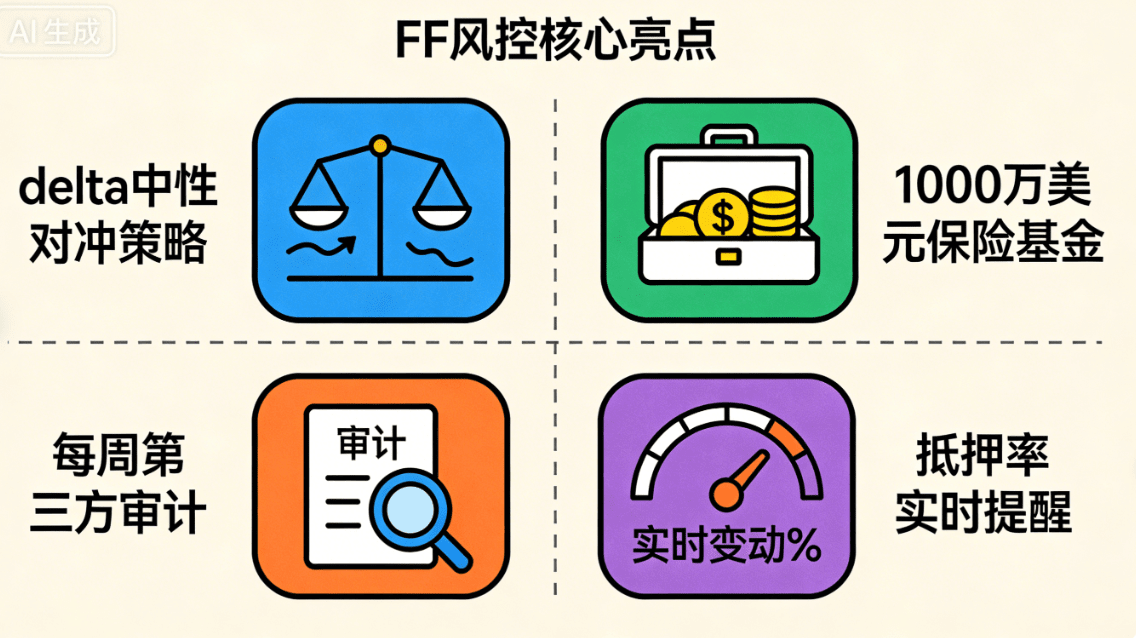
Hurry up and open the FF app to check the collateral status. I didn't expect the page to still show 'Safe.' Although the collateralization ratio dropped to 132%, it is still above the safety line. Later, I learned that FF has a delta-neutral hedging strategy that uses market tools to hedge part of the price fluctuations of crypto assets, effectively providing a layer of 'insurance' for my collateral assets. Moreover, the system automatically sent me a message alerting me of the current changes in the collateralization ratio, suggesting that if I am concerned about future fluctuations, I could supplement with a small amount of collateral. This level of thoughtfulness is much better than those previous 'cold' projects.
What reassures me even more is that FF's $10,000,000 insurance fund is not just for show. On the day of the pullback, I specifically checked the real-time risk control report published by the project team, which clearly stated that the insurance fund balance is sufficient to cover all potential risks of the current collateral assets. Furthermore, every week, the third-party auditing firm Harris & Trotter LLP issues an audit report detailing the collateral specifics and the flow of funds. This information can all be found on the official website, rather than being mere claims from the project team.
A friend in the group, like me, did ETH collateral minting, but in another project, due to the lack of a hedging strategy, the collateralization ratio directly dropped to 110% after the pullback, and he was forcibly liquidated for a portion of his ETH, losing quite a bit. He saw that I was fine here and specifically asked me how FF's risk control was different. I did some calculations for him: using ETH as collateral, FF not only has a hedging strategy to buffer price fluctuations but also has an insurance fund to back it up, and the collateralization ratio calculation is very transparent; there are no hidden issues. Even if the price drops, there is enough time and space to supplement the collateral without being liquidated all at once.
This recent pullback also helped me summarize an experience: For newcomers to DeFi, don't just focus on 'annualized returns.' First, check whether the project's risk control system is solid enough. Projects like FF, which have hedging strategies to cope with market fluctuations, insurance funds to back them up, and regular third-party audits, can protect the principal and returns to the greatest extent even in unexpected situations. In contrast, those projects that only shout 'high annualized returns' but avoid discussing risk control are likely traps.
After the pullback, I not only didn't reduce my position but also added some flexible staking of $FF. On one hand, I am optimistic about FF's fundamentals; on the other hand, I feel that having such a mature risk control system to safeguard in the current volatile market is much more reliable than chasing those high-yield projects without guarantees. After all, for ordinary investors, steadily making money is more practical than taking risks for uncertain returns.