You know, I've always considered myself a cautious investor. The kind who double-checks the lock before leaving home and reads reviews about a restaurant before going there. So when I decided to invest in @YieldGuildGames, I spent weeks studying all possible risks. Because no matter how much I admire the concept of gaming guilds and the potential of GameFi, turning a blind eye to dangers is the quickest way to lose money. And today I want to talk specifically about the dark side of this investment, without embellishments and rose-colored glasses.
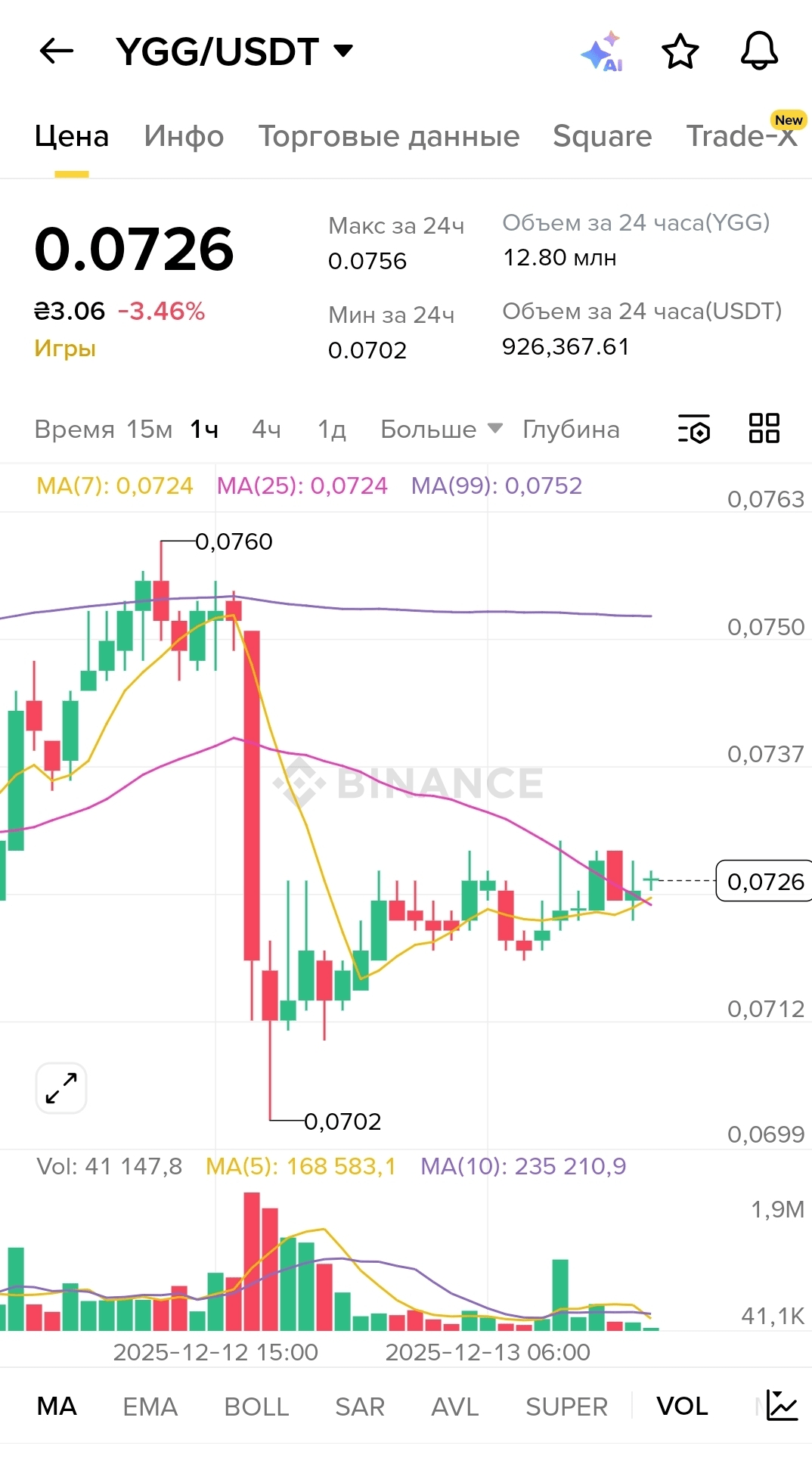
The first thing that stands out when you look at the chart of $YGG is the volatility. Right now, the token is trading at $0.0726, and over the past day it has dropped by 3.46%. But that's nothing compared to what I've seen before. Look at this chart — do you see that huge red candle when the price fell from $0.0760 almost to the minimum of $0.0702? That is a drop of almost 8% in a short period of time. And such movements are not uncommon here. I can go to sleep when my position is in the black and wake up with a loss of 20%. Or vice versa — but the stress from such swings is real. If you have weak nerves or need this money soon, it's better not to even think about investing in cryptocurrencies.
Honestly, I’m scared of how the technical indicators look right now. MA(7) at $0.0724, MA(25) also at $0.0724, and MA(99) at $0.0752 — all above the current price. This is a classic bearish signal. The price is trading below all key moving averages, indicating that short-term, medium-term, and long-term trends are all pointing down. When I see such a technical picture, I feel a knot in my stomach. Yes, I hold tokens long-term, but watching your position slowly fade away is unpleasant.
The trading volume also raises questions for me. Over the last 24 hours, 12.80 million YGG tokens have been traded, amounting to about 926 thousand dollars in USDT. That's not much, to be honest. I look at the volume chart below and see that after that powerful surge of activity that happened before (those huge red bars), the volumes have significantly decreased. This may mean that interest in the token is fading. And low liquidity is a problem, especially if I suddenly need to urgently exit my position. Try selling a significant amount of tokens when volumes are low — you’ll get slippage and sell for less than you planned.
The biggest risk that keeps me awake at night is YGG's dependence on the viability of the play-to-earn model. The entire guild is built on the idea that people can earn by playing blockchain games. But what if this model is fundamentally unworkable in the long term? I saw what happened with Axie Infinity — there was crazy hype, people were earning several hundred dollars a month, prices for Axies were astronomical. And then the game's economy started to collapse. Too many players, too little new money, rewards fell sharply. Scholars who could once support their families began earning pennies. NFTs that were worth thousands of dollars became worth dozens.
YGG is certainly diversified and invests in dozens of games, but what if the problem is systemic? What if the "play and earn" model cannot be sustainable because it requires a constant influx of new money, like a classic financial pyramid? Recently, the YGG Play Launchpad was launched — find your favorite web3 games from YGG, complete quests, and gain access to new game tokens on the Launchpad. It's cool, but it also means that now the success of the guild depends on how successful these new games turn out to be. More eggs in the basket — but also more ways for everything to go wrong.
Regulatory risks are a whole separate song. I constantly read news about how different countries are passing cryptocurrency laws, and with each month the regulation gets stricter. The SEC in the US has already classified many tokens as securities, which creates huge legal problems for projects. What if they decide that $YGG is also a security? Or if the Philippines, where YGG has a huge base of scholars, impose strict restrictions on play-to-earn games? #YGGPlay could end up illegal in key regions, and what then? I'm not a lawyer and can't predict how legislation will evolve, but this Damocles' sword hangs over the entire industry.
Competition is also not sleeping. Merit Circle, GuildFi, and a bunch of lesser-known projects are competing for the same players, the same games, the same investors. YGG is currently the leader, but history is full of examples where market leaders lost their positions. What if a competitor offers scholars better conditions? Or builds a more efficient platform? Or simply is more aggressive in marketing? I remember how Nokia dominated the mobile phone market, and it seemed like they were impossible to displace. Where is Nokia now?
I look at this chart and see that after reaching a local maximum of about $0.0760, the price has pulled back and cannot break back up. This consolidation around $0.0726 could be either accumulation before the next upward push or a harbinger of further decline. Technical analysis is not a crystal ball, but when all indicators are red, it’s hard to stay optimistic. I hold my position, but every time I open the chart, I get a little nervous.
Technical risks are also real, despite all the security audits. One bug in a smart contract, one unforeseen vulnerability — and millions can be stolen. I have seen enough stories about hacks of DeFi protocols to understand that this is not paranoia, but a very real threat. YGG stores a huge amount of NFTs and tokens in smart contracts — this is a tempting target for hackers. Yes, the team takes security seriously, but there are no hundred percent guarantees.
I'm also concerned about risk concentration in the metaverses. YGG has invested significant funds in virtual lands in The Sandbox, Decentraland, and other projects. But what if these metaverses don't take off? What if people don't want to spend time in these virtual worlds, buy anything there, build businesses? I remember the hype around Second Life in the 2000s — everyone thought it was the future, buying virtual real estate for real money. And now who even remembers Second Life? The lands that YGG bought for hundreds of thousands of dollars might end up being digital junk.
Liquidity is a constant headache. Yes, right now you can buy and sell $YGG without much trouble, but what will happen during a real bear market? I remember 2022, when liquidity in altcoins practically dried up. Trading volumes fell by orders of magnitude, and the spreads between buying and selling became enormous. If panic starts and everyone rushes to sell at once, I might find myself in a situation where the only way to sell tokens is at a huge loss. This is a risk that cannot be ignored.
The macroeconomic situation also plays against us. If a global recession starts, money will flow out of risk assets into safe havens. Cryptocurrencies, especially altcoins like $YGG, will be the first to suffer. People will sell speculative positions to cover real expenses. Central banks are raising rates, money is getting more expensive, and suddenly traditional investments start looking more attractive than crypto. I can't control the macroeconomy, but I need to understand how it affects my assets.
There is also the risk of a narrative change. Right now, GameFi is one of the hot topics in crypto, but what will happen in a year? Capital in this space is very mobile and always flows to the hottest trend. Yesterday it was NFTs, today it’s GameFi, tomorrow it might be AI tokens or something else. If GameFi goes out of fashion, investors will lose interest, regardless of the project's actual achievements. It’s unfair, but that’s how the market works.
Operational risks of YGG also cannot be ignored. The guild manages thousands of scholars around the world, coordinates dozens of SubDAOs, and holds a huge amount of NFT assets. This is a complex machine where many things can go wrong. Payment issues, conflicts within the team, poor investment decisions — all of this can harm the project. Even the most talented teams make mistakes, especially as the scale of operations grows.
Dependence on key people is a classic risk. Although YGG is called a decentralized organization, in practice there is a core team that makes many important decisions. What if someone from them leaves? What if internal conflicts arise? I have seen how the departure of one key person can destroy entire projects. YGG seems stable, but there are never any guarantees.
The risks of DAO governance are real too. Yes, democratic governance sounds cool, but what if the community makes a bad decision? What if a proposal goes through that harms the project? The crowd can be wrong, especially when decisions are made emotionally or under the influence of short-term interests. In traditional companies, there is a board of directors that can block clearly harmful decisions. In a DAO, such protection may not exist.
Tax risks add another layer of complexity. Legislation is constantly changing, and I'm not always sure that I'm declaring everything correctly. Penalties for incorrect taxation of cryptocurrencies can be serious and easily eat up all profits. Moreover, different countries have different rules, and this creates confusion.
You know what’s the most interesting? Despite all these risks, I still hold my $YGG tokens. Because I made a conscious decision. I invested only the amount I can afford to lose. I diversified my portfolio, so even a total collapse of YGG won't ruin my financial life. I constantly monitor the situation and I'm ready to exit if the risks become unacceptable. But ignoring these risks or pretending they don't exist is a path to disaster. Crypto investments are not easy money, they're high risk in exchange for potentially high returns. And everyone must decide for themselves if they are ready for that risk.
#YGGPlay @Yield Guild Games $YGG