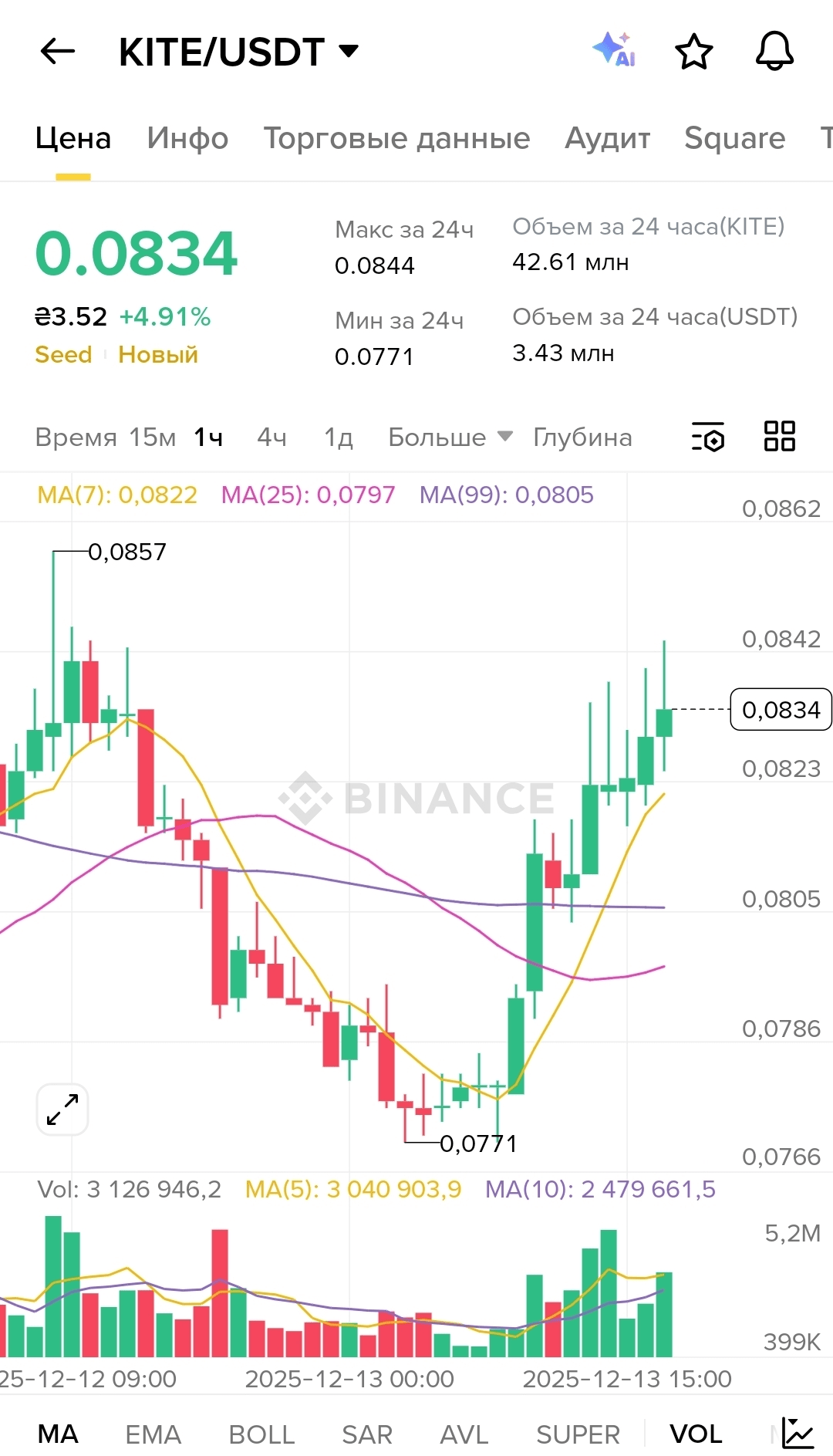
You know, I've been thinking a lot lately about how quickly the crypto industry is changing, and one of the most interesting trends is the gradual shift from purely speculative models to real utility. And here @GoKiteA announced their roadmap for the $KITE token, where the second phase of development is clearly outlined with the implementation of staking, governance, and fee payments. When I look at the chart and see that the price is currently fluctuating around 0.0834, I understand — we are at that very point where the project transitions from concept to a real economic model. And honestly, this concerns me more than any short-term price movements, because it is about a fundamental transformation of how the token will be used in the ecosystem.
Currently, KITE is in the first phase, which the team describes as a phase of participation in the ecosystem and receiving rewards. Essentially, this is a period of community formation, attracting early users, testing the core functionality of the network. The token is already trading, there is liquidity, people can buy and hold it, but for now, it looks more like an investment in the future than a full-fledged utility token with clearly defined functions. And you know, I see a certain wisdom in this. Because many projects try to launch all the functions simultaneously — staking, governance, and some complex economic mechanisms — and then it turns out that nothing really works because there was no time for testing and iteration.
KITE is taking a different path. They say: let’s first launch the basic functionality, give people the opportunity to get acquainted with the project, start using the network, understand how everything works. And when the ecosystem strengthens and a critical mass of users and developers appears, then we will add more complex mechanisms. This reminds me of Ethereum's approach in its early days — first proof-of-work, a simple model, focus on stability, and then a gradual transition to proof-of-stake and more advanced features. Only in the case of KITE, this path is traveled much faster because they learn from the experiences of other projects.
Let’s talk about what exactly will happen in the second phase. The first is staking. For those who are not in the know, staking is when you lock your tokens in the network and get rewarded for it. The mechanics can vary, but the essence is that you are saying, "I believe in this project for the long term, I am willing to freeze my funds, and in return, I receive a percentage." For the network, this is important because staking reduces the circulating supply, makes the price more stable, and creates long-term holders who are interested in the project's development. For token holders, this is passive income and a way to participate in the security of the network.
I can already imagine how this will work in the context of KITE. Given that this is an L1 network for AI agents, staking might not just be tied to block validation but also to providing some services for agents. For example, you stake tokens $KITE and launch a node that helps coordinate the work of agents, provides computing resources, and stores data. For this, you receive rewards from both the inflation of tokens and from the fees that users of the network pay. This transforms token holders from passive speculators into active participants in the infrastructure. And the more people stake and launch nodes, the more decentralized and resilient the network becomes.
The second point is governance. The word is trendy, but the essence is simple: token holders get a say in important decisions about the project's development. Which network parameters to change, what new features to add, how to allocate funds from the treasury, which partnerships to conclude — all this can be put to a vote. And the weight of your vote depends on the amount of staked tokens. For me, this is one of the most important aspects of the second phase because governance is what distinguishes a real decentralized project from another centralized startup with a token.
I have seen too many projects where the team speaks beautiful words about decentralization, but in practice, all decisions are made in a closed chat of the founders. KITE has not yet launched governance, but the mere fact that it is outlined in the roadmap speaks to the seriousness of their intentions. Of course, there are nuances — the voting system needs to be designed correctly to avoid plutocracy, where a few whales make all the decisions. There need to be mechanisms to protect against attacks when someone buys tokens specifically to sabotage important votes. Tools for delegating votes are needed so that small holders can also influence decisions. All this is complicated, and I really hope that @GoKiteA thinks through these points in advance.
The third element of the second phase is the payment of fees in the network. As far as I understand, the fees are either minimal or subsidized by the team to attract users. But in the long term, any L1 network must have a sustainable economic model where fees cover the costs of maintaining infrastructure. Users and AI agents will pay in $KITE for each transaction, for creating sessions, for using computing resources. These fees are distributed among validators, stakers, and may be partially burned to create deflationary pressure.
It's important to find a balance here. If the fees are too high, it deters users and developers, especially when it comes to microtransactions between AI agents. If they are too low, the network does not generate enough revenue for sustainable development. KITE will have to compete with other L1s, and one of their advantages is specialization in AI agents, which allows optimizing the architecture for low fees at high speeds. But still, an economic model that works in the long run is needed.
When I think about tokenomics as a whole, I feel that KITE's two-stage approach is very reasonable. In the first phase, the focus is on adoption: attracting users, developers, creating liquidity, showing that the network works. In the second phase — monetization and decentralization: turning the token into a full-fledged utility tool with many functions, handing over governance to the community, launching a sustainable economy. Many projects try to jump straight to the second phase, and this often ends in failure because there is no user base, no real demand, governance turns into a theater where three whales and the team vote.
Another point that interests me is the timing of the transition to the second phase. The roadmap does not have specific dates, and that is correct because it is impossible to predict how quickly the ecosystem will grow. But I think the team will look at several metrics: the number of active users and agents in the network, the volume of transactions, the number of developers building on the platform, and the stability of the technical infrastructure. When all these indicators reach a certain level, then it makes sense to launch staking and governance. Too early — and you risk complicating the system without real necessity. Too late — and you miss the moment when the community is ready to take responsibility for the project's development.
I also ponder how the second phase will impact the price of $KITE. On the one hand, staking will reduce the circulating supply, which, with the same demand, should increase the price. Governance will make the token more valuable for long-term investors who want to influence the direction of development. Fees will create real demand for the token from users of the network. All these are fundamentally positive factors. On the other hand, much depends on how well the ecosystem will grow, how many real use cases will appear, and what competition there will be from other L1s for AI agents.
Looking at the chart now, I see a typical picture for a young token — volatility, searching for a fair price, reacting to the overall market. But when the second phase launches, the dynamics will change. Long-term holders will emerge who stake and do not sell at the first correction. Real utility will appear, creating demand regardless of speculative sentiments. Governance will emerge, making the token not just an asset, but a tool of influence. All this should make the price more stable and predictable, although, of course, in crypto, you never know for sure.
I am also interested in how KITE will balance between rewards for early participants in the first phase and incentives in the second. Because if you distribute tokens too generously at the start, inflationary pressure arises, which suppresses the price. But if you are stingy, you do not attract a critical mass of users. The classic dilemma of cold start in any platform economy. Judging by the fact that the project is already trading and there is activity, the first phase is going pretty well. But the real test will be in the second phase when it will need to prove that the ecosystem can exist on its own economy, not on team subsidies.
I also think about what new opportunities will open up for $KITE holders in the second phase. For example, staking can be tiered — the more and longer you stake, the higher the APY. Or you could choose where to direct your stake — for block validation, for providing storage for agents, for liquidity pools. Governance can also be multi-layered — some decisions are made by a simple majority, others require a qualified majority, and others go through several rounds of voting. All these mechanisms make the ecosystem richer and more interesting but require careful design.
When I compare KITE to other L1 projects, I appreciate their honesty regarding the roadmap. They do not promise everything at once; they say: here is where we are now, here is where we are headed, here is what we plan to add. This creates realistic expectations and helps avoid disappointment when promised features are delayed for years. And delays in crypto are the norm because building decentralized infrastructure is incredibly complex. Every change to the protocol must be thoroughly tested, every economic model must be calculated, and every mechanism must be resistant to attacks.
So yes, I am looking forward to the second phase of KITE. I want to see how staking will work, how the community will participate in governance, how fees will affect the network's economy. I want to see if the project can fulfill its promises and transform from a promising startup into a full-fledged infrastructure for the economy of AI agents. And so far, all signs indicate that @GoKiteA is moving in the right direction. They are building a foundation, attracting a community, and thinking about long-term sustainability. And this is exactly what distinguishes the projects that will survive the next crypto cycle from those that will disappear at the first correction.