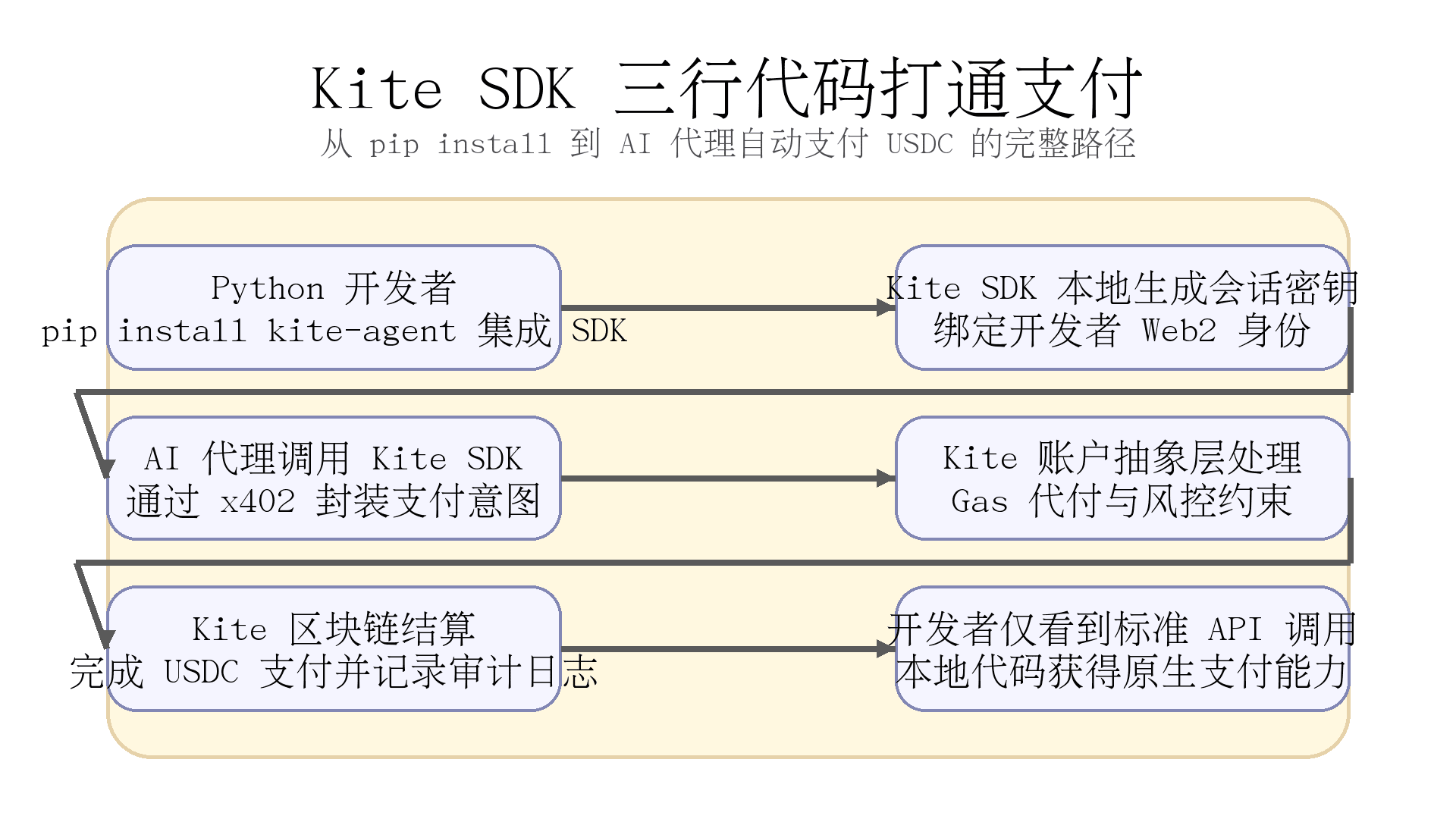
At the PyCon venue in 2025, Kite gave Python developers a very intuitive impact.
An engineer from the Django community typed three lines of code on stage:
pip install kite-agent
from kite import Agent
agent = Agent()
agent.pay("https://api.example.com/premium", amount="0.5", asset="USDC")
The Llama 3 model on the screen is still running on the local computer, but this agent can now directly pay USDC to any globally supported API x402:
No MetaMask popups, no mnemonic backup, no complicated guidance of 'first go to the exchange to buy some Gas and then talk' for the more than 3000 engineers in the audience; this feels more like integrating Stripe rather than 'playing with chains'.
At this moment, Kite puts a niche capability originally belonging to a few Web3 geeks in front of 15 million Python developers through the SDK.
One, what Kite aims to solve is not 'how to go on-chain', but 'how to fuss less'
From the developer's perspective, traditional Web3 is full of friction:
Requires learning a new language (Solidity / Move), which is very costly for engineers whose primary language is Python;
Requires building or hosting wallets and understanding details like mnemonic phrases, signatures, gas, nonce, etc.;
To monetize AI agents, one must also set up billing systems, risk control, tax, and compliance processes.
For the vast majority of developers focused on models and business logic, these burdens belong to 'raising a cow to drink milk.' The result is:
Although AI agents are smart, they do not have their own 'bank accounts' and can only be stuck in subscription-based SaaS, unable to natively participate in on-chain value settlements.
Kite has chosen a very pragmatic entry point:
Not to turn Python developers into on-chain experts, but to adapt the chain itself to the daily workflow of Python developers.
Two, the underlying design of Kite SDK: compressing complexity beneath the API
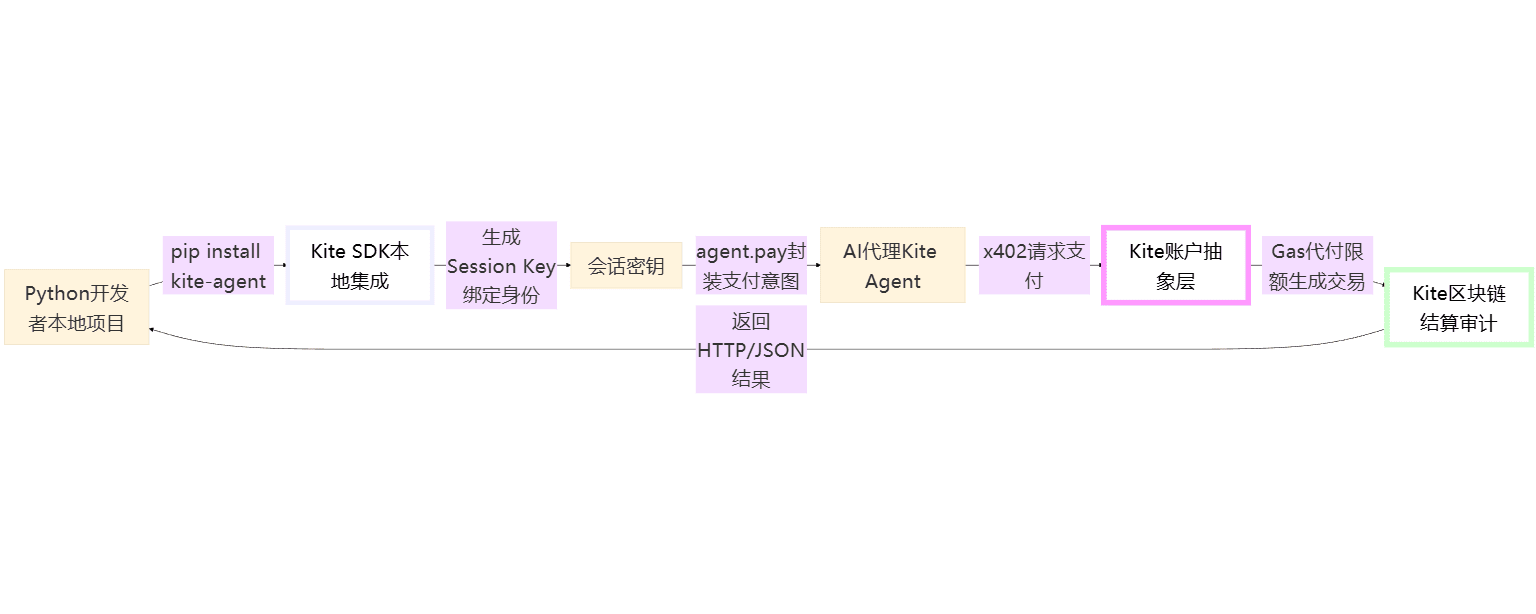
Kite's SDK is essentially a 'translator' layer for the SPACE account system and x402 payment protocol.
On the surface, Python developers only see a clean RESTful style interface, for example:
agent = Agent(identity="github:alice")
agent.pay(url, amount="0.001", asset="USDC")
Under the surface, Kite SDK is synchronously doing several things:
Locally generate session keys (Session Key)
Deriving short-lived session keys based on BIP-32/HD Wallet, bound only to the current device and current proxy process;
Session keys can have limits, time constraints, and can be revoked, avoiding the exposure of long-term master keys to application code.
Map Web2 identities to on-chain accounts
Bind with identities like GitHub / Gmail through OAuth 2.1, forming a unified identity in the form of did:kite:github:alice;
Deploy a unified smart contract account on the Kite chain for that identity, with all payments and authorizations hanging under this account for easier auditing.
Compile payment intentions into x402 requests
When encountering a paid API, the server will return a 402 response with the WWW-Authenticate: x402 ... header;
Kite SDK automatically parses parameters such as price and asset type, initiates payment transactions, and obtains payment credentials, then automatically replays the request.
The entire process is fully encapsulated within the SDK. For Python developers, Kite is just an additional library;
For the compliance and settlement layer, the chain leaves a complete, traceable flow of funds and responsibility boundaries.
Three, account abstraction + embedded wallets: allowing 'AI agents to have cards to swipe'
Kite introduces account abstraction (Account Abstraction, AA) and embedded wallet design at the protocol layer, allowing the SDK to achieve 'seamless on-chain integration.'
1. Unified smart contract accounts
When developers first deploy a proxy through the Kite SDK, Kite creates a unified smart contract account on the chain for that identity:
This account can hold assets, set authorization rules, and record all payment and call logs;
Agents started in different languages and environments can share the same account, needing only to change a session key.
2. Gas abstraction and third-party payment
In many scenarios, Kite does not want developers to purchase or manage on-chain gas themselves.
Through AA design, Kite can bear gas costs at the protocol layer or through Relayer, and developers only see an abstraction of 'cost per call':
For businesses: Just need to estimate 'each request costs about $0.000x';
For the compliance layer: Each on-chain transaction still has a clear initiator and source of funds.
3. Python logic → On-chain risk control rules
Kite SDK allows developers to describe payment constraints using Python logic, for example:
agent.set_policy(
daily_limit_usdc=10,
allowed_domains=["api.openai.com", "api.example.com"]
)
These strategies will be compiled into on-chain rules that directly constrain the behavior of smart contract accounts:
Daily expenditures exceeding $10 will be automatically rejected;
Directly revert when initiating payments to domains not on the whitelist.
This way, developers can write 'financial firewalls' in a familiar language environment, while Kite is responsible for solidifying these rules on-chain in an immutable form.
Four, the actual benefits Kite brings to developers: not 'going on-chain', but 'saving time'
Combining the requirements of CreatorPad for 'professionalism + practicality', the core value of Kite SDK can be broken down into three points:
1. Significantly reduce learning and operational costs
For an AI engineer who only knows Python, the traditional Web3 route generally looks like this:
Learn basic cryptography → Learn Solidity → Learn contract deployment → Learn wallet and account models → Learn gas and on-chain debugging → Build your own billing system and compliance audit process
Kite compresses this learning path into:
pip install → call an SDK → refer to best practices in documentation
In many teams, this means that one engineer responsible solely for 'on-chain integration' can be omitted, allowing the same budget to be invested in models and business instead.
2. Natively equipped with compliance audit capabilities
With the gradual implementation of the EU AI Act and various countries' crypto regulatory frameworks, **'who triggers the flow of funds'** is becoming increasingly crucial.
Kite's design has taken audit requirements into account from day one.
Each agent is bound to a clear Web2 identity;
Each transaction has an immutable record on the chain;
The code side directly outputs logs that can be used for accounting and auditing.
For institutions that need to face risk control, legal, and compliance teams, this 'log-first' design significantly reduces internal communication and approval costs.
3. Allow long-tail AI agents to also have the opportunity to participate in the global value network
Before Kite, small teams or individual developers could typically only:
Wrap the proxy as SaaS, integrating traditional payments;
Accept high payment channel fees and settlement cycles;
Give up the natural global circulation of crypto assets.
Kite provides a new path:
Any Python project, as long as it has a clear calling scenario, can become an 'AI agent that can collect money on its own.'
Five, early validation from data and ecosystem side (perspective of testnet)
During the testnet phase following the launch of the Kite SDK, some publicly available data provided a valuable observation window (referencing test data disclosed by the project):
Added about 17,600 test users, most of whom are developers with purely Web2 backgrounds;
Weekly x402 call volume is at the level of hundreds of thousands, indicating that developers have integrated payment and authentication capabilities into daily development;
Retention rates are significantly higher than traditional Web3 projects, indirectly confirming the intuitive logic that 'lower barriers = higher usage frequency.'
On the other hand, the $33 million financing completed by Kite, along with participation from institutions like PayPal Ventures, resembles a sort of **'path validation'**:
Large financial technology institutions are willing to bet on a more transparent and automated machine payment infrastructure rather than just paying for the next purely speculative narrative.
It is important to emphasize that:
These financings and testnet data can only indicate that Kite's direction possesses a certain industrial logic, and do not guarantee token prices or future profits. Any investment decisions still require independent research and judgment.
Six, what type of opportunity does Kite represent?
Kite actually hits three logic main lines worth continuous tracking:
Narrative layer: AI × Payment × Compliance
It is not about 'building a high TPS public chain' but solving the very specific problem of 'how code can securely collect money directly.'
Technical layer: compressing the complex Web3 stack into SDK
Including account abstraction, embedded wallets, x402 protocols, on-chain audits, and other directions, the technical details are rich, and further thematic breakdowns can continue to be produced.
Ecosystem layer: from protocols to developer tools, to agent markets
If Kite can continuously attract non-crypto-native developers, then the real 'network effects' will occur at the AI application layer, rather than in the TPS competition of the chain itself.
Seven, summary and risk warnings
Kite packages complex on-chain accounts, payment protocols, and compliance audits into a ‘basic infrastructure that can be used with pip install’ through a simple Python SDK.
For developers, this represents a paradigm shift of 'turning blockchain into a tool, not a goal';
For the broader Web3 ecosystem, this design provides an executable template for 'allowing AI agents to directly participate in the machine economy.'
Finally, a simple reminder:
The above content is my personal understanding of Kite's technical route and economic logic, only for technical and educational discussions;
It does not constitute any investment advice, nor is it equivalent to a recommendation for any tokens, projects, or products;
Cryptographic assets and early protocols carry high risks, please be sure to DYOR (do your own research) and make prudent decisions based on your risk tolerance.
I am a sword seeker, an analyst who only looks at essence and doesn't chase noise. @KITE AI $KITE #KITE