

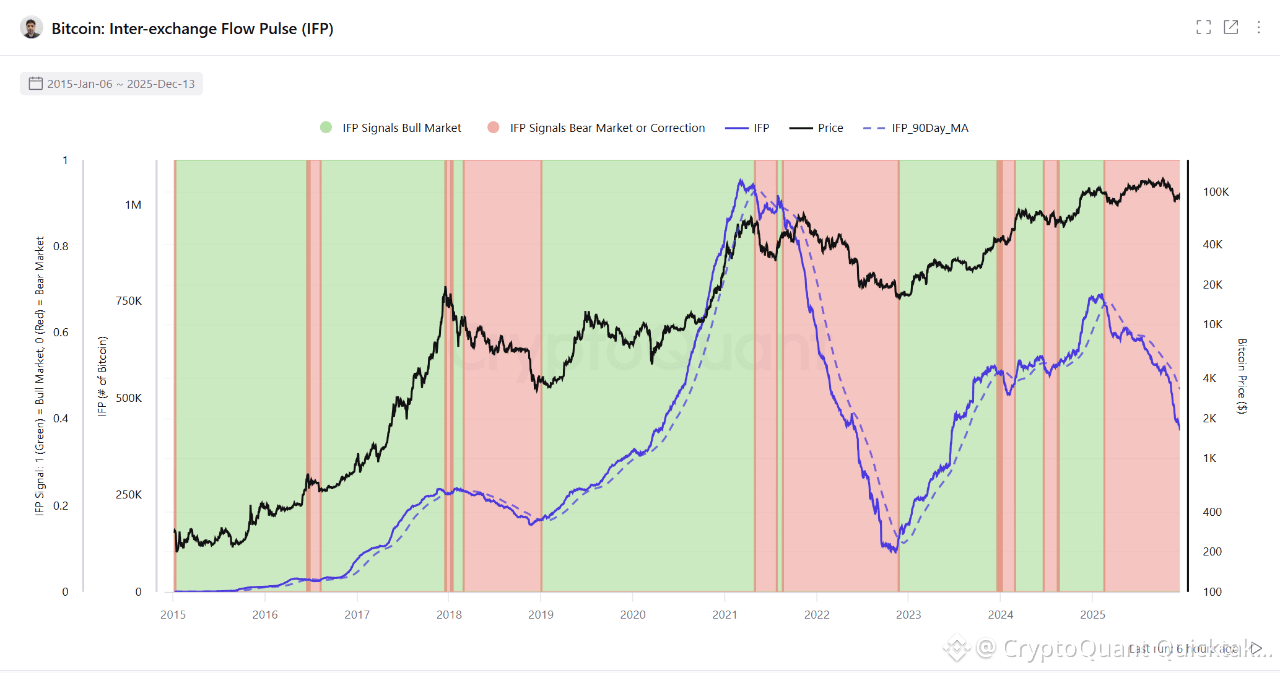
At first glance, Bitcoin’s price action appears calm. However, on-chain data suggests a growing structural risk beneath the surface. The Inter-Exchange Flow Pulse (IFP) has turned red, indicating a clear slowdown in capital movement between exchanges.
IFP measures how actively Bitcoin moves from one exchange to another, serving as a proxy for internal market liquidity and capital circulation. When IFP is high, arbitrage and liquidity provision function smoothly, order books remain thick, and price movements tend to be more stable. When IFP declines, market “blood flow” weakens, making prices more sensitive to relatively small trades.
This deterioration in liquidity is occurring alongside historically low exchange balances. While limited sellable supply can support prices, it also results in thinner order books. Once price begins to move in one direction, slippage increases and volatility accelerates. With leverage still elevated, instability is driven less by direction and more by magnitude.
Historically, periods when IFP turned red were not defined by orderly trends but by sharp corrections and sudden price swings. The key risk today is not aggressive selling, but structural fragility. Until liquidity recovers, markets are more likely to experience abrupt moves, making leveraged positioning especially vulnerable in the current environment.
XWIN Research Japan
(https://xwin.finance/)
Written by XWIN Research Japan
