

When you first hear about @KITE AI and its role in “agent-to-merchant commerce,” it’s tempting to feel a bit of cognitive whiplash. Payment systems have always lived on the visible rails of credit card networks and bank rails things we touch, swipe, approve with a thumbprint. But picture a world where humans don’t start these actions at all. Instead, self-running software agents smart programs acting for people or businesses make deals, buy and sell, pay, and finish transactions without us watching every step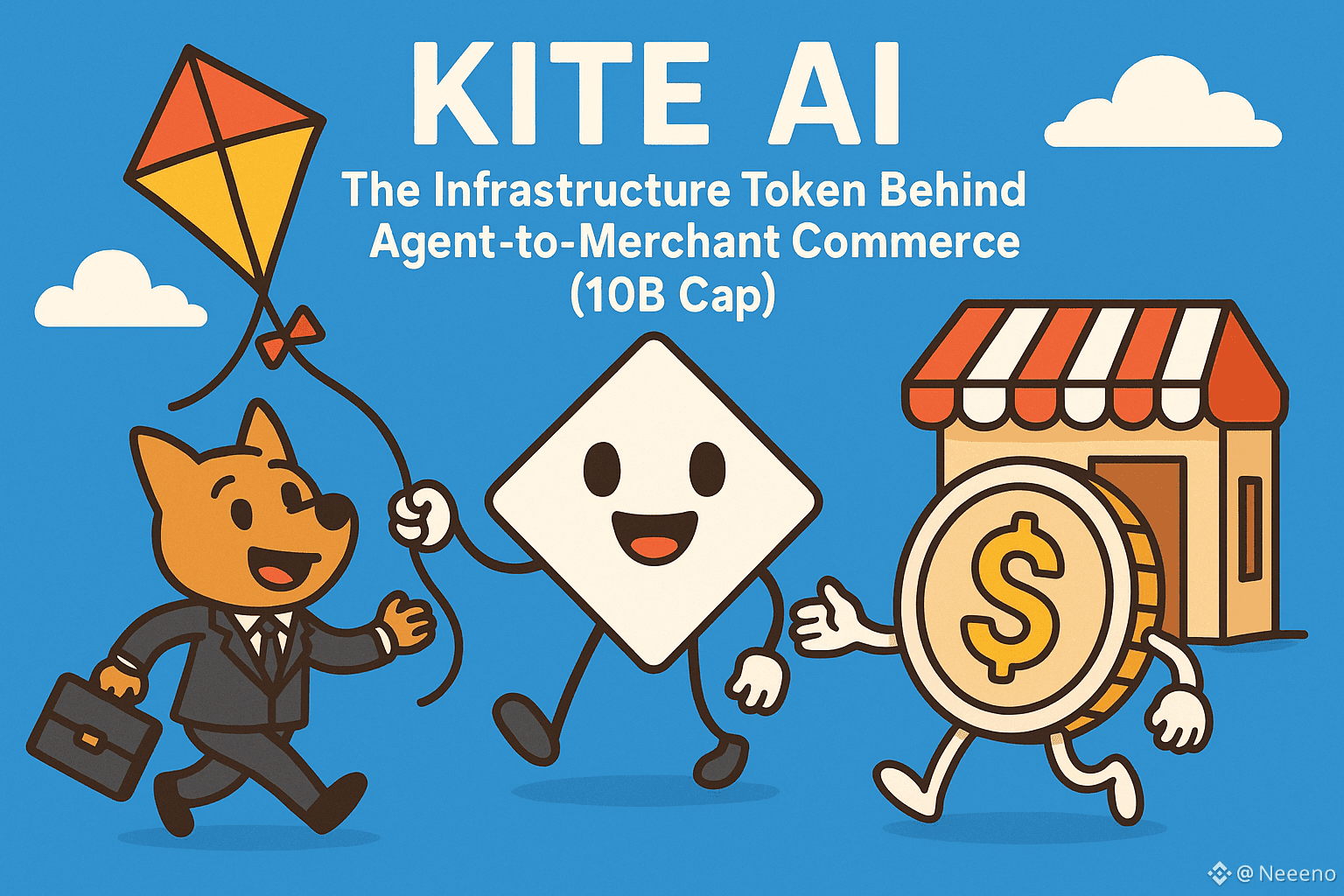 .
.
That’s the world Kite aims to build infrastructure for—and why its native token KITE feels timely in late 2025. At its core, Kite isn’t about being “the next crypto fad.” It’s about rewriting the assumptions around how value moves when the actor in the economy isn’t a human being but a machine with autonomy, contracts, incentives, and yes money. Traditional payment rails simply weren’t built for that world. They assume humans signing off; they struggle with sub-cent payments; they don’t offer cryptographically bounded authority for delegated systems. Kite stitches these gaps together with a blockchain designed from first principles for what many call the agentic economy—an environment where autonomous agents transact, coordinate, and create value on behalf of their principals.
A useful starting point is to think of KITE not just as a token but as a kind of digital meter. It measures and settles economic activity between agents, services, and platforms in real time. When one AI agent needs data from another service, it doesn’t wait for a human invoice and a bank payment that settles in days. It pays in the moment, on-chain, with KITE powering those microtransactions. The token itself has a fixed supply cap of 10 billion units, which anchors expectations about inflation and scarcity, even though only a fraction circulates in any given moment.
What makes this more than an intellectual exercise is the tangible progress Kite has made. The project’s whitepaper was published in November 2025, clearly outlining the architectural and economic rationale for an agent-native payment system and addressing earlier critiques about vague use cases by tying the vision to explicit mechanisms like stablecoin-based micropayments, hierarchical identity layers, and programmable constraints for autonomous operations.
One of the central pivots in Kite’s design is its three-layer identity model—separating the user, the agent acting for that user, and the session during which the agent operates on a task. This hierarchy isn’t an academic platitude. In everyday systems, when you give an app permissions, you often hand over the keys to everything. But on Kite, that authority can be finely scoped, limited by time, function, or spending rules, and verified cryptographically. This way, if an agent acts weird—or gets hacked—the harm stays limited, easy to spot, and fixable within clear rules. Older blockchain systems weren’t built for that level of detail.
This feels futuristic, but you can see the direction already. More businesses use AI to handle customers, manage logistics, and run finance work. So what happens when AI can make deals, plan appointments, or pay invoices on its own? If there’s no special infrastructure, it’ll be pushed into slow, human-focused systems that don’t fit constant, instant automation. Kite’s approach is different—it builds a network where autonomous agents are treated like real economic players.
There’s a distinctly economic motivation behind this architectural stance. If you slice a business invoice into thousands of tiny pieces—charging for compute cycles, API calls, or data needs—traditional payment fees and settlement delays become untenable. A credit card charge for a ten-cent data request simply doesn’t pencil out. Kite’s infrastructure is engineered for sub-cent micropayments that settle near-instantly and transparently. That’s what makes it genuinely interesting: it isn’t layering a new token on old rails. It’s rethinking the rails entirely.
The KITE token itself serves multiple roles in this ecosystem. It functions as the medium of exchange for agent transactions, a staking asset that secures the network, and a governance token that lets holders influence the protocol’s trajectory. Developers and service providers who build on Kite may need to hold or lock KITE tokens to participate, aligning incentives between those creating value and the broader network.
But let’s pause here for a moment—not everything about Kite’s journey is straightforward or guaranteed. Projects that marry grand visions with nascent tech often run into execution challenges. Kite’s high fully diluted valuation and a large portion of its token supply still locked away could create volatility as those tokens unlock and enter circulation. The project’s long-term success will depend on real adoption by developers and meaningful economic activity on its chain, not just speculative trading.
There’s also competition looming from other blockchain efforts that target niches around AI, data verification, or decentralized computation. Kite’s proposition stands out because it focuses on financial autonomy for agents—where the economic value exchange itself is automated and trustless. That’s a subtle but significant distinction. Many projects aim to power AI workloads or tokenized services; Kite aims to let those workloads pay for themselves in real time.
What happens next will be a test of both technology execution and ecosystem dynamics.Will developers build hardware-agnostic, agentic services that leverage Kite’s payment rails?. Would firms find it worthwhile to let automated agents handle contract talks and payments without human supervision?
These aren’t trivial bets. They implicate regulatory frameworks, security standards, and new kinds of economic behavior we haven’t charted yet.
My own sense is that we’re seeing the beginnings of a larger shift: economic infrastructure no longer optimized solely for humans but optimized for systems that act on behalf of humans. It’s similar to the transition from desktop computing to mobile apps—but this time, the shift is from human-initiated interactions to autonomous ones. Kite’s attempt to build the plumbing for that future is grounded in real technical choices and early network effects. But like all infrastructure projects, value accrues slowly then suddenly. Whether Kite becomes that plumbing for agent-to-merchant commerce remains to be seen—but it’s one of the most concrete attempts yet.
In that light, KITE is more than a token; it’s a bet on a future where commerce is increasingly automated, where machines don’t just compute—they transact. How fast we reach that future, and how much human supervision remains, will be one of the decade’s key economic trials.


