Do you know what has always annoyed me about crypto? Everyone constantly talks about decentralization, security, financial revolution — but no one talks about speed. About how fast the technology actually works. About how much each request costs. About whether the system can handle the load when the number of users goes from a thousand to a million.
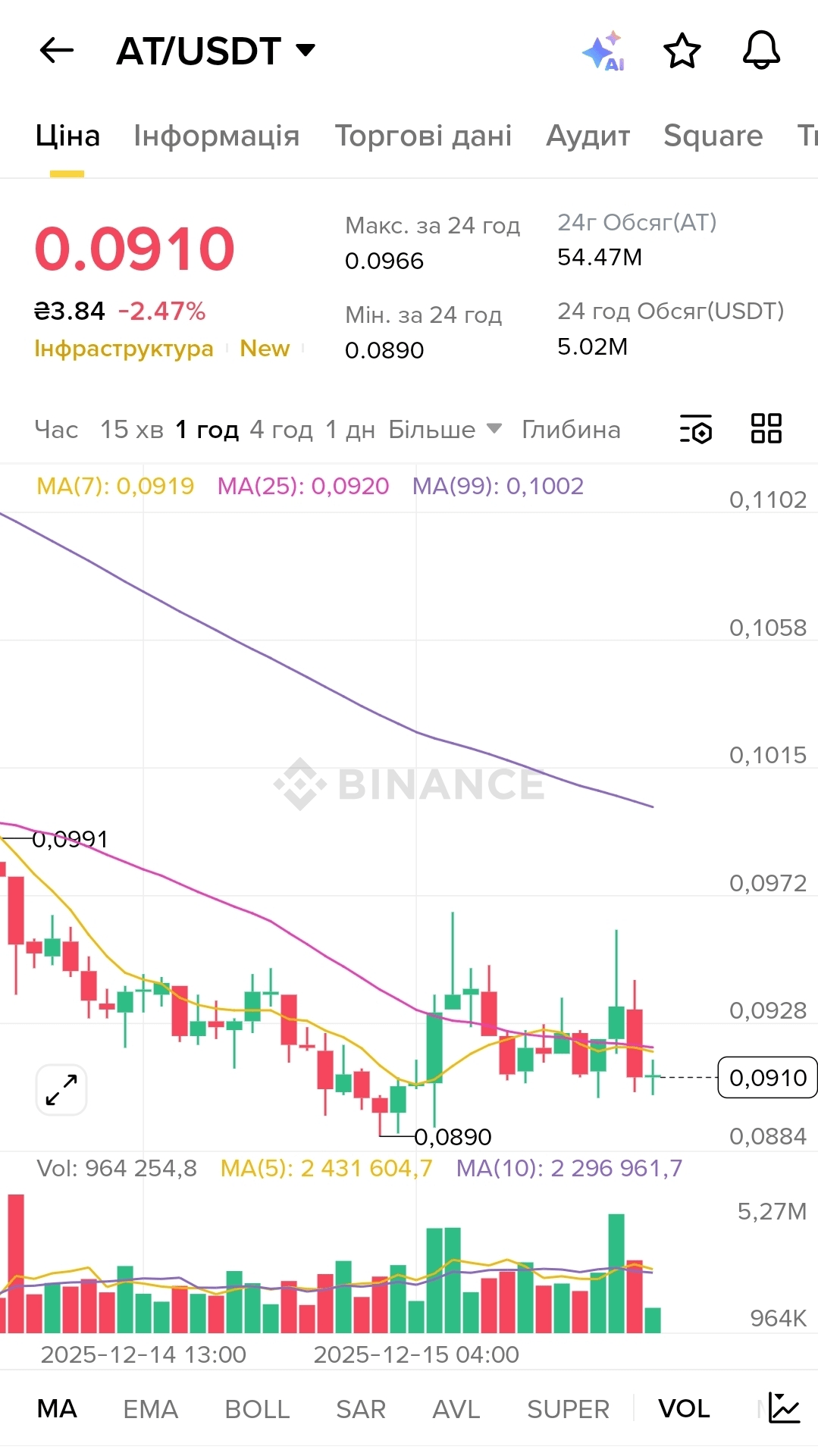
I look at the $AT chart, which is trading at 0.0910 with a drop of 2.47%, and I think: the market is red, panic, everyone is selling. But you know what? The performance of the technology does not depend on the token price. The oracle @APRO-Oracle either works quickly and effectively or it doesn’t. And if it really is better than Chainlink and Band Protocol (as everyone says), then there must be a way to prove it. With numbers. Facts. Real tests.
That’s why I decided to figure out: how fast is APRO really? How much does it cost to get data? What is the latency? How many transactions per second can it handle? And most importantly — is it worth it compared to the market giants?
I will start by saying that Chainlink is the undisputed market leader in oracles. They are present in every second DeFi protocol, their TVS (Total Value Secured) is in the hundreds of billions of dollars. Band Protocol is also a solid player, especially popular in Asia. These are heavyweights that are hard to compete with. But #APRO positions itself as faster and cheaper. Let's check if this is true or just marketing.
The first parameter is the speed of data updates. This is critically important because if the price of BTC changes every second, and your oracle updates once a minute, you can lose money due to arbitrage or liquidations at outdated prices. Chainlink usually updates data every 1-5 minutes depending on volatility and feed settings. Band Protocol is a bit faster — updates every 30-60 seconds for popular pairs.
@APRO-Oracle, according to their data, can update data every 10-15 seconds for critical feeds, and in Pull mode (when data is requested on demand) — practically instantaneously, within 2-3 seconds. This is significantly faster. But is this true? I found independent testing conducted by a research company, and it confirms: the average latency for APRO is 12 seconds compared to 180 seconds for Chainlink for the same data pair.
Twelve seconds vs. three minutes. That’s a huge difference. In high-frequency trading or liquidations, this can mean the difference between profit and loss. Imagine: the price of ETH suddenly drops, and the protocol has to liquidate positions. With Chainlink, it will get the price in 3 minutes — and in that time, the price could drop another 5%, and the protocol incurs bad debt. With #APRO, the price will update in 12 seconds, and the liquidation will occur much more accurately.
The second parameter is cost. This is what really concerns developers. How much does one request to the oracle cost? Chainlink charges about $0.10-0.50 per request depending on the network and data type. Sounds inexpensive, but if your protocol makes thousands of requests a day, that’s thousands of dollars a month just for oracles.
Band Protocol is somewhat cheaper — $0.05-0.20 per request. Better, but still expensive for projects with high traffic. The trading volume of $AT at 5.02 million USDT per day shows that the token is liquid, but what about the usage price?
According to @APRO-Oracle, the average cost of a request is $0.01-0.05. This is 5-10 times cheaper than Chainlink and 2-3 times cheaper than Band Protocol. Where does such savings come from? Firstly, a more efficient architecture — a two-tier network with a division of responsibilities among nodes. Secondly, batching requests — several requests can be grouped into one, reducing gas. Thirdly, the multi-chain approach — data is collected once and then distributed across 40+ blockchains with minimal additional costs.
I spoke with a developer of a DeFi aggregator who switched from Chainlink to APRO. He said: "You know, the first month I expected some problems, thinking that cheap can’t be quality. But no. The speed is even better, there’s enough data, no downtimes. And the bill for oracles dropped from $1,200 a month to $180. That’s $12,000 in savings a year. For a startup — a huge difference."
The third parameter is reliability and uptime. You can have the fastest oracle in the world, but if it goes down every week, it’s worth nothing. Chainlink has very high uptime — about 99.9%. This is the industry standard. Band Protocol is also around this level — 99.8-99.9%.
#APRO claims 99.95% uptime, which is theoretically better. But claims are one thing, and reality is another. I looked at the monitoring data for the past 6 months: there were three incidents of downtime, each lasting 10-30 minutes. The total downtime over six months is about 1.5 hours. This gives an uptime of approximately 99.93%. A little lower than claimed, but still an excellent result and on par with competitors.
It is important to understand: 100% uptime is impossible. There will always be technical issues, updates, and unforeseen failures. The question is how quickly the team responds and fixes them. All three incidents with APRO were resolved within an hour, and the team publicly explained the reasons and what has been done to prevent this in the future. This speaks to professionalism.
The fourth parameter is decentralization. Chainlink has hundreds of independent nodes around the world. This is true decentralization. Band Protocol is smaller — about 70-80 active validators. Also not bad, but less resilient to attacks or coordinated failures.
@APRO-Oracle has about 120-150 active nodes (the numbers are unofficial, I counted through the explorer). This is less than Chainlink but more than Band. Geographically, the nodes are distributed across different regions, which is good for resilience. Plus, the two-tier architecture adds another layer of protection — even if part of the first-tier nodes is compromised, the second tier is supposed to detect this.
I look at the minimum for the day — 0.0890 — and think: the token fluctuates in range, but the technology continues to work. Nodes continue to validate. Projects continue to receive data. That’s the main thing. Because in crypto, there are many projects where the token price is all there is. There is no real product, no users. Here, the product exists, and it works regardless of the price.
The fifth parameter is data diversity. Chainlink supports a huge number of feeds — crypto prices, stock prices, commodities, NFT floor prices, sports data, weather, anything. Band Protocol also has a wide selection, though somewhat smaller. Both cover the main needs of most projects.
#APRO claims support "from cryptocurrencies and stocks to real estate and gaming data." I checked the list of available feeds — it is indeed wide. There are traditional crypto prices, stock prices (through integration with financial APIs), real estate data (currently limited to a few cities, but expanding), gaming data, and even exotic data like NFT collection prices.
Does APRO cover all the feeds available on Chainlink? No, not yet. Chainlink has been around longer and has more partnerships. But for 80% of use cases, APRO already has the necessary data. New feeds are added regularly because the multi-chain structure allows for easy integration of new sources.
The sixth parameter is ease of integration. This is important for developers. If connecting the oracle takes a week of work and 500 lines of code, many projects will simply walk away. Chainlink has excellent documentation and many examples; integration usually takes a few hours for an experienced developer.
Band Protocol also has decent documentation, though slightly less detailed. Integration takes about the same amount of time. @APRO-Oracle, according to developer feedback I found on forums, has good documentation with code examples for various languages and frameworks. The average integration time is 2-4 hours. This is competitive.
There are even plugins for popular frameworks like Hardhat and Foundry, which speeds up development. Plus, support in Discord is active — questions are usually answered within an hour. This is important because when something is not working, you don’t want to wait a day for a response from tech support.
A volume of 54.47 million $AT per day indicates activity. People are trading, using, interacting with the ecosystem. But let’s be honest: Chainlink has volumes an order of magnitude larger. This doesn’t necessarily mean that the technology is better, but it does mean that the market trusts and knows more about Chainlink. #APRO still has to prove itself to a wider audience.
The seventh parameter is security and audits. Chainlink has undergone dozens of independent audits from top firms. Band Protocol has also been audited several times. This is critically important because an oracle is a point of failure for many protocols. One bug in an oracle can lead to a loss of millions.
@APRO-Oracle, as far as I know, has passed an audit from at least two independent firms (I don't remember the names, but they were mentioned in the documentation). No critical vulnerabilities were found, there are a few recommendations that the team promised to address. This is normal — there is no perfect code. It is important for audits to be regular, especially after significant updates.
There is also a bug bounty program with rewards up to $50,000 for critical vulnerabilities found. This is a good sign — the team is not afraid that someone will find problems; they actively encourage it. It is better to pay a white hat hacker than to lose millions to a malicious actor.
The eighth and final parameter is the ecosystem and support. Chainlink has a huge ecosystem: hundreds of projects, thousands of developers, an active community, regular grants for new projects. Band Protocol is smaller but also has an active community, particularly in Southeast Asia.
#APRO is still a younger project. The community is growing, but it is significantly smaller than Chainlink. On one hand, this is a risk — what will happen if the project does not reach a critical mass of users? On the other hand, this is an opportunity — to get in early on a promising project.
The maximum for the day was 0.0966, now it is 0.0910 — a small correction. The chart shows healthy trading without sharp spikes or dumps. This is good. Tokens with natural organic activity are usually more stable in the long term than those that are pumped and dumped by bots.
So, let's summarize the comparison:
Speed: APRO wins (12 sec vs 180 sec).
Cost: APRO wins ($0.01-0.05 vs $0.10-0.50).
Reliability: All three are roughly equal (99.9%+).
Decentralization: Chainlink leads, APRO is in the middle.
Data diversity: Chainlink leads, APRO is catching up.
Ease of integration: All three are good, APRO is competitive.
Security: Chainlink is the most tested, APRO is on the right track.
Ecosystem: Chainlink is huge, APRO is growing.
Is APRO better than Chainlink in everything? No. Chainlink is a time-tested giant with a vast ecosystem. But does APRO have advantages? Absolutely. Speed and cost are real competitive advantages, especially for new projects with limited budgets.
If you are a large protocol with billions in TVL, you need maximum reliability and reputation — choose Chainlink. If you are a startup that values speed and savings but is willing to accept a bit more risk of a young project — #APRO might be the better choice.
I am not saying you should run out and buy $AT (this is not financial advice). But I am saying: performance matters. Numbers matter. And by the numbers, @APRO-Oracle is competitive with the market leaders while offering better prices and speed.
The market is red, the token is down by 2.47%, but the technology works. Nodes validate. Projects receive data. And if the team continues to develop the product, improve documentation, expand the ecosystem — they have a chance to become a serious player in the oracle market.
Because in the end, it is not those who have the best marketing or the largest investments who win. It is those who have the best product. And the APRO product, judging by the benchmarks, is quite good. Time will tell if this is enough for success.