

Introduction: From 'tool stacking' to 'ecosystem symphony'
In the world of encryption, there has long been a contradictory phenomenon: although the total market value of stablecoins has surpassed $2.7 trillion, the annual on-chain transaction volume has exceeded $36.3 trillion, far surpassing the combined total of VISA ($28.6 trillion) and MasterCard ($22.1 trillion), the penetration rate of stablecoins in daily consumption has hovered around 6% for years. Why has this asset, known as the 'hard currency of the digital age,' always struggled to enter the lives of ordinary people?
The answer lies in the fragmentation of the ecosystem. Looking at the market, whether it is the built-in payment tools of exchanges or independent crypto payment gateways, most only provide 'point' solutions. Users may trade and exchange assets on platform A, complete payments on platform B, but cannot seamlessly connect the entire process from asset management, daily consumption to value appreciation within one system. Because of this, stablecoins have been confined to a small circle of trading and speculation, failing to unleash their true potential as a circulating currency.
The breakthrough of Solulu lies here. As a platform aspiring to become the world's leading infrastructure for stablecoins, it does not simply pile up features, but weaves five core businesses into a self-driven, cyclically value-adding microeconomic ecosystem through a sophisticated 'flywheel architecture'. This article will deeply dissect how Solulu transforms stablecoins from isolated 'assets' into the 'economic blood' that flows freely within a vast system, using industry data and real case studies.
1. Industry Status: The 'Scale Paradox' of Stablecoins and the Breakthrough Window
To understand the ecological value of Solulu, one must first see the core contradiction in the current stablecoin industry—'there is technological scale, but a lack of practical scenarios.' The following data and charts clearly present the state of the industry:
Core Data Comparison: A stark contrast between on-chain prosperity and offline vacancy
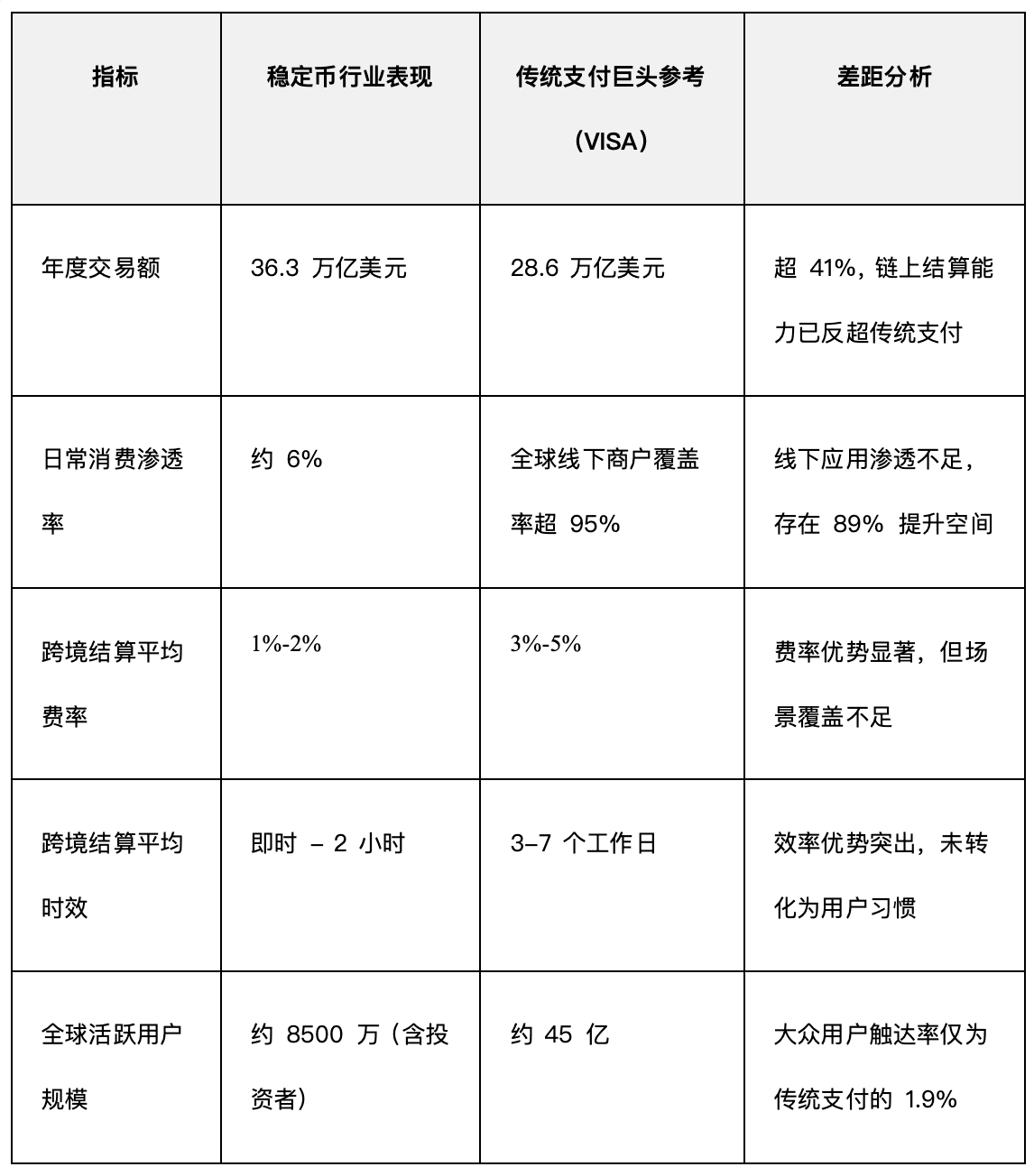
It is not difficult to see through the data that the core pain points and breakthrough opportunities in the industry can be summarized into three key conclusions:
● The technical advantages of stablecoins (low fees, fast settlement) have been validated, but there is a lack of a closed-loop scenario 'from exchange to consumption';
● Over 80% of industry transactions are concentrated in asset exchange and speculation, with true payment scenarios accounting for less than 20%;
● The core barrier of traditional payment giants is not technology, but 'full-scenario coverage + user habits', which is the key to breaking through in the stablecoin track.
2. Key Bridge: Fiat Currency Issuance Business—The 'Two-Way Gate' Connecting Virtual and Real Worlds
The confidence of the Solulu ecosystem comes from the fact that the five major business engines do not fight alone, but mesh together like precision gears, jointly driving the flywheel of value circulation, becoming the core power that is inseparable from the ecosystem.
1. Starting Point and Foundation: Multi-Stablecoin Exchange Center—The 'Reservoir' of the Ecosystem
The prosperity of any economy begins with the aggregation of liquidity. Solulu's multi-stablecoin exchange center is the 'reservoir' and core traffic entrance of the entire ecosystem. Its functional positioning is very clear: it supports real-time mutual exchange of a multitude of stablecoins across multiple public chains, completely solving the 'island problem' of user assets scattered across different chains.
The Messari report shows that by 2025, the average daily trading volume of stablecoins is expected to reach approximately $143 billion, with the proportion of cross-chain transactions soaring from 18% in 2023 to 42%. Solulu, relying on mainstream DEX liquidity aggregation capabilities and smart routing technology, has built a deep cross-chain liquidity pool, fundamentally ensuring a low slippage experience for mainstream stablecoin exchanges, aiming to become one of the core hubs for massive stablecoin trading. Therefore, within the ecological closed loop, this advantage is the beginning of all stories. Without this deep cross-chain liquidity pool, subsequent payment and trade operations will become a source-less endeavor.
2. Key Bridge: Fiat Currency Issuance Business—Connecting Virtual and Real Worlds with a 'Two-Way Gate'
How to achieve free communication with real-world wealth while holding stablecoins? Solulu's fiat currency issuance business is the key bridge to building trust. Its core function is to provide seamless one-click two-way exchange between stablecoins and global fiat currencies, allowing users to bind their bank accounts directly for free flow of funds. Currently, it supports exchanges of 28 mainstream fiat currencies, including USD, EUR, and GBP, significantly improving exchange efficiency based on compliant payment channels and rapid clearing technology, far exceeding the industry average of 2-4 hours, providing users with an efficient and convenient experience for fund communication, while precisely solving the key pain point of users' 'exit concerns.'
3. Breaking Through Consumption: Solulu Crypto Payment Card—The 'Global Consumption Terminal' for On-Chain Assets
After establishing confidence, it is time to break through consumption scenarios. The Solulu crypto payment card is the ultimate tool for instantly converting on-chain assets into global purchasing power.
It seamlessly integrates into the global payment network, allowing users to swipe cards at over 70 million merchants worldwide and withdraw cash at ATMs in over 200 countries and regions. The card supports an automatic exchange function, enabling users to achieve real-time conversion from stablecoins to local fiat currencies without manual operation, and offers lower transaction fees compared to traditional cross-border credit cards.
The Solulu crypto payment card creates the most direct and high-frequency value consumption scenario for stablecoins within the ecological closed loop. Through real-time exchange technology, the complexity of blockchain is completely encapsulated, and users do not feel the underlying conversion, only enjoying the ultimate convenience of 'spending coins.'
4. Ecological Stickiness: Solulu Pay—High-Frequency Interaction 'Social Adhesive'
Payment tools in the crypto space are easily replaceable, but integrating social habits into daily life is the deepest moat—this is the secret weapon that enhances user stickiness of Solulu Pay. It integrates features like QR code/NFC payments, social red envelopes, and group collections, making it the Web3 version of 'Alipay + WeChat', supporting instant payments with multi-chain stablecoins, covering core scenarios such as friend transfers, holiday red envelopes, and offline consumption. Additionally, through content community virality and incentive mechanisms, it strengthens user binding via reward payments and sharing behaviors. Its core highlight is injecting social warmth into cold financial payments; this logic has been validated by the market: WeChat Pay leads in transaction numbers by embedding social scenarios, while Web3 social wallets have increased user retention rates by 35% through simplified operations. Solulu Pay accurately captures this trend, transforming stablecoin payments from 'low-frequency operations' to 'high-frequency interactions', becoming a key lever for ecosystem stickiness.
5. Value Elevation: Web3 Cross-Border E-Commerce Caviar—A Key Move Targeting the Trillion-Dollar Settlement Gap
After conquering personal consumption, Solulu sets its sights on a more imaginative stage—the trillion-dollar scale of cross-border trade. The strong collaboration with Caviar, the world's first Web3 e-commerce platform focused on official authorization of major brands, is a flagship representation of this strategy.
Traditional cross-border trade and luxury e-commerce have long been plagued by long settlement cycles (often taking days) and high fees (generally 3%-5%). According to research in the cross-border payment industry and data from the World Bank, the global cross-border trade settlement market size reaches tens of trillions of dollars, of which about 40% of scenarios suffer from efficiency and cost gaps due to high costs of traditional settlements, while the low fee and instant settlement characteristics of stablecoins can specifically address this issue. Solulu keenly captures this opportunity and partners with Caviar, focused on luxury goods and IP collaborations, to begin this strategic demonstration project: they build a legal and transparent settlement environment through built-in KYB/compliance audits/invoicing and reconciliation systems; leveraging real-time clearing technology to reduce the traditional settlement process from days to minutes, while fees are significantly lower than traditional banking channels like SWIFT; and achieving seamless access with Web3 enterprises, cross-border e-commerce, and supply chain platforms.
Within the closed loop, this combination not only validates the efficiency and reliability of Solulu's underlying settlement network but also substantially expands the application scenarios of stablecoins from consumer-level spending to enterprise-level large trade settlements, providing a more efficient, economical, and trustworthy financial infrastructure for global commerce.
6. Closed Loop Summary
The five major businesses together weave an inseparable value network: users obtain assets from the exchange center, establish trust through fiat currency issuance, travel the world with crypto cards, interact socially in Solulu Pay, and finally complete high-end consumption and business activities at Caviar, ultimately achieving cross-border enterprise-level stablecoin settlement. Each link transmits flow and value to other links, forming a self-reinforcing growth closed loop.
Such an ecological closed loop can keep operating, and its core relies on the two foundations of compliance and trust—if the financial ecosystem of the mainstream market is to go far, its foundation lies here. Solulu deeply understands this industry essence and has proactively laid out global compliance licenses. The platform has not only obtained the US MSB (Money Services Business) license but is also actively applying for financial licenses in key markets such as New York State MTL, UAE VARA, and Canada MSB. This compliance system not only solidifies the legal basis for fiat currency issuance but also clears obstacles for the global clearing of crypto payment cards.
3. Accelerating Fuel: How Incentives and Token Economics Empower Five Major Services
An intricate ecosystem requires not only a solid skeleton but also blood that drives the body to operate at high speed. Solulu's token economic model is the 'super fuel' that makes the above flywheel turn faster.
In terms of incentive collaboration, users can gain deep incentives when using five major services. Whether it's providing liquidity to enhance levels to obtain a maximum annual arbitrage multiplier of over 3.5 times, or promoting the ecosystem to earn proactive income acceleration bonuses, Solulu successfully transforms users from 'users' into 'ecological co-builders.'
In terms of value capture and deflationary design, the SOLU token serves as the core carrier. Taxes generated from all platform businesses (such as withdrawal fees and transaction commissions) are used to repurchase and burn SOLU tokens in the open market each month to continuously enhance the deflation effect.
It is worth noting that this model, through intricate economic incentives, greatly promotes user growth, stickiness construction, and network effects of the five major services, making it an indispensable catalyst for the entire Solulu ecosystem.
4. Industry Benchmarking and Future Outlook
Core Competitive Product Comparative Analysis: The Ecological Fragmentation of Competitors vs. Solulu's Full-Stack Closed Loop
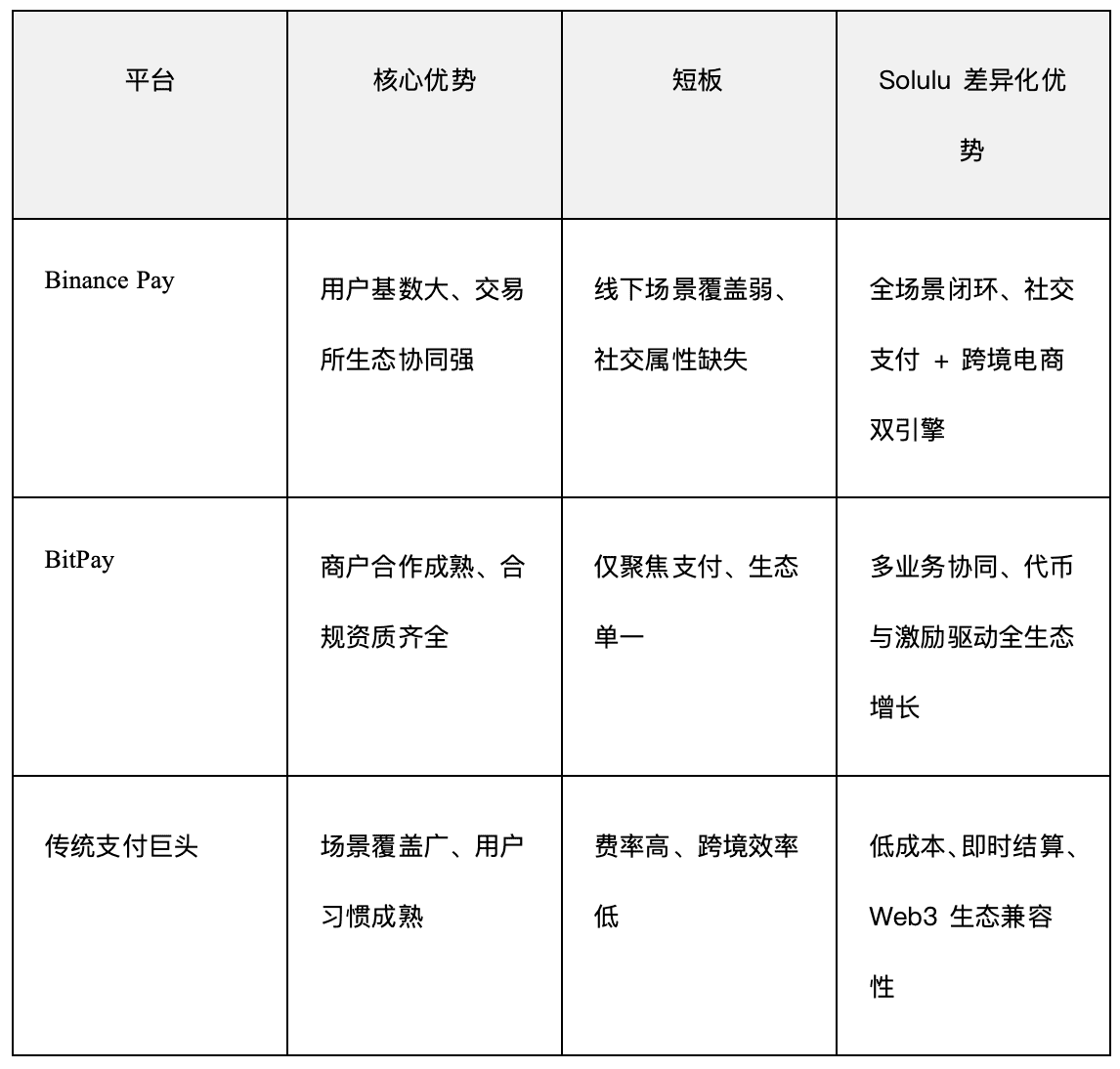
From the perspective of core competitive product differences, the growth potential of Solulu is clearly visible: relying on a full-scenario closed-loop ecosystem and a deflationary token economic model, it has built differentiated competitive barriers. Compared to most platforms that focus on a single functional limitation, Solulu achieves business synergy across 'exchange-payment-social-e-commerce', filling the gap of functional fragmentation in the industry. Moreover, leveraging the inherent low-cost and high-efficiency advantages of stablecoins, it forms a dimensional advantage over traditional payment systems. The entire 'comprehensive strategy' drives its growth flywheel to accelerate continuously—various business segments within the ecosystem empower each other, turning users from mere 'users' into 'ecological co-builders', further enhancing ecological vitality. In the long term, Solulu's development goal is not limited to a functional aggregation platform or functional stacking but is expected to grow into a core infrastructure supporting large-scale applications of stablecoins, truly practicing the core mission of 'making value flow more stable, transparent, and usable', ultimately becoming a key bridge connecting traditional finance and the Web3 economy, promoting the realization of a stable value ecosystem.
Summary: SOLULU—From 'Building Functions' to 'Designing Economies'
Solulu's practice clearly verifies its core proposition: through the 'five major business engines', systematically reconstructing the stablecoin infrastructure, it opens the door for breakthroughs in the industry. This brings fundamental insights to the entire track: the competition in the second half has long departed from the comparison of single technologies or functions, elevating to the ultimate showdown of overall ecological design and economic model construction capabilities.
Relying on the closed-loop growth flywheel formed by five major engines and integrating diversified landing scenarios, Solulu encapsulates the technical complexity and underlying challenges, returning a simple and smooth experience along with core value to users. From personal daily payments to enterprise cross-border settlements, from online social transfers to offline merchant collections, this new architecture built by five major business segments is the bridge that Solulu constructs towards the future of stable value. It successfully propels stablecoins from 'technologically useful' to 'user-friendly', gradually moving towards the ultimate vision of 'ubiquitous in life.'
And this is the core power of 'architecture'—not limited to solving a single pain point but reshaping the underlying paradigm of value flow.