

but one of the most revealing is to see it as an answer to a question that on-chain finance has avoided for a long time: what happens when value stops wanting to move so violently?
For years, the dominant energy in crypto has been acceleration. Faster blocks, faster trades, faster leverage, faster exits. Liquidity has been treated like something you tear out of assets rather than something that can coexist with them. FF arrives with a different temperament. It assumes that on-chain finance is no longer just a proving ground, but a place where capital wants to stay. Where assets want to live, not constantly be broken down and rebuilt.
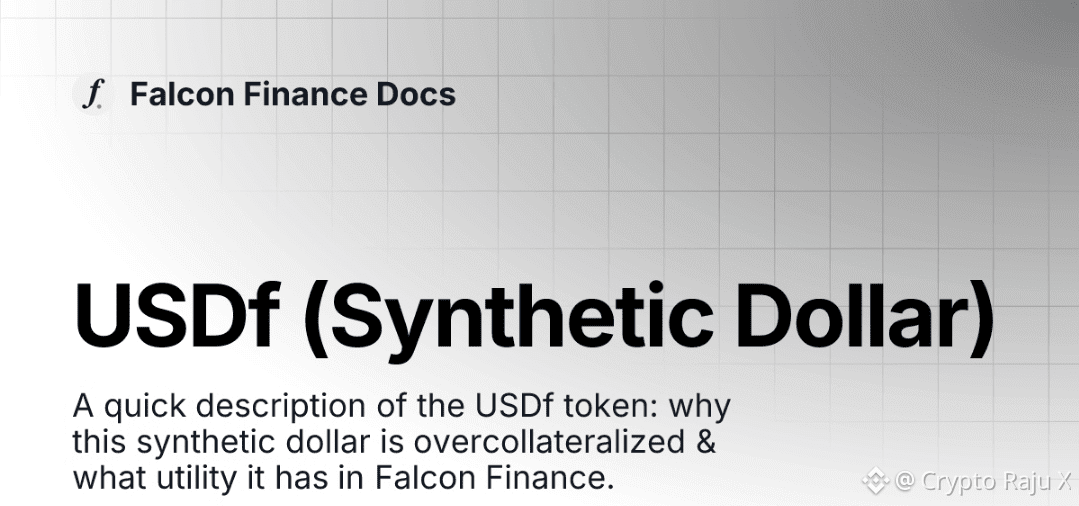
From the perspective of the holder, Falcon Finance feels like a system that finally respects stillness. People do not always want to trade. They want to hold exposure, retain conviction, and still have room to breathe financially. Until now, liquidity often demanded a dramatic act: sell the asset, close the position, give up the upside. FF dissolves that drama. Liquid assets, whether digital tokens or tokenized real-world assets, can be deposited as collateral without being sacrificed. USDf, the overcollateralized synthetic dollar, does not interrupt ownership. It quietly sits alongside it, giving users access to on-chain liquidity without forcing them to exit their story.
From a design standpoint, this is a fundamental shift. Falcon Finance treats collateral not as a temporary hostage, but as a long-term participant. Overcollateralization is not framed as a burden or a necessary evil. It is a statement of intent. USDf is backed by more value than it represents because the system is built to last through unpredictability, not just perform during calm. This choice slows everything down in the best possible way. It creates space for volatility to exist without instantly turning into liquidation events. Stability here is not promised, it is practiced.
Looking at FF through the lens of asset evolution, its universality becomes its quiet power. On-chain finance is no longer dealing with a single species of value. Tokenized real-world assets bring with them slower rhythms, different expectations, and a heavier sense of consequence. Many protocols struggle to absorb this without bending their own logic. Falcon Finance does not force convergence through simplification. It allows coexistence through structure. If an asset is liquid and verifiable, it belongs. USDf becomes the shared language that lets different forms of value interact without erasing their differences.
From a behavioral angle, FF changes how people relate to risk. Systems that sit close to liquidation thresholds encourage anxiety and impulsiveness. Falcon Finance lowers that emotional pitch. When liquidity can be accessed without dismantling positions, people are less likely to act out of fear or urgency. Decisions stretch across longer horizons. Yield, when it appears, is not the result of pressure or artificial incentives. It emerges from capital being allowed to remain productive over time. This aligns naturally with responsible communication norms, because the system does not imply outcomes, guarantees, or inevitability. It simply explains how value can move.
From the ecosystem’s perspective, FF behaves like infrastructure rather than a competitor for attention. Universal collateralization reduces the need for isolated liquidity silos. USDf can flow between applications as a neutral medium, allowing different protocols to interact without inheriting each other’s fragility. This kind of quiet interoperability is what allows ecosystems to mature without constant resets. Innovation can happen above the foundation without threatening the foundation itself.
There is also a psychological maturity embedded in Falcon Finance that is easy to miss. It does not reward constant activity. It does not punish patience. It assumes that finance, at scale, must accommodate human rhythms rather than fight them. Assets can be held, beliefs can persist, and liquidity can still exist. FF respects the idea that value carries memory, and that ownership is not something people want to renegotiate every time they need flexibility.
The written focus on FF matters because the name itself feels directional rather than promotional. FF suggests flow, forward movement without rupture. Falcon Finance does not shout about revolution. It quietly corrects a flawed assumption: that liquidity must always come from loss. By redesigning that assumption, it opens space for a calmer, more coherent on-chain economy.
USDf embodies this posture clearly. It provides stable and accessible on-chain liquidity without requiring liquidation of holdings. It does not remove risk, responsibility, or judgment from the user. It offers a tool, backed by structure, and leaves decisions where they belong. Trust is built not through claims, but through consistency.
Seen from a wider financial perspective, Falcon Finance feels like a reconciliation between instincts. Traditional finance understands collateral but often immobilizes it. DeFi understands motion but has sometimes underestimated endurance. FF brings these instincts together. Collateral remains alive without becoming fragile. Liquidity remains available without becoming extractive. Yield remains possible without being forced into existence.
In the end, Falcon Finance is less about changing what finance can do and more about changing how it feels to participate in it. FF allows assets to remain whole, liquidity to remain accessible, and time to remain a feature rather than an enemy. Dense in intent, fluid in execution, and grounded in human behavior, Falcon Finance is not trying to dominate a cycle. It is trying to hold the ground beneath many cycles, quietly, reliably, and with purpose.

