Do you know what has always annoyed me about DeFi? This boring monotony. Everyone is doing the same thing — staking, farming, lending. You open one protocol — you see liquidity pools. You open another — again liquidity pools. The third one — surprise, again liquidity pools, just with a different name. I am tired of this copy-paste. So when I started studying the psychology of investing through @LorenzoProtocol and realized how automated strategies change your attitude towards money and risk — it was like a breath of fresh air. Now I will share how Lorenzo changed not only my portfolio but also my mind.
I will start with an honest confession — I was an emotional investor. I bought on the hype, sold in a panic, made decisions based on fear or greed, rather than logic. The classic story of 90% of retail investors. I see Bitcoin rising — FOMO, I need to buy now, or I will miss out! I see Bitcoin falling — panic, I need to sell before I lose everything! This cycle of emotions drained me mentally and financially. Every day I opened my phone twenty times, checked prices, and got anxious. This was not investing; it was an addiction.
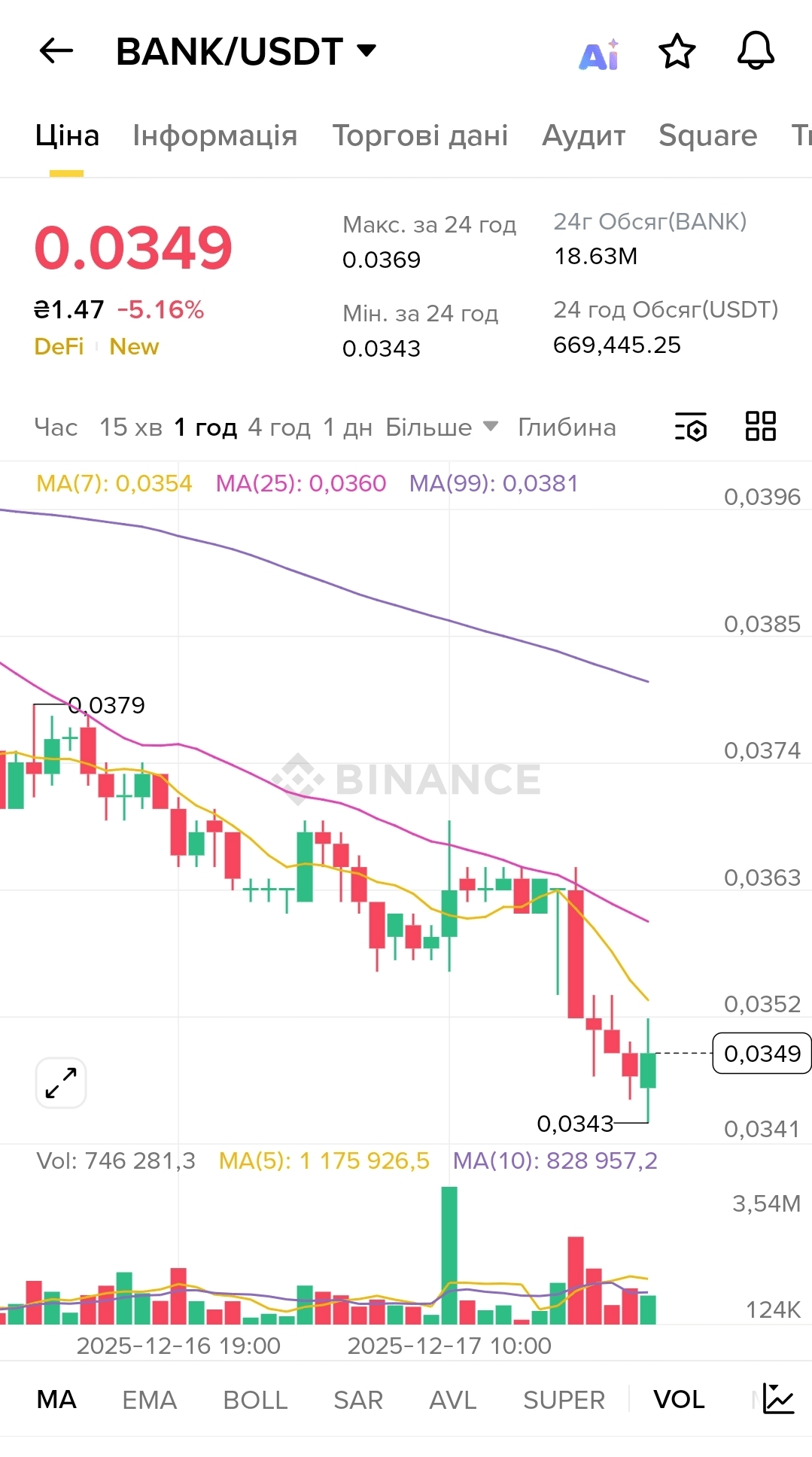
I now look at the chart $BANK and see a perfect illustration of the emotional swings experienced by every investor. The price is now $0.0349, down 5.16% in a day. The maximum in 24 hours was $0.0369, the minimum $0.0343 — a range of fluctuations over 7.5%. Look at the history of the last days — on the left side of the chart is the point $0.0379, from which the fall began. The price has lost almost 8% from that level and continues to go down. On the right, there is a series of red candles forming an aggressive downward trend. For an ordinary investor, each of these candles is a blow to the nerves, a question "should I sell or wait?", sleepless nights.
Look at the technical indicators. MA(7) at $0.0354, MA(25) — $0.0360, MA(99) — $0.0381. The current price of $0.0349 is trading below all three moving averages — this is the most bearish signal you can get. The yellow MA(7) is falling the fastest, the pink MA(25) follows it, and the purple MA(99) is also directed downwards at a steep angle. All three lines diverge downwards in a fan — a technical sign of a strong downtrend with no signs of reversal. For an emotional investor, such a chart is a nightmare. For an automated strategy — it’s just data for the algorithm.
Volumes show the drama unfolding. In one day, 18.63 million BANK and 669 thousand USDT. The volume chart below shows one massive green spike of about 3.54 million — this is an attempt to buy a falling knife, classic behavior of traders who think they see the bottom. MA(5) for volume — 1.17 million, MA(10) — 828 thousand. The current hourly volume of 746 thousand is below MA(5), indicating a decline in activity after the spike. Emotions in the market are fading, panic is giving way to exhaustion.
Now about how Lorenzo changes the psychology of investing. When I invested part of my portfolio in Lorenzo's automated strategies, at first, nothing changed. I still checked prices every hour, got anxious at every dip, tortured myself with questions like "Should I exit?" or "Should I buy more?". But gradually, something began to change. The realization that it is not me making the decisions, but the algorithm, which has no emotions, does not panic, does not succumb to greed — this freed my mind.
The first psychological change: reduction in the frequency of checks
Previously, I opened the price app 20-30 times a day. I woke up at night — to check. I had breakfast — to check. I rode the subway — to check. It was an obsession. After Lorenzo, the frequency dropped to 2-3 times a day, then to once a day, and now I sometimes skip days altogether. Why? Because I know the strategy works automatically. My constant monitoring changes nothing. The algorithm doesn’t wait for my emotions to make decisions. This gave me psychological freedom — I stopped being a slave to charts.
The second change: acceptance of volatility
Look at that sharp drop on the right side of the chart $BANK — from $0.0363 to $0.0343 in a short time, a series of red candles without a bounce. Earlier such a picture would have triggered a panic attack for me. My heart would race, my hands would tremble over the "sell" button. Now I look at it calmly. Why? Because I understand that it’s just volatility. The market moves up and down — that’s normal. The Lorenzo strategy is designed for such volatility; it accounts for it, uses it. My panic won’t help — on the contrary, impulsive decisions will only harm.
The third change: shifting from short-term to long-term thinking
An emotional investor lives in the horizon of days or weeks. Bought yesterday — I want profit tomorrow. Fell today — I’ll sell today. This is a recipe for disaster. Lorenzo forced me to think in months and years. When I locked part of $BANK in veBANK for a year, I physically couldn’t sell impulsively. This made me stop reacting to every fluctuation. My horizon has broadened. Now a 5-10% drop doesn’t cause panic — it’s just noise on a long-term chart.
The fourth change: understanding that I cannot predict the market
The greatest psychological liberation is the acknowledgment of one’s own ignorance. I used to think I could "feel" the market, predict movements, buy at the bottom and sell at the peak. This was an illusion of control. The reality is that no one knows where prices will go tomorrow. Even professional traders are right 55-60% of the time at most. Lorenzo took this burden of prediction away from me. The algorithm doesn’t attempt to predict — it reacts to what’s happening. The market goes down? The strategy adapts. It goes up? Adapts differently. There’s no stress in trying to "guess" the direction.
The token $BANK at the current level of $0.0349 after a drop of 5.16% is a test of psychological resilience. Those who bought at $0.0379 a few days ago are now sitting at a loss of about 8%. An emotional investor panics: "What if it drops more, I need to exit!" or "I need to buy more, catch the bottom!". A composed investor with Lorenzo thinks differently: "My strategy is designed for volatility ±15-20%. As long as the drop is within the expected range. The algorithm is working. I wait."
The fifth change: the fear of missing out (FOMO) became manageable
FOMO is the worst enemy of an investor. You see a coin rising 50% in a day — you think, "I need to buy, or I’ll miss out!" You buy at the peak, and it drops 30% the next day. Classic. Lorenzo helped me structure my FOMO. Now when I see something rising, I ask myself: does this fit my strategy? Do I understand why it’s rising? Am I ready for a 50% drop? If the answers are negative — I don’t buy, no matter how much it rises. My strategy in Lorenzo provides predictable returns without the need to chase every hype.
The sixth change: acceptance of losses as part of the process
The hardest psychological challenge is accepting that losses are inevitable. No strategy provides 100% profitable periods. There will be months in the red. Previously, every negative month was a tragedy for me, proof that I was doing everything wrong. Lorenzo taught me to look at results from a long-term perspective. One month down 3%, the next up 2%, another up 4%, another down 1% — summed up for the quarter, up 2%. This is healthy profitability. Focusing on individual periods makes no sense.
Look at the volumes after that big green spike. MA(5) shows 1.17 million, significantly above the current volume of 746 thousand. This indicates that activity is declining after the attempt to buy the dip. Emotional buyers have already made their moves, now the market is waiting for the next catalyst. For a rational investor, such periods of low activity are the best time for slow accumulation of positions through DCA (dollar cost averaging).
The seventh change: sleep improved
It may sound trivial, but it’s true. I used to not sleep well. I would go to bed thinking about my portfolio. I would wake up at 3 a.m. checking prices. My mornings didn’t start with coffee but with checking charts. It was chronic stress. After Lorenzo, especially after locking part of my capital in long-term strategies, my sleep improved. I physically cannot change anything in the middle of the night, even if I want to. This forces my brain to relax. The market operates 24/7, but my participation in it is now automated.
The eighth change: fewer comparisons with others
Crypto Twitter and Reddit are full of stories about how someone made 1000% in a month. This causes envy and a sense of personal failure — "why didn’t I get into that coin?", "why do I only have 10% in a year?". Lorenzo helped me understand that most of these stories are either lies or survivor bias (we only see those who got lucky, we don’t see thousands who lost everything). My strategy brings stable returns without extreme risks. It’s boring, but it works. I stopped comparing myself to anonymous success stories online.
The ninth change: trust in the system is more important than trust in oneself
The most counterintuitive psychological change. I learned not to trust my emotions and intuition in investments. When I "feel" I need to sell — it’s usually the worst moment. When I "feel" I need to buy — often that’s the peak. My emotions are a bad advisor in finance. Lorenzo is a system that works on data and statistics, not on feelings. Trusting the system lifts the burden of constant self-analysis "did I do the right thing?".
Look at the technical picture. All three moving averages are pointing down, the price is below all of them, there are no signs of reversal. For a technical trader, this is a clear signal — do not buy, wait for confirmation of a reversal. For an emotional investor, this is a moment of panic or an attempt to guess the bottom. For a Lorenzo user, this is just information — the strategy sees the same data and makes decisions according to its algorithm. I don’t need to interpret signals — that’s already done.
The tenth change: money stopped being a source of stress
Paradoxically, when I stopped constantly thinking about money, worrying about every dip, and monitoring every movement — my financial situation improved. Not because Lorenzo provides some astronomical returns (it doesn’t), but because I stopped making costly mistakes driven by emotions. I didn’t sell in a panic, didn’t buy on hype, didn’t chase quick money. The stability of the strategy brought stability to my mind.
The psychology of investing through Lorenzo is not about becoming a robot without emotions. Emotions don’t go away. I still feel pleasure when I see green candles and discomfort with red ones. But the intensity of these emotions has decreased dramatically. They no longer control my decisions. This is not the removal of emotions but liberation from their tyranny. For me, this is the greatest value of Lorenzo — not the percentage returns (though they are important too) but psychological peace. And how do you cope with emotions during dips? Panic, composure, or something in between? Share your experience!
#LorenzoProtocol @Lorenzo Protocol $BANK