

Bitcoin fell again to the $91,000 zone on Tuesday, after a failed attempt to recover above $94,000 earlier in the day.
Fresh data shows that despite improvements in key demand indicators, strong selling pressure remains near a critical resistance level.
Bitcoin under pressure
The pullback occurred after an unsuccessful attempt to break above the $94,000–$95,000 range — order book data revealed nearly $100 million in sell orders concentrated at major exchanges within this corridor.
This concentration of liquidity has become a ceiling for the market. It prevented further price momentum and triggered short-term profit-taking.
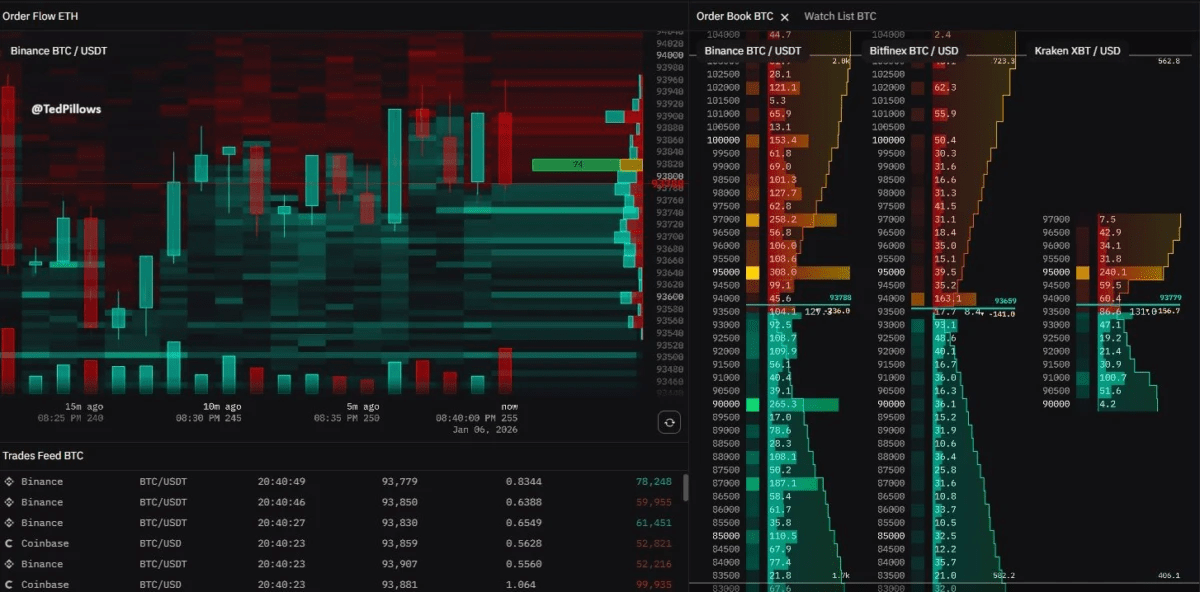
The $91,000 zone for Bitcoin is a key entry point for a large number of new buyers who entered the market at the beginning of 2025. Now they are taking profits amid recent volatility.
Heat maps of order books show how sellers absorb demand as Bitcoin approaches this level.
As the upward momentum began to fade, leveraged traders started exiting their positions, accelerating the move toward $91,000. Market structure, not a sudden shift in sentiment, determined this pullback.
A reversal is possible
Even with the decline, on-chain and flow metrics still indicate overall positive sentiment.
According to CryptoQuant, the ratio of Bitcoin reserves to stablecoins on Binance is rising again. This suggests that idle capital is accumulating on the market, ready for purchases.
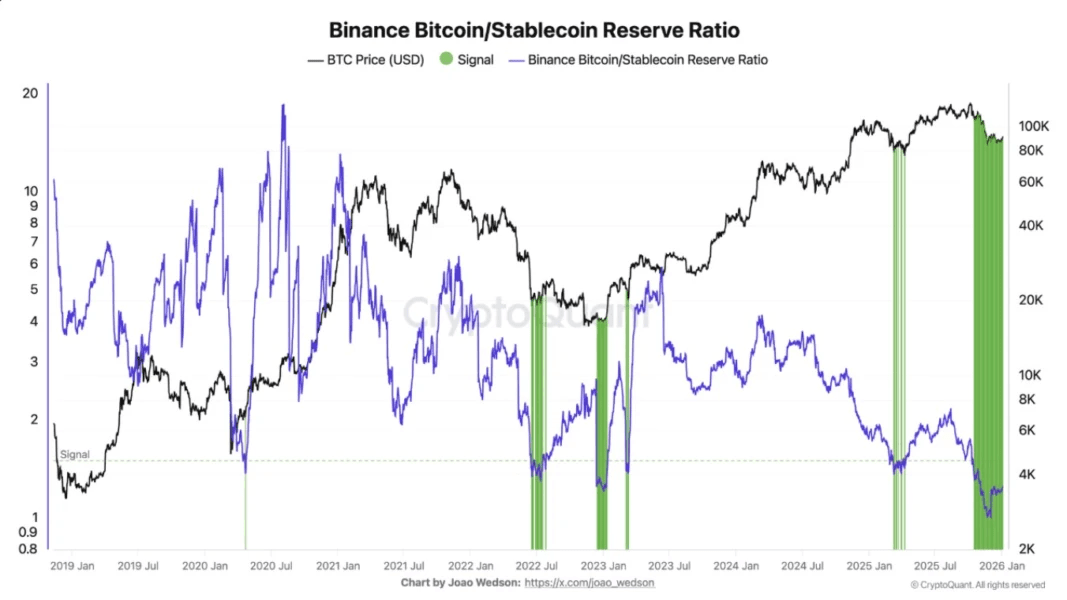
Increasing this indicator shows that traders are holding stablecoins in anticipation of good entry points — typically, capital from these participants enters the market after corrections, not at peak levels.
Gradual liquidity buildup often leads to consolidation — when the price fluctuates within a range for a period before a new surge. This dynamic typically does not create conditions for sharp price impulses over short periods.
Institutional investor demand remains strong. On January 5, spot Bitcoin ETFs saw net inflows of approximately $697 million, with the total inflow volume close to $58 billion.
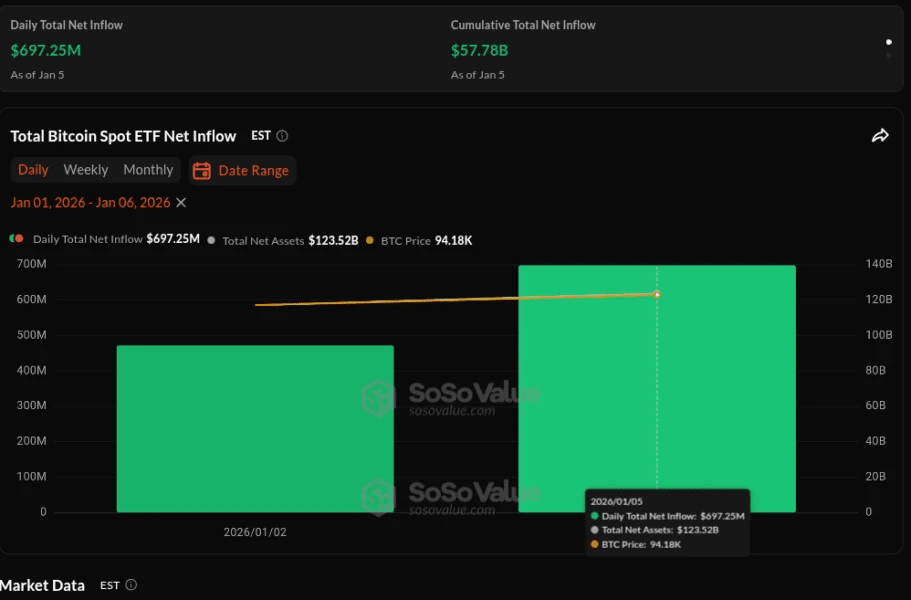
Funds continued to flow in, even as Bitcoin faced resistance pressure. This indicates the formation of long-term positions, rather than speculative demand.
The sharp contrast between large inflows into Bitcoin ETFs and the short-term weakness in price suggests growing divergence in market participants' views.
Long-term investors continue accumulating the asset, while short-term traders are more focused on technical levels and liquidity clusters. This balance explains why Bitcoin failed to hold above $94,000. Meanwhile, no large-scale sell-offs have been recorded on the market.
No significant coin transfers to exchanges or active sales from long-term holders were observed during the correction period.
The data points more toward consolidation than a reversal. A confident breakout above $95,000 will require sustained spot demand, reduced supply for sale, and support in higher-risk markets.
Until the price decline to around $90,000 appears to be a natural stage of consolidating recent gains.
#BTC #BTCReview #Bitcoin #CryptoMarketAnalysis
