
The price of digital gold may correct to $60,000 against the backdrop of escalating trade tensions between the US and the EU. Such a scenario was suggested by macroeconomist Luke Gromen.
In his opinion, the international isolation of the United States and economic recession could also provoke massive selling and capital outflows from institutional investors.
Moreover, the expert emphasized that institutional investors are unlikely to be the driving force of the first cryptocurrency towards a new high this year. A 'strong fundamental catalyst' is needed for that.
'If you expect institutional investors to raise the price from $90,000 to $150,000, then without a serious catalyst, this is unlikely to happen. This is not how institutional investors act. They will wait,' he said.
For such a growth, Bitcoin will need to rise more than 65% from the current levels around $89,800.
As the main drivers of growth, the analyst highlighted the adoption of the Clarity Act in the USA and a possible new quantitative easing by the Fed.
Institutional demand remains high
The CEO of the analytical platform CryptoQuant, Ki En Zhu, noted that 'institutional demand for Bitcoin remains strong.'
'Wallets of American custodial services typically contain between 100 to 1000 BTC each. If exchanges and miners are excluded, this gives an approximate estimate of institutional demand. ETFs are included in the calculation,' he wrote.
According to the expert, over the past year, large investors have purchased 577,000 BTC worth $53 billion. The influx of funds continues, noted Zhu.
ETFs are losing capital
As a result of the last trading session, American spot Bitcoin-based exchange-traded funds lost $708.7 million. This became the largest daily outflow in two months.
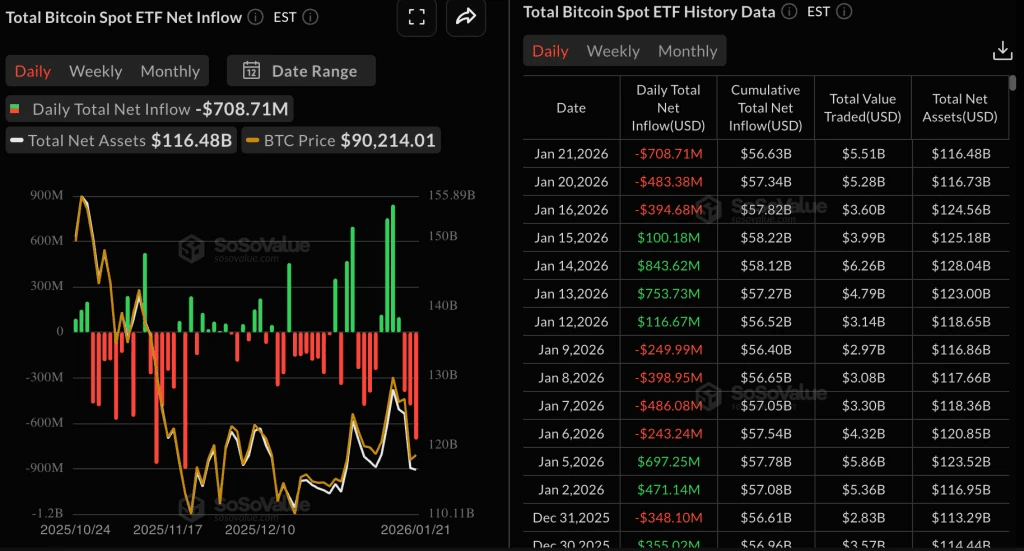
The largest losses were incurred by IBIT from BlackRock — $356.6 million. Following that was FBTC from Fidelity with an outflow of $287.7 million.
Investors withdrew $286.9 million from Ethereum ETFs. The bulk was from ETHA by BlackRock — $250.3 million.
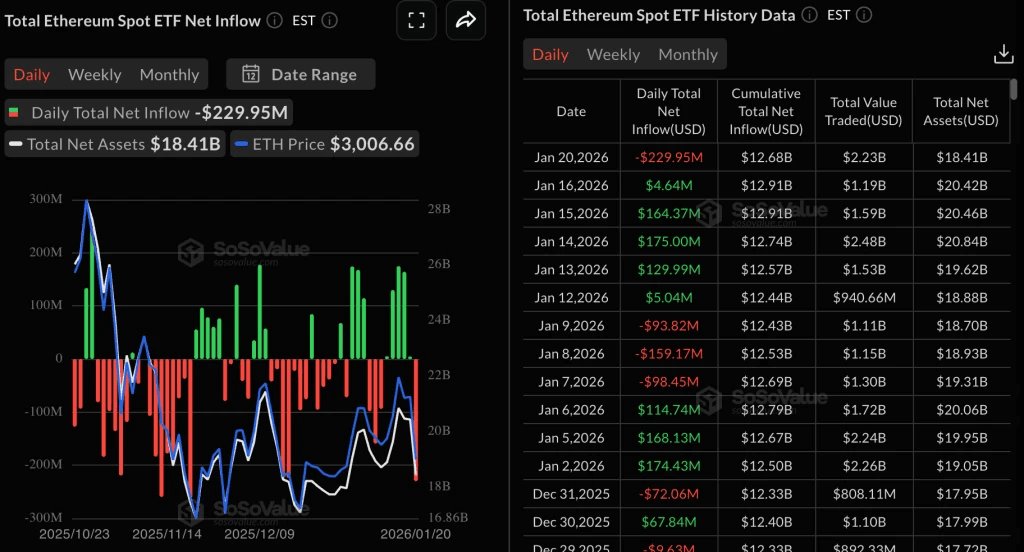
BTC Markets analyst Rachel Lucas believes that the negative dynamics are not related to structural weakness — rather, the outflows are caused by 'classic risk reduction.'
'When macro conditions worsen — rates rise, geopolitical tensions escalate, or sudden volatility occurs — institutions usually first withdraw funds from high beta assets,' she commented.
On January 21, the price of Bitcoin fell below $88,000 against the backdrop of a stock market crash due to tensions between the USA and the EU.
Soon the quotes stabilized, aided by President Donald Trump's statement about reaching an agreement on Greenland. The politician also decided not to impose tariffs on imports from European countries in February.
'Despite the complex macro context, the crypto market demonstrates relative resilience as positions normalize,' noted Vincent Liu, Chief Investment Officer at Kronos Research.

