
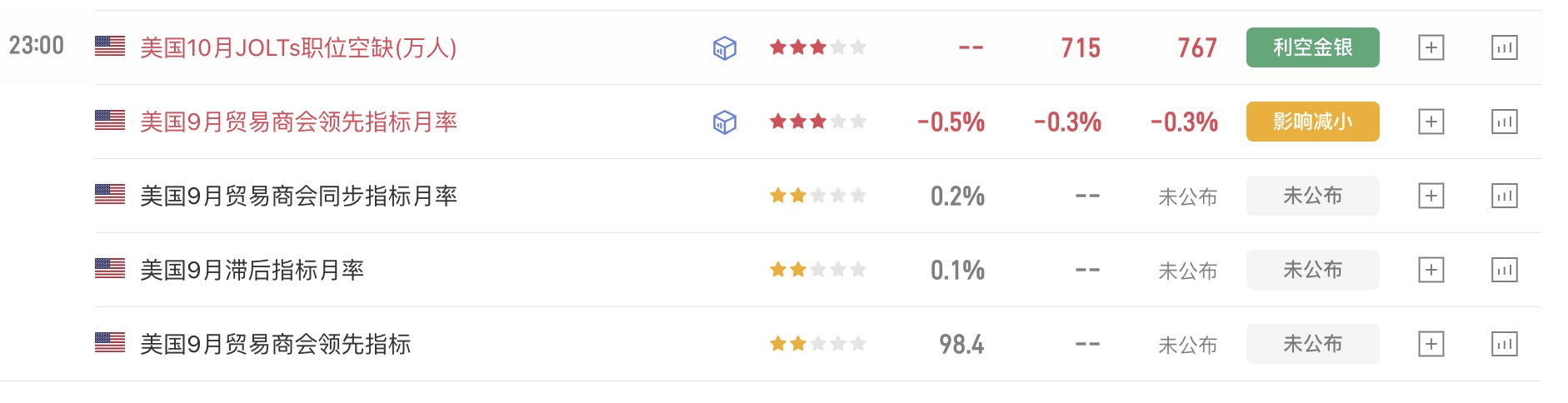
Yesterday, the U.S. released the latest job vacancy data, which showed that the U.S. economy is doing well, boosting market confidence, so both the U.S. stock market and the cryptocurrency market saw a decent rebound.
The shadow chairman of the Federal Reserve, Hassett, also stated that the Federal Reserve still has plenty of room for rate cuts, further boosting market confidence.
Next, everyone's attention is focused on the Federal Reserve's interest rate meeting early Thursday morning.
A 25 basis point rate cut in December is basically secured, but the key is to look at the latest dot plot and Powell's speech.
What the market is most worried about is whether this will turn into a 'hawkish rate cut'.
What it means is that although interest rates have been lowered, Powell may release hawkish signals, such as suggesting that future rate cuts may slow down or even pause, to manage expectations.
Why do I say this? Because the current rate cuts by the Federal Reserve seem more like an emergency measure. The U.S. economy is struggling to cope in a high-interest-rate environment.
For example, the default rate on residential loans remains high, and commercial real estate is also on the brink.
Currently, the 10-year U.S. Treasury yield remains as high as 4.15%, which is the highest in 20 years, putting pressure on businesses, real estate, local governments, and banks.
The purpose of this rate cut is to quickly reduce financing costs and avoid economic recession triggered by high interest rates.
Therefore, this rate cut is essentially not aimed at stimulating the economy by flooding it with money.
From the perspective of monetary easing, the Federal Reserve's monthly bond buyback plan starting in January next year, amounting to $40-45 billion, will be the true direct stimulus.
The latest actions of the two major regulatory agencies, the CFTC and OCC, yesterday have also contributed to driving the market.

The CFTC allows cryptocurrencies such as BTC, ETH, and USDC to be used as margin collateral, mainly to test the practical application of these tokenized assets, providing them with new guarantees, guidance, and exemptions to ensure compliance.
The OCC officially allows the federally regulated banks in the United States to conduct risk-free principal transactions in cryptocurrencies.
In simple terms, banks can now partially replace exchanges and provide cryptocurrency trading services.
The simultaneous launch of these two initiatives by the CFTC and OCC indicates that the U.S. has entered a constructive phase in cryptocurrency regulation.
Their policies complement each other, with the CFTC focusing on innovation in the derivatives market while the OCC strengthens the banking infrastructure.
This connects front-end trading with back-end settlement, forming a complete ecological loop.
This could accelerate the integration of cryptocurrencies into traditional finance, similar to gold or foreign exchange.
If implemented smoothly, it could further reduce regulatory uncertainty, which would be a long-term benefit for the cryptocurrency industry.
What about on-chain data?
From the data, the turnover rate of BTC continues to decline, indicating that investor sentiment is relatively stable, with most people waiting for the results of the Federal Reserve's meeting.
Currently, the chip structure of BTC is also very stable, with no signs of large-scale selling.
The balance of BTC on exchanges has dropped to only 2,936,000 coins, marking a new low for this cycle.
This indicates that a large amount of BTC has been moved to cold wallets, resulting in minimal selling pressure.
The last time the exchange balance was this low was on December 17, 2022, after the FTX collapse, due to a lack of trust in centralized exchanges and large-scale withdrawals.
Overall, as we enter December, there will be several macro events: the Federal Reserve meeting, the latest U.S. economic data release, Powell's speech, the latest interest rate dot plot, the Japanese monetary policy meeting, and so on.
In times of uncertainty, market volatility is bound to be high, so be prepared mentally.


