
After the Federal Reserve's interest rate meeting, what everyone is most concerned about is the release of data on the U.S. economy, and whether the Bank of Japan will raise interest rates.
Will the U.S. economy fall into recession?
Some analysts believe that if the Federal Reserve continues to stubbornly maintain high interest rates, the probability of a technical recession in the U.S. over the next 12 to 18 months is around 50% to 60%.
The Cleveland Fed and the New York Fed calculated using a yield curve model that the probability of a recession within a year is about 20% to 30%.
Some more aggressive models even estimate it to be 60% to 70%.
U.S. non-farm payrolls are also beginning to show negative growth.
The recruitment boom in the United States from 2021 to 2023 has completely ended, and the growth rate has been declining.
By the end of 2025, there may even be a negative growth of -9000 people. Although this number is not large, it is significant.
Because employment is the lagging indicator among all economic metrics, if even employment starts to weaken, it indicates that the resilience of the U.S. economy is nearing exhaustion. The Federal Reserve's argument for maintaining high interest rates for an extended period will no longer hold, forcing the Fed to consider lowering interest rates.
Looking at these signals together: companies are reducing investment, small business bankruptcies are increasing, the market is shifting to defense, and finally, even employment cannot hold up.
Therefore, at yesterday's monetary policy meeting, Powell, in a rare move, prioritized job preservation over inflation and employment.
He stated that the U.S. economy is still growing moderately, but this year employment growth has slowed and the unemployment rate has risen.
If employment data continues to deteriorate, the Fed's policy will be more accommodative to stabilize the economy and employment.
What about on-chain data?
From the data, although the BTC price has shown a volatile decline, most investors who are stuck at high levels and early investors are observing and there is not much selling pressure.
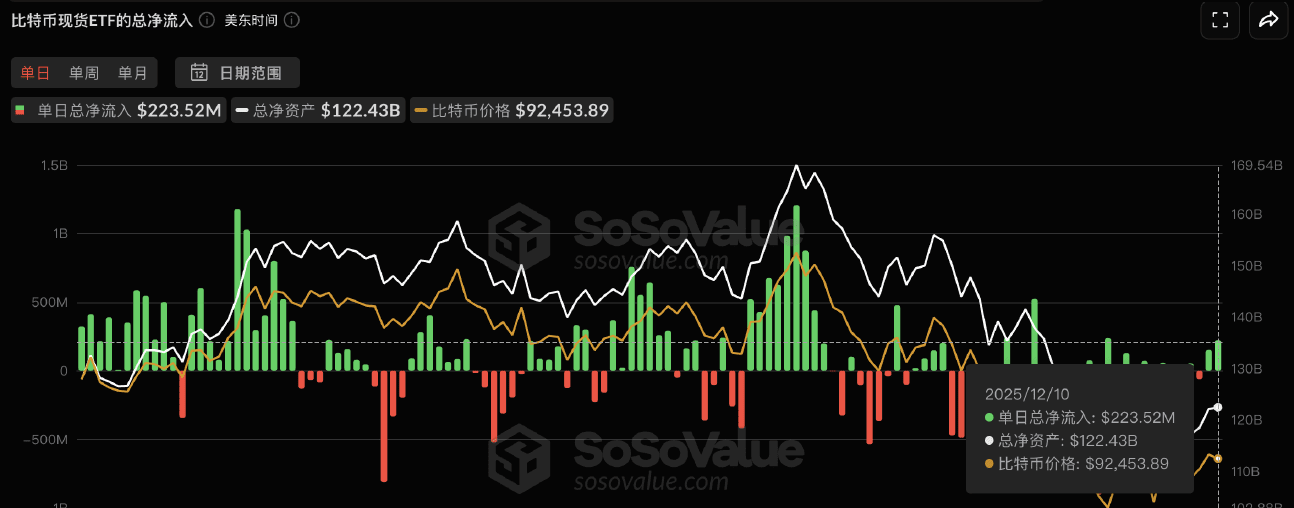
The spot ETF also shows that BTC and ETH are experiencing net inflows.
On December 10, BTC saw an inflow of 223 million USD, with net inflows for 2 consecutive days. ETH also saw an inflow of 57 million USD, with net inflows for 3 consecutive days.
It's worth noting that the bipartisan leadership of the House Financial Services Committee sent a formal letter to SEC Chairman Paul Atkins, urging him to expedite the process allowing ordinary retirement investors to buy alternative assets, including cryptocurrencies, in 401(k) plans.
This indicates that both parties in the U.S. agree to formally include crypto assets in the retirement system.
Once the SEC and the Department of Labor amend the rules as requested in the letter, Bitcoin and Ethereum's spot ETFs will naturally become compliant options for 401(k) plans.
Long-term, stable, and continuous buying pressure from retirement funds will create a slow but never-ending accumulation force.
Additionally, Binance founder CZ stated that the four-year BTC cycle may have expired, and we might be entering a super cycle.

In fact, the BTC cycle has not disappeared; it has just been extended.
Previously it was a four-year cycle, but now it may be eight years or even ten years, which is what CZ refers to as a super cycle.
However, in the short term, both the U.S. stock market and the crypto market are experiencing tight liquidity.
Next, we can pay attention to the non-farm employment and CPI data in November, as well as whether Japan will raise interest rates in December; these will affect short-term market sentiment and trends.


