
The market has been relatively quiet these past two days, with everyone's attention focused on the Federal Reserve's interest rate meeting on December 11.
The Fed's 25 basis point rate cut is basically a done deal and there's little controversy.
The market's biggest concern is whether this will turn into a "hawkish rate cut".
This means that although interest rates have been cut, the Fed's tone and signals may be hawkish, making people feel that the future will not be so accommodative.
The usual tactic is that when the Federal Reserve cuts interest rates, it will release hawkish signals through statements or press conferences, such as hinting that future rate cuts will slow down or be paused, in order to appease officials who are worried about inflation and to gain internal consensus.
However, this time there is a new variable: Federal Reserve Shadow Chairman Hassett suddenly became extremely dovish.
Just two days ago he said that interest rate cuts could be done gradually, but now he has changed his mind and believes that the Federal Reserve should seize the opportunity to cut interest rates quickly, which would help alleviate the problems of the US economy.
He believes the AI boom has boosted productivity, allowing the Federal Reserve to cut interest rates aggressively without triggering inflation. This could offset potential hawkish comments from Powell.
In addition, the Federal Reserve releases a dot plot after its meetings in March, June, September, and December each year. We can use the dot plot to estimate how much room there is for interest rate cuts in 2026.
I think 2026 will most likely be a year of great monetary easing.
China has also recently indicated that it will introduce more proactive fiscal policies and looser monetary policies next year.
Moreover, the Federal Reserve's interest rate decision on Wednesday will most likely announce its balance sheet expansion plan for 2026, with investment banks predicting monthly U.S. Treasury repurchases of $400-450 billion.
As the world's largest money printing machines, the US and China's loose fiscal policies combined with government bond buybacks amount to massive monetary easing.
The US and China are now in a honeymoon period, with the US opening up Nvidia's H200 chips to China, and China agreeing to buy more US soybeans.
Next year there is Trump's midterm election, and in order to stabilize the situation, he will definitely focus on stabilizing growth, employment, and the stock market.
Moreover, if the Federal Reserve chairman is replaced in 2026, he will choose someone more compliant.
I think that even if the new chairman doesn't implement rapid interest rate cuts after taking office, he will most likely agree with Trump's ideas and truly start a rate-cutting cycle, which will help restore investor confidence.
Data shows that Bitcoin's ownership structure is quite stable, with most people observing and little selling pressure.
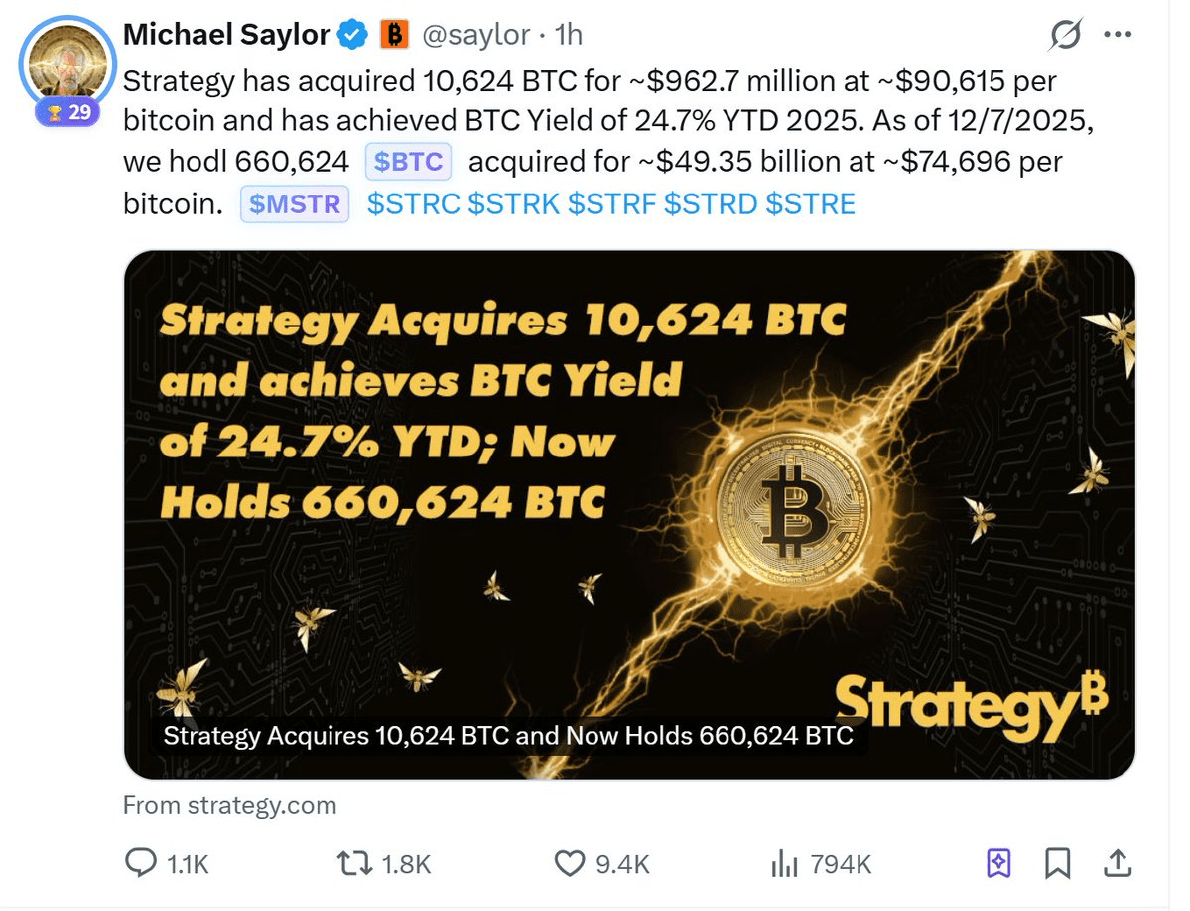
MicroStrategy spent another $960 million to buy 10,624 Bitcoins, with an average purchase price of $90,615 and a total average cost of $74,696. Currently, it has a floating profit of $10.473 billion.
Ethereum's microstrategy BMNR also increased its holdings by 138,452 ETH, the largest weekly increase since mid-October.
They currently hold a total of 3,864,951 ETH, with an average cost of $3,925, resulting in a paper loss of $3.095 billion. The company has accumulated 3.2% of the total ETH on the network, getting closer to its 5% target.
BlackRock's iShares has submitted its fourth application for a crypto ETF, this time an ETH-staking ETF.
This indicates that pledged ETFs are also on the horizon. In mid-November, the IRS just standardized the taxation of digital asset staking, and institutions have already taken action.
Therefore, overall, the short-term trend of US stocks and the cryptocurrency market is mainly driven by expectations of interest rate cuts by the Federal Reserve.
The most pressing concern right now is the Federal Reserve meeting on December 11.
What Powell says and how many rate cuts the dot plot indicates in 2026 will directly impact market trends and sentiment.


