
Affected by the official cessation of the U.S. tapering, U.S. stocks rose after the market opened yesterday, and BTC followed the rebound in U.S. stocks.
Bitcoin is the barometer of market liquidity. As soon as the U.S. stops tapering, the price immediately rises.
This wave of increase is mainly driven by sentiment, as everyone expects the Federal Reserve to start massive monetary easing, so they are not afraid of interest rate hikes in Japan.
However, before liquidity is fully restored, this can only be considered a rebound; a complete reversal is difficult.
Who will be the next chair of the Federal Reserve?
Trump made his latest speech yesterday, and he will announce the new Federal Reserve chair candidate early next year.
He also hinted that a potential Federal Reserve chair was present. It is clear that this statement suggests that Hasset will become the next Federal Reserve chair.

The reason he delayed the announcement until early next year may be to prepare for the review and inquiries after Hasset's nomination.
Recently, the Federal Reserve has also been pumping blood into the market; on December 1, it overnight repurchased $13.5 billion, the scale only second to the pandemic period in 2020, exceeding the internet bubble period in 2000.
Musk predicts: A $38.3 trillion crisis could cause Bitcoin prices to soar.
He said that the U.S. is facing a debt crisis that could lead to severe fluctuations in Bitcoin prices.
He believes that in the future, the concept of 'currency' will disappear, and energy will be the real currency.
In an interview, Musk stated: "This is why I say Bitcoin is energy-based because you cannot create energy through legislation."
He predicts that within three years, artificial intelligence will increase the output of goods and services at a rate exceeding inflation.
About three years from now, the growth rate of output will exceed the growth rate of money supply, and at that time, deflation may occur, interest rates may drop to zero, and the debt problem may not be as severe as it is now.
Musk also said that the 'American Party' he supports is more inclined to choose Bitcoin over the dollar; he believes that the dollar and other unbacked currencies have no future.
I completely agree with this; I have previously shared that the future rise rate of Bitcoin entirely depends on the speed of global central bank money printing and bond issuance; the more they issue, the more it rises.
How is the on-chain data?
From the data, the turnover rate of BTC is not very high; currently, the main force in turnover is short-term bottom-fishing investors, especially those who have entered below $90,000 who are exiting the most.
Most investors are on the sidelines, and the chip structure is quite stable.
From the spot ETF data, BTC spot ETFs are still seeing inflows; although the inflow of funds is not large, it also indicates that institutions are not selling off chips in large amounts. Vanguard Capital has also launched a BTC ETF.
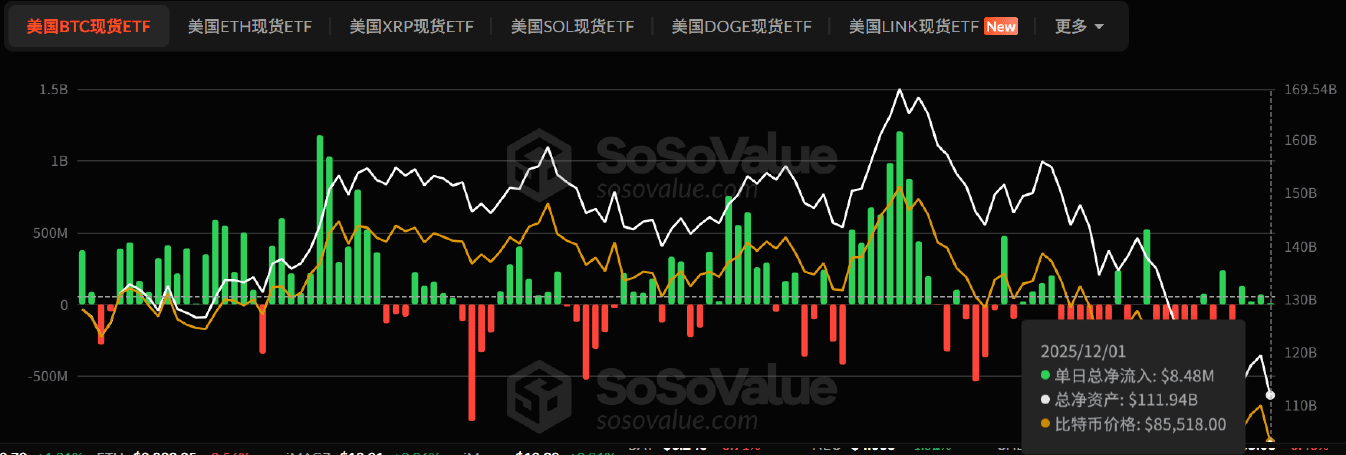
The spot ETFs for ETH and SOL have seen a slight outflow, but the amount is not large; mainly focus on BTC.
Another point worth noting is that U.S. banks are advising clients to allocate 4% of their investment portfolio to cryptocurrencies, especially Bitcoin.
This is the first time they have publicly suggested that clients invest such a high proportion in digital assets.
Previously, this proportion was 1%; now it is 4%, which has increased fourfold, and this is a long-term positive for Bitcoin.
From the perspective of funding, both Asian and American capital are flowing back into the market.
Currently, the total amount of funds in the market is $310.9 billion; USDT increased by $44 million, and USDC increased by $817 million.
With the U.S. officially stopping tapering, we can clearly feel the inflow of funds in the U.S. area, and market liquidity is slowly recovering.
Overall, short-term prices are completely driven by market sentiment, which can also be influenced by macro policies; today optimism can turn into panic tomorrow due to a policy change.
So we need to be mentally prepared; the market will experience significant fluctuations moving forward.
Before liquidity is fully restored, this can only be considered a rebound; it is difficult to completely reverse.
Short-term fluctuations are just noise; focus on the main line of the Federal Reserve's easing; as long as the Fed continues to pump money, it will be hard to enter a full bear market.


