
Today, Asian stock markets and the cryptocurrency market collectively fell, with Bitcoin, the Nikkei 225 index, and the Korea Composite Stock Price Index all performing poorly.
The main reason is that the market expects the Bank of Japan may raise interest rates.
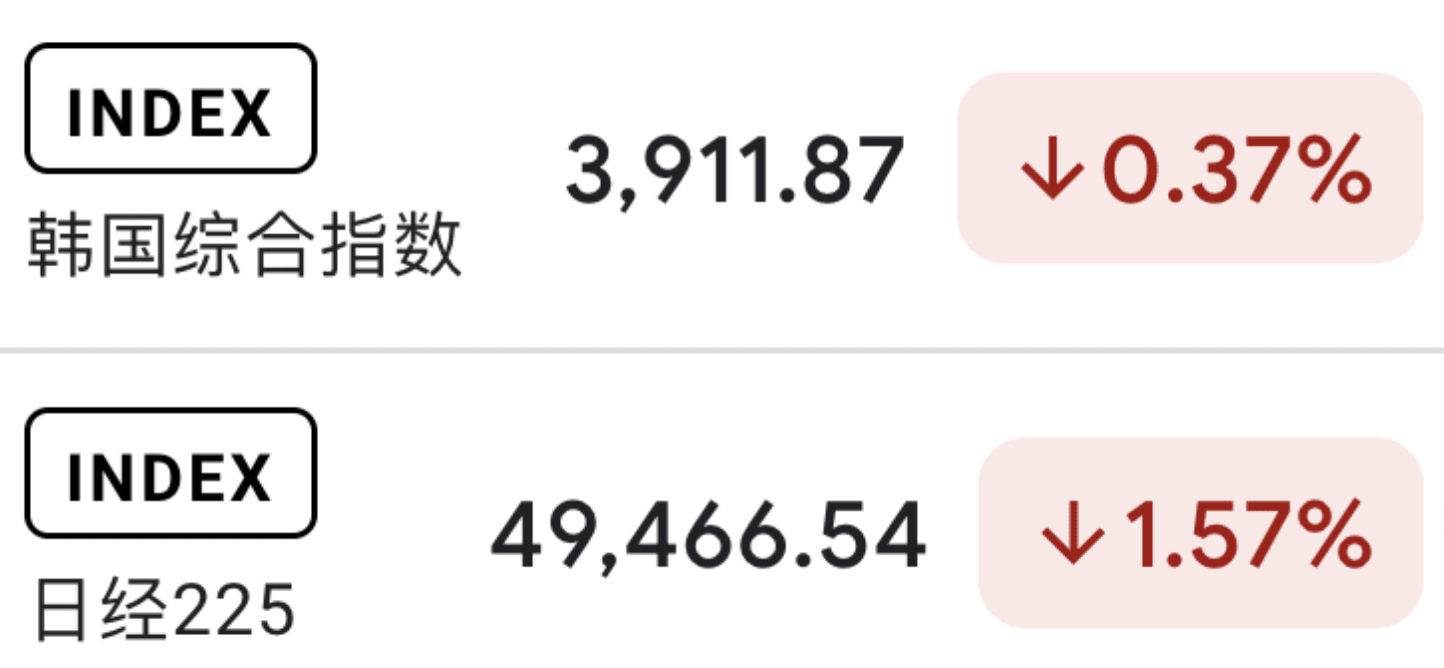
Recently, Bank of Japan Governor Kazuo Ueda stated that if the economic outlook meets expectations, they may raise interest rates.
Currently, the market bets that the probability of the Bank of Japan raising interest rates by 25 basis points is 48%, while the probability of not raising is 51%.
Meanwhile, the yield on 10-year Japanese government bonds has surged to 1.80%, approaching a historic high.
Japan has maintained ultra-low interest rates for a long time, which has allowed Asia to borrow cheap money for arbitrage trading—borrowing at low interest to invest in high-return assets.
Once Japan raises interest rates, the cost of borrowing will increase, and everyone's arbitrage games will be disrupted, which may lead to capital withdrawal and trigger market panic.
However, from the structure of Bitcoin's chips, investors' sentiment is relatively stable, and there are no signs of panic selling.
Does Federal Reserve Chair Powell want to resign?
Yesterday, rumors began circulating online that Powell would resign on December 1. But I believe this is false news; the likelihood of Powell resigning early is very low.
This rumor originated from overseas KOLs on Twitter, and it has not been reported by mainstream U.S. media or the Federal Reserve's official website.
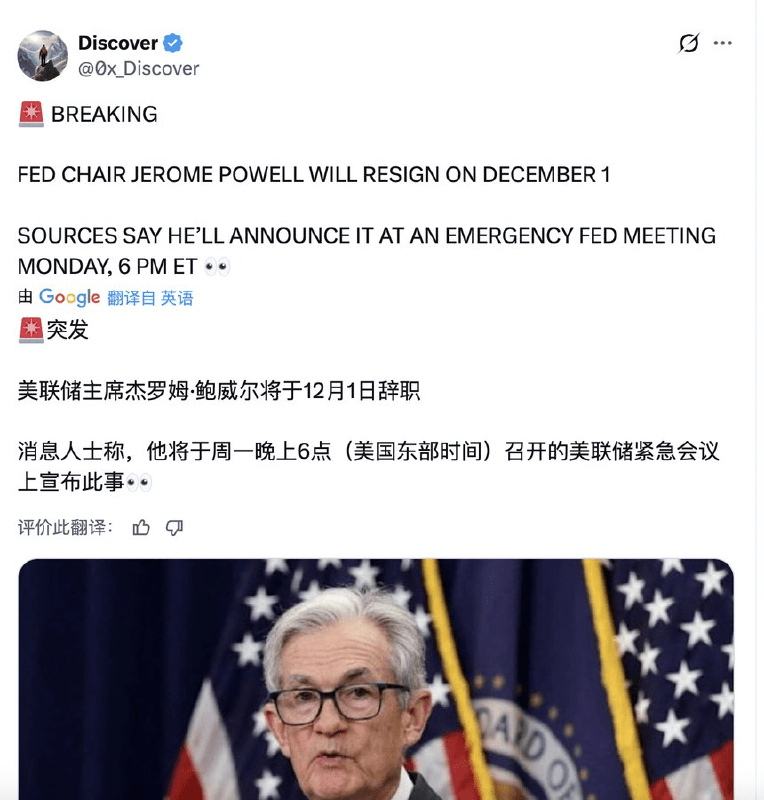
As a core position of the Federal Reserve, resigning is not as simple as just leaving; it requires a formal process.
Even if Powell wants to resign, the Senate must confirm a new chairperson, including nomination, review, and voting. The fastest it can take is 2-3 weeks.
Currently, it seems unrealistic for him to suddenly resign.
This rumor may be to gain attention and put pressure on Powell before the December meeting to force a rate cut.
Trump is also putting pressure, saying he has already chosen who will be the next Federal Reserve chair and will announce it soon.
The original plan was to announce before Christmas on December 25, but it cannot be ruled out that it will be announced before the December 10 rate meeting.
The current frontrunner is Hassett, who is a close economic advisor to Trump and fully supports significant rate cuts.
Next is Waller, who is more moderate and pragmatic, listens to market opinions, and emphasizes communication and logic.
If Waller is chosen, the market will feel that the Federal Reserve will not act recklessly. It depends on who Trump ultimately chooses.
What should we pay attention to next?
As December approaches, there will be more macro events, and it will also be a time of increased panic for investors, leading to greater market volatility. At this time, I will manage my positions well to avoid being unprepared when prices fall.
On December 1, the U.S. will officially stop quantitative tightening, marking a key turning point in this economic cycle. It signifies the end of the liquidity withdrawal era that began in 2022.
The market will shift from a shrinking game to a stock or even an increasing game, which is a long-term positive for risky assets like U.S. stocks and cryptocurrencies.
The Federal Reserve will soon enter a quiet period, and all officials' speeches will be completely suspended. The market can only rely on this week's three speeches and data to speculate whether there will be a rate cut in December.
On December 2, Powell will give a speech. Although the Federal Reserve has entered a quiet period, the market will be closely watching Powell's every word and action.
Everyone wants to know his views on future monetary policy, whether to continue preventive rate cuts or to wait and see the inflation pressures.
If Powell deliberately sends hawkish signals to suppress rate cut expectations, the risk market may experience a short-term sharp drop.
On the evening of December 3, the U.S. will announce the small non-farm ADP employment data. Without the large non-farm data, this data becomes very important. The worse the data, the more favorable it is for the Federal Reserve to cut rates.
The Challenger job-cut report on the evening of December 4 is also crucial; ADP is equivalent to employment, and Challenger is equivalent to unemployment. The more layoffs there are, the more favorable it is for the Federal Reserve to cut rates.
On December 5, the U.S. will announce the PCE inflation data for September. Although it is released two months late, it can reveal inflation trends. If it is below market expectations, it will strengthen confidence in a rate cut.
But if it indicates signs of rising inflation in the U.S., even if it is old data, hawks will use it to make their case, disrupting confidence in a rate cut in December.
