

When @Falcon Finance first announced USDf back in early 2025, it was another entrant into the crowded world of stablecoins. Synthetic dollars have been around for years, promising to blend decentralization with price stability. But for a long time, most of these projects lived somewhere tension-filled between “trust us” and opaque technical dashboards that only insiders could decipher. Falcon’s recent transparency efforts feel different. They signal a shift in how some teams now think about trust, not as a slogan to slap on a website but as something that should be visible, verifiable, and continually updated.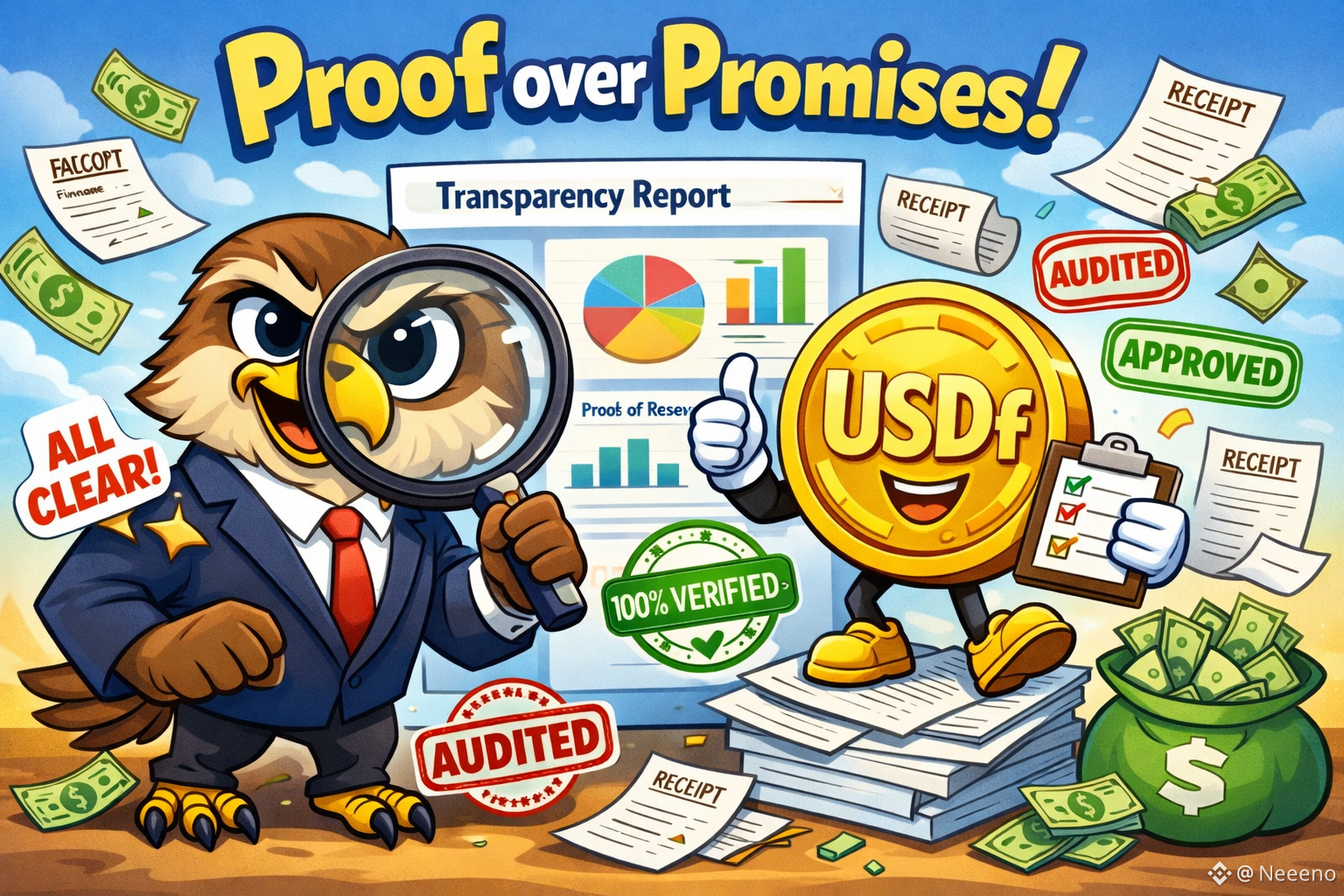
The idea of transparency in crypto isn’t new. Bitcoin’s ledger is public by design, and every transaction can be traced back to its origin. But that doesn’t automatically translate to honest reporting around the health of financial products built atop blockchain networks. Stablecoin failures over the years — from algorithmic collapses to hidden reserve practices — have scarred the space. People who came in early remember the anxiety of watching a peg wobble and not being sure what was actually backing the token. That’s part of why Proof Over Promises resonates so strongly in the Falcon context: it’s a move from vague claims of backing toward hard data that users can check themselves.
At the core of Falcon’s transparency push is its public Transparency Page — a continuously updated dashboard that lays out what’s backing USDf in near real time. You don’t have to guess what collateral exists or where it’s held. Instead, you see a breakdown of reserves by type and custody method, including assets held on-chain in multisignature wallets or with institutional custodians and even allocation to yield strategies. There’s a simplicity to seeing actual numbers that weren’t there before. It’s not perfect, but it’s a big step toward stripping away the fog that has historically hung over many stablecoin protocols.
In human terms, what this transparency page does is open a window — not a curtain. You can watch as Bitcoin, Ether, stablecoins, tokenized treasuries, or other assets sit in reserve backing the USDf supply. You can see how those reserves shift over time. You can watch how ratios of collateral to issued tokens hold up or move. That matters because stablecoins only work if the promise of stability and liquidity is real, not hypothetical. This is the part where the tech feels genuinely useful, not just flashy: for the first time, a broad audience can start to verify the health of a synthetic dollar without needing insider tools or proprietary feeds.
There’s also a story about timing here. In the broader world of crypto and finance, stablecoins have become a focal point for regulators, institutional actors, and retail participants alike. Governments are tightening frameworks.
Because the market has been through so many cycles of hype and collapse, people are paying closer attention to risk now. USDf’s transparency effort is showing up at the right time, when the market expects solid evidence—data that can be examined and tested by auditors, regulators, and advanced users. That’s partly why Falcon paired its on-chain reporting with third-party attestations and full audits under recognized standards. These external validations build confidence far beyond what an internal dashboard alone could achieve.
For people who’ve worked or invested in financial systems — whether traditional banking or decentralized networks — there’s a familiar tension between speed and safety. Markets reward innovation, but they punish assumptions that aren’t grounded in solid risk management. What feels fresh about Falcon’s approach isn’t just that there’s a dashboard; it’s that the dashboard lives alongside independent verification and a commitment to making those records available weekly or quarterly.
It treats transparency like daily work, not a one-time headline. That’s an important change in the culture..
What’s more, the transparency frame seems to be part of why USDf’s circulation has grown substantially. As of the latest reporting, USDf has surpassed $2 billion in supply — an indicator that users are engaging with the product and possibly finding comfort in the openness around it. That doesn’t mean it’s bulletproof or immune to market shocks. But it does mean that more people are making decisions with access to data they can check, revisit, and interpret on their own.
Reading through the numbers and the updates, I’m struck by the human element: people want to see what they’re holding. They want assurance that something as critical as a dollar peg isn’t backed by a black box. That’s not a niche desire; it’s basic financial psychology. When you know where the collateral is, how it’s held, and how often it’s verified, you make different decisions — and the whole market moves differently. Falcon’s transparency page doesn’t just broadcast numbers.
It lets people look in and keep an eye on what’s going on. That’s small, but it changes the relationship.Proof Over Promises” shouldn’t be treated like a slogan. It’s more like a standard people are starting to expect in parts of decentralized finance: show what’s true, clearly, and keep showing it over time. Transparency doesn’t make a project risk-free, but it makes trust easier to build. That’s why USDf’s transparency page stands out now—because it supports a wider push for responsibility and real-world trust when a lot of people feel cautious.
@Falcon Finance #FalconFinance $FF



