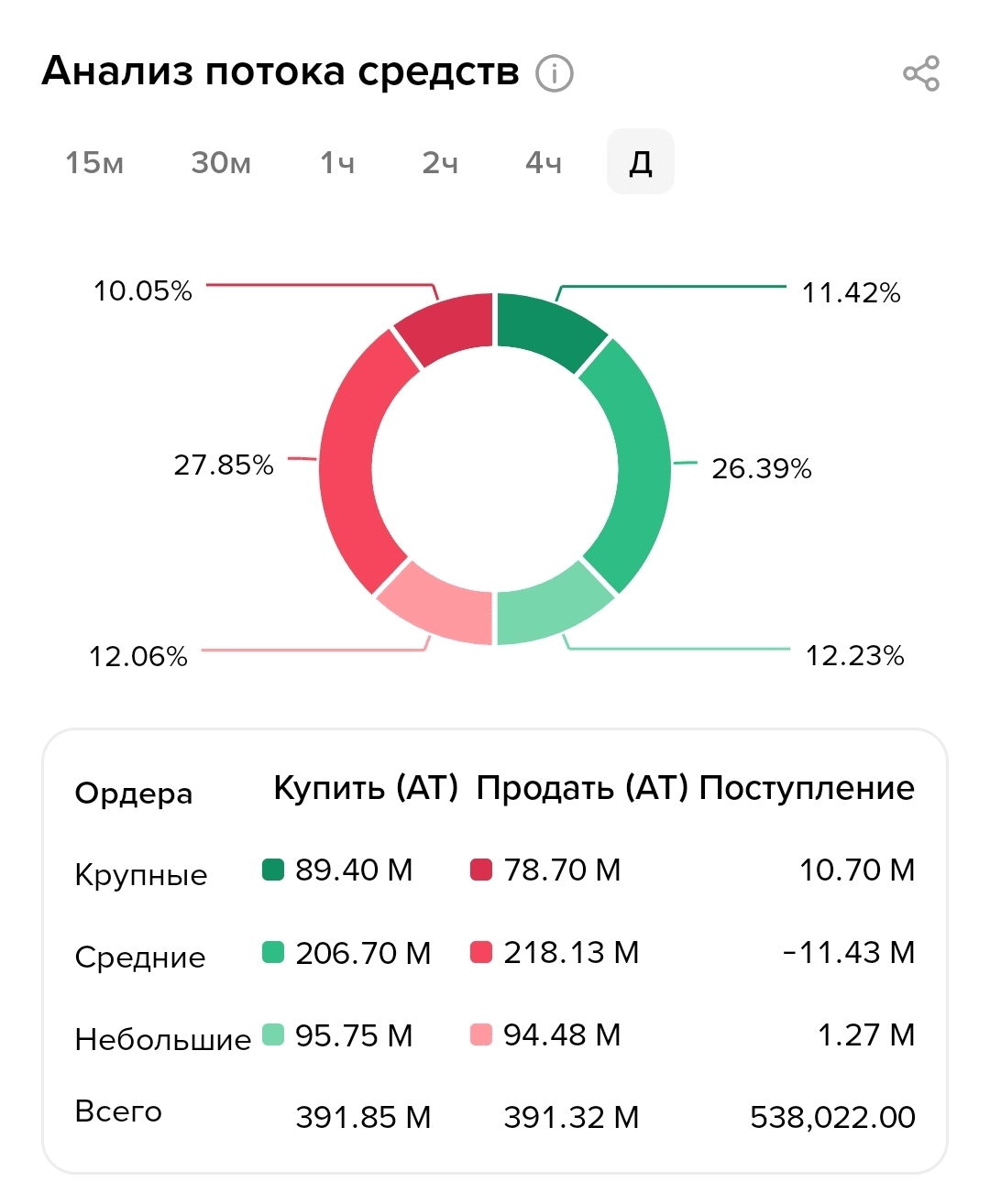
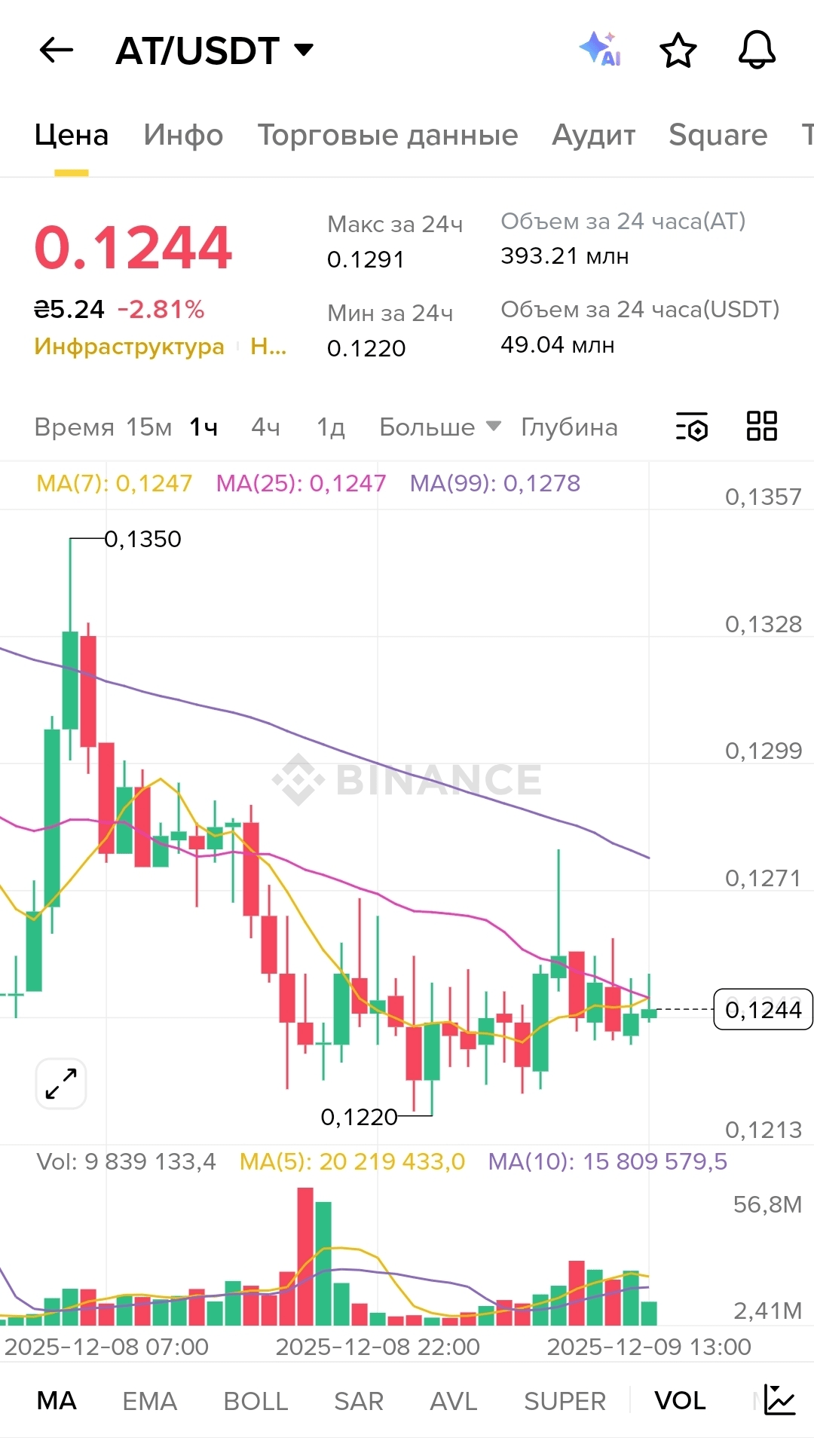
I'm sitting in the evening with tea, looking at the chart $AT and catching myself thinking - when will the market finally start to value truly important things, and not just meme coins and hyped projects? Price 0.1244, minus 2.81% for the day, volumes nearly 50 million USDT. It seems like an ordinary altcoin in the red zone, of which there are hundreds now. But wait, let's figure out what @APRO-Oracle really is and why it might be more important than it seems at first glance.
Oracles in blockchain are such a thing that everyone knows they are needed, but few truly understand how critical they are. All of DeFi, all smart contracts that interact with the outside world - they completely depend on oracles. Chainlink was a monopolist in this area for a long time, and everyone was fine with it until it became clear that a single point of failure is very bad for a decentralized system. And here comes #APRO with the idea of building an alternative oracle infrastructure.
I look at the technicals - the chart is interesting. There was a sharp pump to 0.1350, then a similarly quick correction, and now there is consolidation around 0.1220-0.1291. MA(7) and MA(25) have converged at the same level of 0.1247, which often foreshadows a strong movement in one direction. MA(99) is a bit higher at 0.1278, and the price is trading below all moving averages. Technically, this is a bearish signal, but I have long stopped trusting only the technicals, especially in such young projects.
I remember trying to explain to my friend what oracles are a year ago. Imagine, I say, that a smart contract is like a robot-judge that automatically executes the conditions of a contract. But how does it know what happened in the real world? Who won the football match, what is the current gold price, what is the temperature in New York? That's what oracles are for - they bring external data into the blockchain. And if an oracle lies or makes a mistake, the whole contract works incorrectly.
@APRO-Oracle builds its network on the principles of multiple data validation and economic incentives for honest behavior. In their model, data comes from many independent sources, is then aggregated and validated, and nodes that provide incorrect information lose their stake. It sounds logical, but in crypto, there is always a huge gap between theory and practice.
The trading volumes surprised me - 393 million AT tokens in a day. This is a significant number for an infrastructure project that usually doesn't attract speculators. I look at the volume chart below - there are powerful spikes, especially around 22:00 on December 8, when over 56 million tokens were traded in an hour. Such activity may indicate either some important announcement or the entry of a major player.
What attracts me to the #APRO concept is that they are not trying to directly compete with Chainlink on its turf. They are taking a different path, focusing on specific niches where special accuracy or speed of data updates is needed. For example, high-frequency financial applications, where a delay of just a few seconds can cost millions. Or complex derivatives, where validation of data from many different sources simultaneously is required.
Technically, the price is currently at a support zone of 0.1220. If we break this level downwards, the next stop will be around 0.12, which is another two percent down from here. But if we hold and start bouncing back, the first target is to break MA(7) and MA(25) at 0.1247, and then we can aim for 0.1278 (MA99) and even the maximum of 0.1291. However, a trigger, some kind of growth catalyst, is needed for this.
I am pondering how in demand alternative oracles really are. On one hand, decentralization is good, monopolies are bad. On the other hand, the network effect in oracles is very strong. The more protocols use a specific oracle, the more data it processes, the more reliable it becomes, and the more protocols choose it. A vicious circle. It is harder for a newcomer to break into this market than in most other DeFi niches.
But @APRO-Oracle has an ace up its sleeve - they didn't come empty-handed. They already have partnerships with several interesting protocols, a functioning infrastructure, and technical documentation that shows the team understands what they are doing. This is not just another fork of someone else's code with renamed functions; it is original development with its own architecture.
I look at the MA(5) volume - 20 million, MA(10) - almost 16 million. The current volume is about 10 million, significantly lower than the average values. After yesterday's spike in activity, there has been a lull, which is normal - the market is digesting information, positions are being redistributed. Usually after such periods of low activity, a new movement follows; the only question is where it will go.
The tokenomics of $AT is built interestingly. The token is used not only for governance but is also integrated into the operation of the oracle network itself. Nodes must stake tokens as collateral, users pay tokens for data requests, and validators receive rewards in tokens. So it is not a speculative asset without utility, but a working tool of the ecosystem. The more protocols use the oracles of #APRO, the higher the demand for the token, and the greater its value.
Honestly, I still can't understand why infrastructure projects are so undervalued by the market. Everyone wants to find the next meme coin that will do x100 in a week, but few pay attention to the protocols that ensure the operation of all DeFi. Without oracles, there are no price feeds; without price feeds, DEXs, lending protocols, and synthetic assets do not work. The whole tower collapses. But for some reason, the market values a picture of a dog more than critical infrastructure.
I am analyzing the candlestick pattern of the last few hours. I see a series of small red and green candles without a clear trend - classic consolidation after a sharp move. There is neither strong buying nor strong selling pressure. Everyone is waiting. Either for news, or for the movement of Bitcoin, or for some external trigger. Such periods can last for days, but can also end at any moment with a sharp impulse.
I am thinking about the risks of investing in $AT. The main risk is technological. If the oracles of @APRO-Oracle fail and a protocol loses money because of it, the reputation will be destroyed forever. In oracles, there is no room for error. The second risk is competition with Chainlink, which has a huge first-mover advantage and billions in market capitalization. The third is the overall market, which is not in the best shape right now and can drag even strong projects down.
But despite the risks, the project looks interesting for the long term. If DeFi continues to grow, the demand for reliable oracles will only increase. And having alternatives to Chainlink is great for the entire industry. Monopolies never benefit innovation. So $AT for me is in the category of projects worth watching. Maybe it’s even worth taking a small position if technically we see a reversal and confirmation with volume. Let's see what happens next.